Written by: Arjun Karnik, Growth Marketing Specialist
Key Takeaways
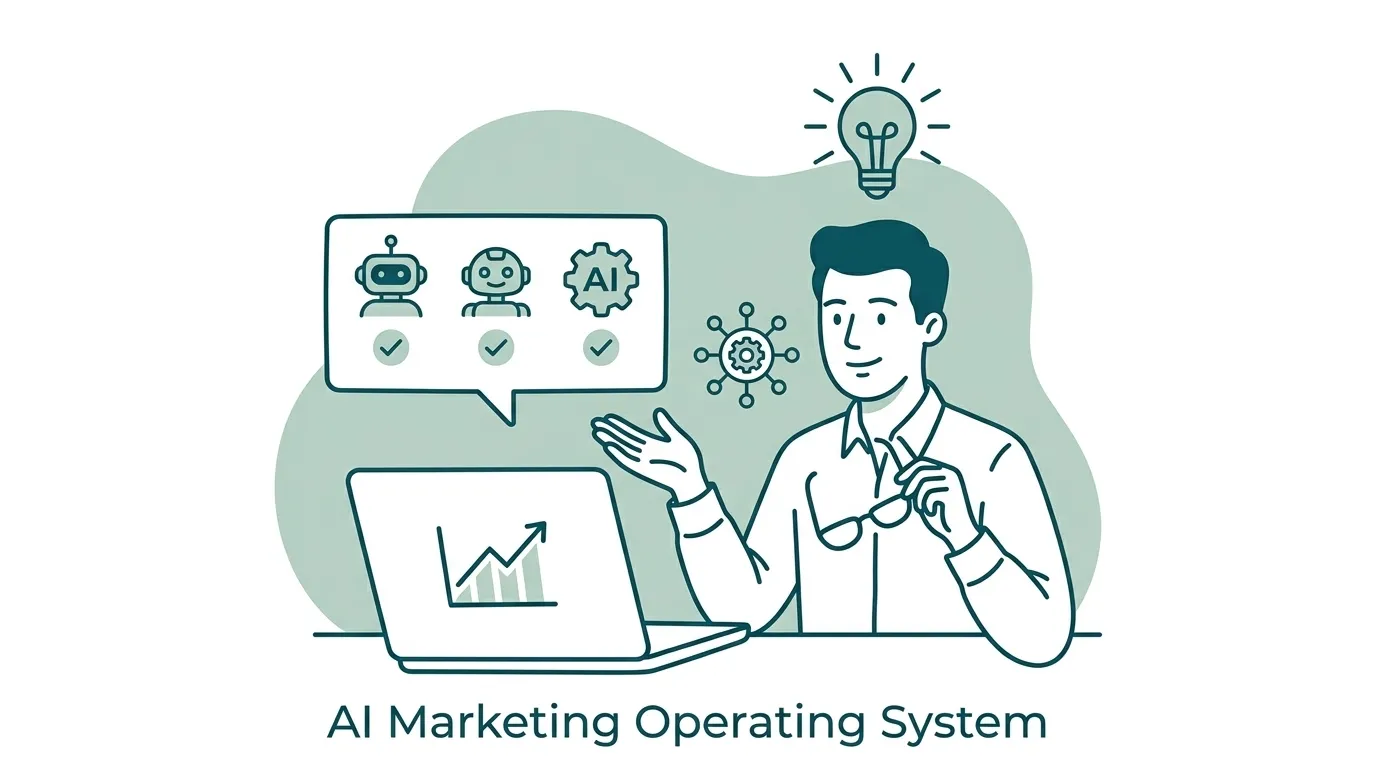
- AI marketing for agencies works as an operating system of three connected engines: new business, client delivery, and content, all running on a shared question map.
- Buyers now rely on AI chatbots for vendor research, with 69% choosing a different vendor than planned based on AI answers, so citation inside AI responses has become the core visibility metric.
- The three engines compound when they share one question map: new business targets comparison queries, client delivery automates reporting workflows, and content stays fresh, which supports 3.2× more citations for pages under 30 days old.
- Agencies that sell judgment, strategy, and measurable outcomes build pricing power, while agencies that sell cheaper execution slide toward a price floor near zero.
- Ready to run AI marketing for agencies as an operating system? See the operating system in action.
How AI Marketing For Agencies Works Day To Day
AI marketing for agencies means running three connected engines on a shared question map. The market context shows why this matters now.
Forrester’s 2026 report, released in partnership with 4As, confirmed nine in ten US marketing agencies now use generative AI and half use agentic AI for marketing execution, yet rapid adoption focused only on productivity is undermining marketing effectiveness and long-term brand growth.
The buyer side has already shifted. G2’s March 2026 survey of 1,076 B2B software buyers and decision-makers found that 71% use AI chatbots for software research, 69% chose a different vendor than the one they had planned on based on what the assistant told them, and 33% bought from a vendor they had not previously heard of. That behavior describes a vendor-selection event. Being in the answer now decides whether a brand enters the consideration set or disappears from it.

Want to see how this operating system would look inside your agency? Walk through a live example.
Three Engines That Share One Question Map
The three engines share one question map, and that shared map makes the system compound instead of scatter.
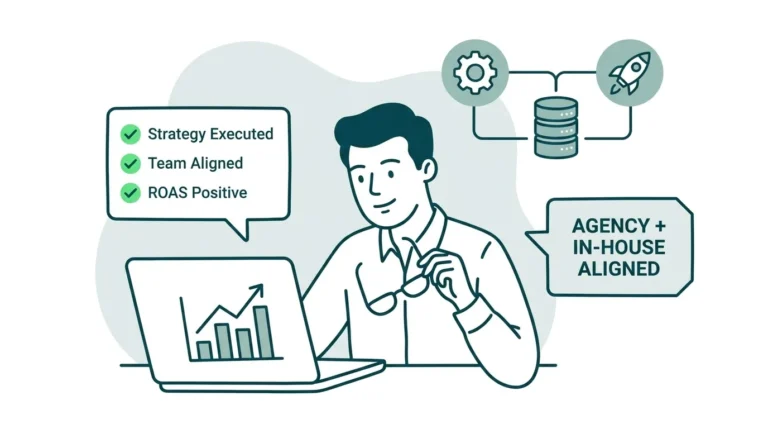
New Business Engine. AI supports lead generation by targeting alternative and comparison queries, the searches buyers run when they already evaluate options. Pre-educated prospects arrive at sales calls informed because an AI answer walked them through the category before anyone from your agency joined the conversation. The workflow starts by mapping the fan-out queries buyers actually type, then publishing structured comparison and alternative pages that answer them. From there you monitor which pages earn citations and feed those wins back into production, so the next round of pages builds on what already worked. AI Growth Agent clients average more than 12,000 additional AI citations and mentions and a 20% or greater lift in impressions across the first twelve weeks. That pattern shows the new business engine running.
Client Delivery Engine. AI supports client reporting, account management workflows, and content production, with human review at defined checkpoints. The workflow pulls data, drafts analysis, adds a human strategic layer, assembles and QA’s the package, then sends it. Boutique marketing agencies that rebuilt their reporting workflows around AI tools cut monthly reporting time from 4–6 hours per client to under 90 minutes. The strategic interpretation layer, which explains what the numbers mean for a specific client’s goals, stays human. The mechanical 80% shifts to AI.
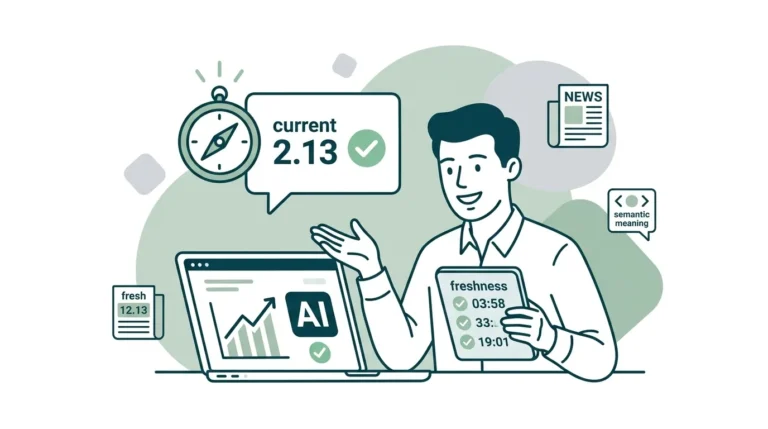
Content Engine. AI supports publishing at cadence, structured pages, schema markup, and a refresh loop. The workflow extracts fan-out queries, aligns slugs, titles, and H1s, publishes at cadence, then uses impression-decay tripwires to auto-queue updates. Content freshness accounts for 40% of Perplexity’s ranking signal, and pages under 30 days old receive 3.2× more citations than older content. The content engine behaves like a living system that repairs itself.

The shift is easiest to see side by side: every dimension of agency work, from target to success metric to authority source and what sustains a win, moves from human-readable artifacts to machine-generated answers.
| Dimension | Traditional Agency Model | AI Marketing For Agencies |
|---|---|---|
| Target | Rankings on a human-readable list | Citation inside a machine-generated answer |
| Success Metric | Rankings, clicks, impressions | Citations, mentions, share of answer |
| Authority Source | Backlinks and domain authority | Expert topical coverage |
| What Sustains A Win | Accumulated domain authority | Continuous freshness, in a game that resets weekly |
Where AI Helps Agencies And Where Humans Stay In Charge
AI is commoditizing execution while human judgment remains the source of advantage.
Inside an agency, AI handles volume, structure, drafting, monitoring, refresh triggers, reporting summaries, ad copy variants, keyword grouping, and schema suggestions. The agency tasks most vulnerable to AI commoditization are basic content drafting, routine reporting, standard research summaries, initial SEO briefs, ad variation generation, and templated execution support.
Human oversight stays mandatory for strategy, proprietary client data, creative judgment, positioning, executive communication, and accountability for outcomes. A study published in Industrial Marketing Management concluded that AI is commoditizing content production and forcing content marketing agencies to compete on judgment, creativity, and business strategy rather than production capacity.
The agency that sells judgment wins. The agency that sells cheaper execution enters a race against a cost floor that keeps dropping and that every client can see.
What AI Agents Can Safely Own
AI agents can run defined workflows autonomously, including drafting, monitoring, refreshing, reporting, lead qualification, anomaly detection, and budget pacing. The practical test for distinguishing an AI agent from an AI tool: if you close your laptop and the system keeps optimizing your campaigns, it is an agent; if it stops working the moment you stop interacting, it is a tool.
Humans set the objective, define the guardrails, and own the outcome. Brand positioning, high-stakes messaging, budget authority, offer strategy, and major campaign direction stay human-led. Gartner projected that by 2028, at least 15% of day-to-day work decisions will be made autonomously through agentic AI, while more than 40% of agentic AI projects will be canceled by the end of 2027 due to unclear value, weak controls, or poor execution. The common failure mode comes from unclear human direction, not from the agent itself.
Escaping The Commoditization Trap
Selling cheaper execution creates a race to the bottom, while a defensible agency offer combines strategy, proprietary processes, client data, creative judgment, and measurable outcomes. That mix reflects what AI cannot replace.
The market benchmark is roughly $5,000 a month for an AI content engine, against roughly $10,000 a month for 7 to 10 human-written articles with no refresh loop. These numbers describe market benchmarks, not Arjun’s prices. The higher number buys better prose. The lower one buys volume, structure, and freshness, which are the three things the channel actually rewards. Agencies pivoting to AI search optimization are charging 20–30% higher retainers than traditional SEO shops because the expertise is new, scarce, and cannot be replicated by a prompt. The premium lands on judgment rather than production.
Pricing AI-Augmented Services Around Outcomes
Price the outcome instead of the hours so AI efficiency gains expand margin instead of shrinking fees.
A task that once took ten hours and now takes two means an hourly-billing agency earns a fraction of prior revenue for identical output, so its own efficiency cuts its revenue. The structural fix moves pricing toward outcome and scope tied to measurable visibility and pipeline. Three contract shapes now dominate: a retainer of outcomes with KPI-tiered fees and an accelerator, an output menu with fixed-price productized deliverables, and an AI subscription with an annual bundle and defined scope. Niche specialists who price around value and outcomes are reportedly clearing margins many times higher than generalists stuck near the industry average, because they have escaped the hourly trap. Reframe retainers around outcomes, access, and capacity instead of a monthly allotment of hours.
Want to stress-test your current pricing against this model? Review your pricing structure live.
The 30-Day Starting Sequence
Plumbing comes before content, because if the retrieval layer cannot read the site, nothing downstream matters. Here is the sequence with day ranges and the reasoning behind each step.
- Days 1–3: Baseline visibility audit across ChatGPT, Google AI Overviews, Perplexity, and Gemini. Before publishing anything, establish where the agency currently appears, where competitors appear instead, and where the gaps sit. This baseline becomes the control group every later result is measured against.
- Days 4–7: Technical plumbing to unblock AI crawlers, add schema, and make pages machine-parseable. This work is foundational. By 2026, brand visibility in search depends less on page position in ranked results and more on whether a brand is cited within AI-generated responses. If the retrieval layer cannot access the site, citation remains impossible regardless of content quality.
- Days 8–12: Fan-out query mapping. Extract the full question space behind a buyer’s prompt, not just the prompt itself. Fan-out queries come directly from ChatGPT rather than from keyword tools, because the target is the machine’s questions instead of the human’s visible search.
- Days 13–20: Structured publishing at cadence. Publish structured pages that match the mapped question language. Query language goes in URLs, titles, and H1s, and schema goes on everything. In Arjun’s own test lab, new articles on his site reached thousands of monthly Google impressions within weeks.
- Days 21–26: Freshness loop with impression-decay tripwires. In Arjun’s tests, pages on his site dropped 78% to 99% in two months without updates. 76.4% of pages cited by ChatGPT were updated within the prior 30 days. Tripwires auto-queue updates when performance drops, so the library keeps renewing instead of decaying in place.
- Days 27–30: Citation and share-of-answer measurement. Track citations across ChatGPT, Google AI Overviews, Perplexity, and Gemini, plus AI referrers such as chatgpt.com in analytics, plus impressions and decay curves in Google Search Console. A competitive share of citation for B2B brands in 2026 sits between 5% and 15% aggregate across major AI engines, with 20% or above signaling category leadership. Feed wins back into production so the system compounds.
Measuring AI Impact On Agency Growth
Measurement shifts from rankings to citations, mentions, and share of answer across ChatGPT, Google AI Overviews, Perplexity, and Gemini, with AI referrers and decay curves layered in.
Add AI referrers such as chatgpt.com in analytics, and track impressions and decay curves in Google Search Console. Pew Research Center tracked the actual browsing behavior of 900 US adults across 68,879 Google searches in March 2025 and found that when an AI summary appeared, users clicked a traditional search result in 8% of visits, against 15% when no summary appeared. The content still gets consumed, but it sends fewer clicks than before.

Seer Interactive analyzed 47,097 AI citations across 7,683 pages in ChatGPT, Gemini, and Perplexity between March and June 2026, and found that 75% of cited pages had been updated within the last year, with consistently cited pages averaging under six months since their last update.

Buyers often copy an answer and paste a name into a browser, so a meaningful share of AI-driven demand lands as direct or branded traffic and never gets attributed. A brand can have a 60% mention rate across target prompts and still generate zero attributable revenue from AI search, because visibility metrics alone cannot show whether AEO is driving pipeline. Whatever you measure functions as a floor, not a ceiling, so the practical move is to instrument for citations and share of answer instead of grading the channel on clicks alone.

Why Arjun Karnik’s Public Test Lab Matters For Agencies
Arjun Karnik offers a practical starting point for agencies that want to run this system on their own properties and then roll it out to clients.
He runs a public test lab under his own name, with incentives aligned to being right in public rather than to winning retainers. He publishes the actionable work with misses included, covering what was published, what was restructured, what was refreshed, and what happened. He spent twenty years on the buying side, including CMO roles in B2B software, so he understands where each alternative breaks because he has held the contract when it did.
The method is self-verifying. You can ask an AI assistant about these topics and see who gets cited. The same system being documented is what produces the visibility, which turns the method into a self-proving approach instead of a claim.
The sequence for agencies starts on the agency’s own properties, then moves to client work once receipts exist. On Arjun’s site, the GEO subfolder went from zero to the only source of new impressions on the domain in 60 days. Pages rewritten to match extracted fan-out queries earned citations while control pages did not. Relabelling a jargon-heavy page to buyer language produced citations within weeks.
The engine behind this work is AI Growth Agent, running 5 to 8 autonomous actions a day that mix new articles with updates. Arjun was a paying customer before becoming a partner, and that relationship is disclosed. AI Growth Agent’s published case study for Leva Sleep reports $40,000-$50,000 in attributed store sales in 21 days, which represents an AI Growth Agent case study and not Arjun’s own result.
Ready to run AI marketing for agencies as an operating system on your own properties first? Start with your agency’s test lab.
Frequently Asked Questions
What Is AI Marketing For Agencies?
AI marketing for agencies is an operating system of three connected engines, new business, client delivery, and content, all running on a shared question map. Running these engines together gets an agency mentioned, cited, and recommended in AI answers across ChatGPT, Google AI Overviews, Perplexity, and Gemini.
Is AI Taking Over Marketing Agencies?
The earlier section covers this in depth, and the short version is that execution keeps getting cheaper while judgment holds the value. What changes for an agency is where it prices and how it describes its offer, which ties directly to the pricing and commoditization sections above.
Can AI Agents Do Marketing?
Agents can run defined workflows autonomously, such as drafting, monitoring, refreshing, reporting, and lead qualification, while humans set objectives and own outcomes. Agents handle the workflow, and humans handle strategy and accountability.
How Long Until Results?
Coverage and impressions often appear within weeks, with citations typically following in 1 to 3 months and compounding after month three. The 30-day sequence described earlier sets up this trajectory.
Do I Stop Doing Traditional SEO?
Technical fundamentals, structure, and quality content still support both traditional search and AI search. The main shift lies in the target metric, which moves toward citation and share of answer while still supporting Google impressions and clicks.
Conclusion: Run The System, Get The Receipts
AI marketing for agencies runs three connected engines, new business, client delivery, and content, on a shared question map. The 30-day sequence starts with a visibility audit, fixes the technical plumbing, maps fan-out queries, publishes at cadence, runs a freshness loop, and measures citations and share of answer. Run it on the agency’s own properties first, gather receipts, then take it to clients. The method is self-verifying, because AI answers themselves reveal who executed well.
Ready to build the operating system for AI marketing at your agency? Put the full system under a microscope.