Written by: Arjun Karnik, Growth Marketing Specialist
Key Takeaways
- The B2B marketing agency vs in-house decision depends on three variables: company stage, recurring workload volume, and product complexity.
- Agencies deliver faster multi-channel execution at lower entry cost. In-house teams provide deeper product knowledge and tighter sales alignment.
- Fully-loaded in-house costs sit in the six-figure range mentioned later, while most small and mid-size firms pay $2,500–$15,000 per month for agency retainers.
- Agencies typically reach measurable qualified lead lift in 5–6 months. In-house hires require 52 days to recruit plus 5–7 months to reach full productivity.
- Arjun Karnik helps $1M–$20M B2B companies run a hybrid model that keeps strategy in-house while outsourcing execution volume.
Talk Through Your Hybrid Setup With Arjun
The Decision Rule, Up Front
The B2B marketing agency vs in-house choice is an arithmetic and sequencing question, not a matter of philosophy. Three variables determine the right answer: company stage, recurring workload, and product complexity. These variables interact. A company at early stage with multi-channel needs and a non-technical product almost always gets more execution per dollar from an agency. A company with a complex product, a long sales cycle requiring daily sales alignment, and enough recurring workload to fill a full-time role is a better candidate for in-house. Every other scenario is a variant of those two poles or a hybrid of both.
What Each Model Actually Is
B2B Marketing Agency: An external firm that runs marketing execution for multiple clients with specialized teams. You buy capacity, channel expertise, and speed to execution. All of this comes without adding headcount. Agencies excel at multi-channel execution at volume, especially when the product is not hyper-technical and speed to market matters more than deep brand immersion.
In-House Marketing Team: Internal employees dedicate their time entirely to your brand and product. You buy deep product knowledge, daily agility, and total focus at a fixed overhead cost. In-house teams work best when the product is complex, the sales cycle is long, and marketing must stay tightly coupled to sales conversations every week.
With those definitions in mind, the next section compares the two models across the dimensions that usually drive the decision.
B2B Marketing Agency vs In-House: Side-by-Side
The table below compares agencies and in-house teams across cost structure, ramp time, control, and best-fit conditions.
| Dimension | B2B Marketing Agency | In-House Team |
|---|---|---|
| Cost Structure | Most B2B agency retainers run $2,500–$15,000/month for small and mid-size firms (Howl Marketing, 2026), and full-service programs reach $15,000–$50,000+/month. | BLS OEWS May 2025 reports a national median annual wage of $166,790 for marketing managers. Fully loaded with benefits and payroll taxes, the year-one employer cost ranges within the six-figure band explained in the cost section. |
| Ramp Time | Months 1–2 are foundation and audit; month 3 produces first tangible output; months 5–6 deliver measurable qualified lead lift (upGrowth Digital, 2026). | New B2B marketers typically reach 70–80% productivity in 3–4 months and full productivity in 5–7 months. |
| Control | Scope-defined control with changes handled through contract updates. An account manager is the interface. A Databox survey of agencies found that almost 70% of agencies have account managers handling fewer than 10 clients each, while more than 10% of respondents have 15 or more clients under a single account manager. | Full daily control with direct access to the marketer. Strategy and execution stay inside the building. Turnover resets the clock. |
| Best-Fit Conditions | Multi-channel recurring workload, non-hyper-technical product, need for speed to execution, and budget below the fully-loaded cost of a senior hire. | Complex or technical product, long sales cycle requiring daily sales alignment, recurring workload sufficient to fill a full-time role, and budget for a senior hire plus tooling. |
Is agency or in-house better for B2B? Neither model dominates universally. An agency delivers faster execution and multi-channel capacity at a lower entry cost than a fully-loaded senior hire. An in-house marketer delivers deeper product knowledge and tighter sales alignment. Product complexity, recurring workload volume, and company stage determine the correct answer.
B2B Marketing Agency Vs In-House Cost
Cost comparisons that stop at salary understate the real in-house investment. The fully-loaded arithmetic tells a different story.
The U.S. Bureau of Labor Statistics OEWS May 2025 data reports a national median annual wage of $166,790 for marketing managers. That figure is the starting line, not the finish. The BLS Employer Costs for Employee Compensation report for Q4 2025 shows benefits and required payroll contributions average 31.4% of total compensation for management occupations. That percentage adds roughly $52,000 per year on top of the median salary. Fully loaded with benefits and payroll taxes, the year-one employer cost of a mid-level marketing manager typically falls between roughly $157,000 and $221,000, with the upper end reflecting agency recruiting, family health coverage, and full ramp-up costs.
Recruiting adds more cost and delay. Contingency search firms charge 15–25% of a candidate’s first-year base salary. For a marketing manager at $108,000, that runs $16,200 to $27,000. LinkedIn’s 2025 Talent Trends Report found marketing manager positions took an average of 52 days to fill. At $166,790 annually, using the standard vacancy cost formula (annual salary × impact factor ÷ 260 working days) at 1x impact, each open working day costs roughly $641 in lost productivity, or approximately $33,354 over a 52-workday vacancy.
Tooling sits on a separate line. Real marketing manager job postings name CRM software, content workflow platforms, business intelligence tools, and cloud management software as expected competencies. Those subscriptions run $800–$3,600 per month for platforms like HubSpot alone, per published pricing.
On the agency side, Howl Marketing’s 2026 B2B marketing agency pricing guide puts most B2B agency retainers between $2,500 and $15,000 per month for small and mid-size firms. For a fuller picture of what those retainers include and exclude, see the B2B Marketing Services Pricing In 2026 breakdown.
As a market benchmark for comparison, an AI content engine runs roughly $5,000 per month versus roughly $10,000 per month for 7 to 10 human-written articles with no refresh loop. The first buys volume, structure, and freshness. The second buys better prose on a static library.
Calculate Your Fully-Loaded Cost With Arjun
Ramp-Up and Time to Results on Both Sides
Cost is only half the equation. The other half is how long each model takes to deliver results.
In-house: New B2B marketers typically reach 70–80% productivity in 3–4 months and full productivity in 5–7 months. That clock starts after the hire closes, which itself takes an average of 52 days. A company that begins recruiting today should not expect full marketing output before month nine at the earliest.
For AI-search-oriented execution specifically, coverage and impressions typically appear in weeks. Citations appear in 1 to 3 months, and compounding usually starts after month three. These are market benchmarks drawn from observed patterns, not guarantees of any specific outcome.
Three Core Drawbacks of In-House Marketing
The three primary drawbacks of in-house marketing are skill gaps, fixed overhead, and stagnation without outside exposure. A single in-house marketer cannot cover every channel at expert level, costs the same whether output is high or low, and tends to go stale without the cross-client pattern recognition an agency accumulates.
Skill gaps are structural, not personal. A marketing manager hired for content and SEO is not a paid media specialist. A demand generation hire is not a brand strategist. In a 0–3 person marketing team, every uncovered channel is either ignored or handled badly.
Fixed overhead does not flex with business conditions. The fully-loaded year-one employer cost described in the cost section stays constant. That number does not decrease in a slow quarter, and it does not scale up when the pipeline needs more volume.
Stagnation without outside exposure is the drawback founders mention last and feel first. In-house teams often go stale without outside exposure. A marketer embedded in one company for two or three years stops seeing what is working elsewhere. Agencies run the same playbook across dozens of clients and iterate faster because they see more failure modes.
In-House vs Agency Marketing: Where Agencies Break
Agencies have their own failure modes, and buyers who have signed the retainer recognize them quickly.
Account manager turnover is the most common complaint. The senior strategist who sold the engagement is rarely the person running it by month four. A Databox survey of agencies found that almost 70% of agencies have account managers handling fewer than 10 clients each, while more than 10% of respondents have 15 or more clients under a single account manager, with some agencies reporting 15–30 clients per manager. When that person leaves, the institutional knowledge of the account leaves with them.
Agencies not understanding technical products form the second failure mode. A generalist agency can run LinkedIn ads and write blog posts for a horizontal SaaS product. It cannot accurately represent a developer tool, a compliance platform, or a vertical-specific solution without deep onboarding that most retainer structures do not budget for.
Communication latency is the third. When the sales team surfaces a new objection on Monday, an in-house marketer can have a response asset by Wednesday. An agency works on a weekly or bi-weekly cadence, runs changes through a brief-and-approval loop, and delivers the asset in the following cycle. By that point, the sales conversation has often moved on.
When a Hybrid Agency and In-House Model Makes Sense
The hybrid model gives a prescriptive answer for a specific set of conditions rather than a diplomatic compromise.
Choose an agency if your recurring workload is multi-channel, your product is not hyper-technical, and you need speed to execution. The agency’s capacity and channel expertise will outperform what a single hire can deliver at the same budget.
Choose in-house if your product is complex, your sales cycle requires daily sales alignment, and you have enough recurring workload to fill a full-time role. The depth of product knowledge and the tightness of the sales feedback loop justify the fully-loaded cost.
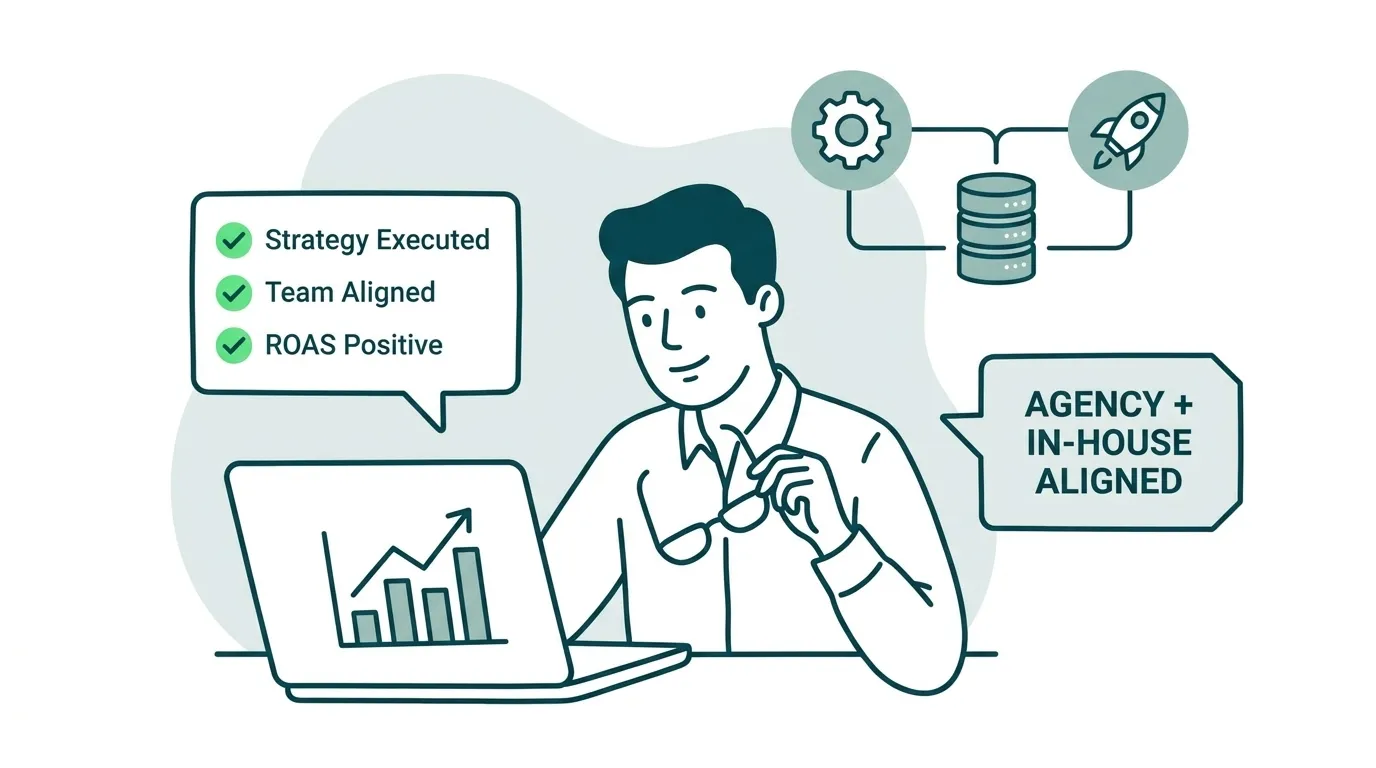
Choose hybrid if you have one internal owner for strategy and context, and the execution volume exceeds what that person can sustain. This is the condition most $1M–$20M B2B companies face: a founder or head of marketing who owns positioning and customer insight, surrounded by more execution demand than one person can meet at the cadence the market now requires.
The Hybrid Model, Prescriptively
The hybrid model follows the logic of what requires institutional knowledge and what requires volume. The split is deliberate, not arbitrary.
Stays in-house: strategy, positioning, brand, customer research, and sales alignment. These functions require daily context that an external team cannot accumulate at retainer cadence.
Goes to an agency or system: paid acquisition, SEO, content production, creative, and analytics. These functions require volume, tooling, and channel expertise that a 0–3 person team cannot sustain internally.
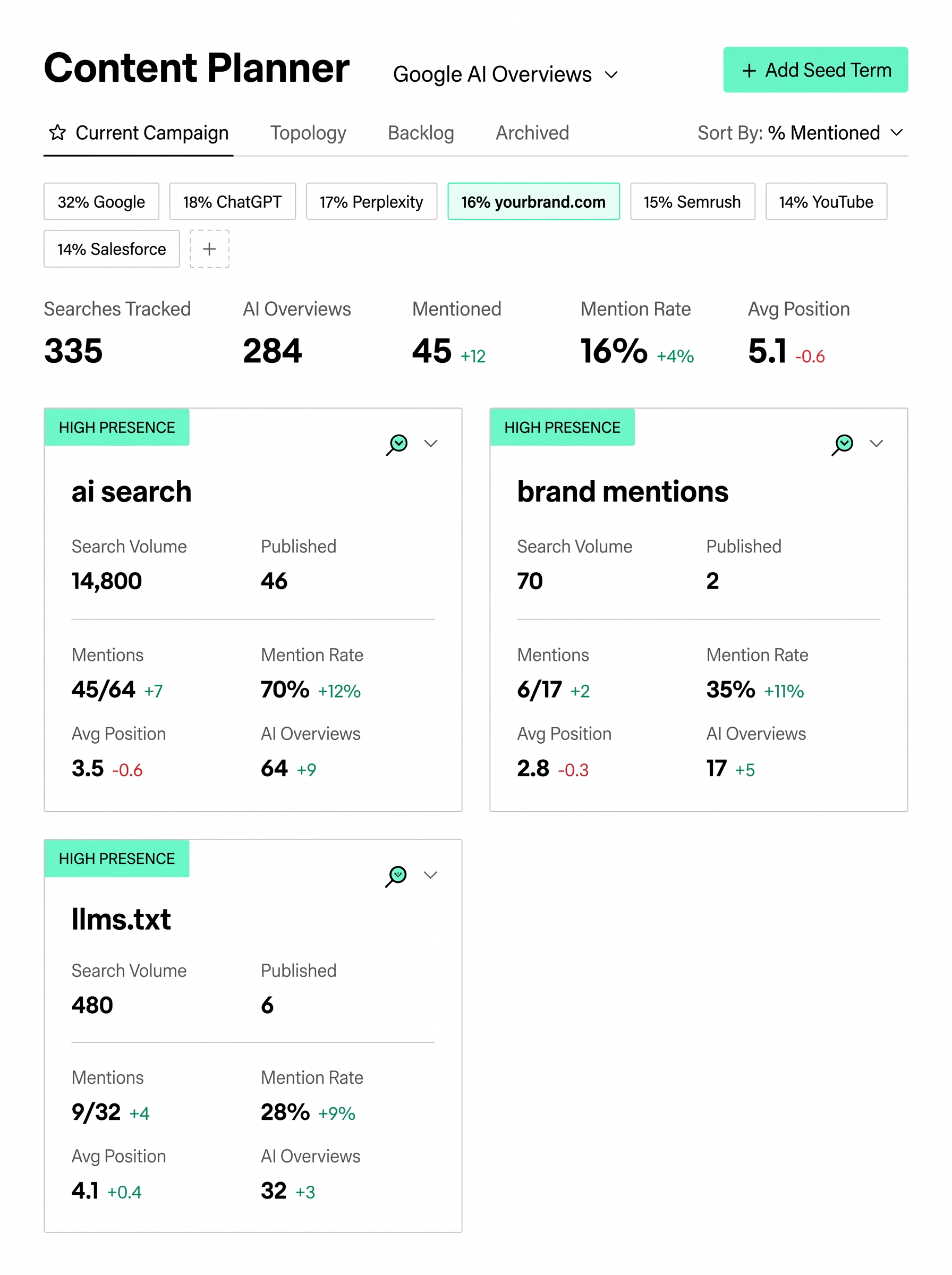
AI search has sharpened this split. Seer Interactive analyzed 7,683 pages and 47,097 citations across ChatGPT, Gemini, and Perplexity from March to June 2026 and found that 75% of cited pages had been updated within the last year, with pages cited consistently across all four months averaging under six months since their last update. AI search rewards continuous publishing and freshness at a cadence a 0–3 person team cannot sustain. That reality pushes execution outward while keeping strategy in-house, driven by arithmetic rather than philosophy.

See the Hybrid Model in Action
The Execution Layer: What Arjun Karnik Runs
If the hybrid model is the answer, the next question is who runs the execution layer. Arjun Karnik is a twenty-year tech marketer and former B2B software CMO who runs a public test lab under his own name, documenting exactly what gets a business mentioned, cited, and recommended in AI answers, and publishing the receipts, misses included.
He runs a test lab. He is not an agency, not a tool, and not a course. The proof is self-referential: ask an AI assistant about his topics and see who gets cited. The same system being documented is what makes the site show up.
The system runs via AI Growth Agent (a partnership Arjun discloses) at 5 to 8 autonomous actions a day, mixing new articles with updates on autopilot. On his own site, new articles reached thousands of monthly Google impressions within weeks, and the GEO subfolder went from zero to the only source of new impressions on the domain in 60 days. Those are his numbers, measured in his own Google Search Console.

For founders and heads of marketing at $1M–$20M B2B companies who need the execution layer of the hybrid model to run at machine cadence while strategy stays in-house, the test lab is where the arithmetic gets applied in practice.
Run Your Execution Layer With Arjun
Frequently Asked Questions
Is Agency or In-House Better for B2B?
Neither model is universally better. An agency delivers faster execution and multi-channel capacity at a lower entry cost than a fully-loaded senior hire. An in-house marketer delivers deeper product knowledge and tighter sales alignment. Product complexity, recurring workload volume, and company stage determine the right answer. Most $1M–$20M B2B companies land in a hybrid model once they do the arithmetic.
What Is the Difference Between In-House and Agency Marketing?
In-house marketing means internal employees dedicate their time entirely to one brand, buying deep product knowledge and daily agility at fixed overhead cost. Agency marketing means an external firm runs execution across multiple clients, buying capacity and channel expertise without adding headcount. The core trade-off is depth of context versus breadth of execution capacity.
What Are Three Drawbacks of In-House Marketing?
The three primary drawbacks are skill gaps, fixed overhead, and stagnation without outside exposure. A single in-house marketer cannot cover every channel at expert level. The fully-loaded cost range mentioned earlier does not flex with business conditions. In-house teams often go stale without outside exposure, while agencies see more failure modes across clients and iterate faster as a result.
How Much Does a B2B Marketing Agency Cost per Month?
Most B2B agency retainers run $2,500–$15,000 per month for small and mid-size firms, per Howl Marketing’s 2026 pricing guide. Multi-channel programs reach $15,000–$50,000 per month. Those figures cover management and strategy only, while ad spend, tool subscriptions, and setup fees are typically separate and can add 20–40% to the out-of-pocket total.
How Long Until We See Results from Either Model?
For an in-house hire, recruiting takes an average of 52 days, then 3–4 months to reach 70–80% productivity and 5–7 months to reach full output. For an agency, months 1–2 are foundation and audit, month 3 produces first tangible output, and months 5–6 deliver measurable qualified lead lift. For AI-search-oriented execution, coverage and impressions typically appear in weeks, citations in 1–3 months, and compounding after month three.
Do We Stop Doing SEO If We Go In-House?
SEO remains essential. Technical fundamentals, structure, and quality content serve both traditional search and AI search. What changes is the target you optimize toward and the metric you report on. Content built for AI citation still earns Google impressions. On Arjun’s own site, articles reached thousands of monthly Google impressions within weeks, and the GEO subfolder became the only source of new impressions on the domain. The two surfaces reward the same underlying discipline.
How Much Content Is Actually Enough?
You need enough content to cover the mapped fan-out question space, refreshed continuously. That is a cadence question, not a total volume question. The reference cadence via AI Growth Agent is 5 to 8 autonomous actions a day, mixing new articles with updates. In Arjun’s own tests, pages dropped 78% to 99% in two months without maintenance, which means volume without a refresh loop behaves like a slow leak.
Why Should I Trust Your Numbers?
The numbers are checkable and labelled. Arjun’s figures come from his own Google Search Console, cadence records, and decay curves, published with the misses included. AI Growth Agent’s case studies are cited as AI Growth Agent’s, never absorbed into his own data. You can verify the claims directly by asking an AI assistant about these topics and seeing who gets cited.
Conclusion: The Decision Framework, Recapped
The B2B marketing agency vs in-house decision resolves to three variables: company stage, recurring workload, and product complexity. Do the fully-loaded cost math, including salary, benefits, payroll taxes, recruiting fees, tooling, and ramp time, before comparing it to published agency retainer benchmarks. Match the model to the conditions. If the execution volume exceeds what one internal owner can sustain at the cadence AI search now requires, the hybrid model gives the prescriptive answer. Test, measure, and adjust.
Design Your Hybrid Plan With Arjun