Written by: Arjun Karnik, Growth Marketing Specialist
Key Takeaways
- AI search freshness importance varies by query type. It matters most for time-sensitive queries, moderately for commercial and comparison queries, and least for evergreen definitions and historical facts.
- Freshness behaves as a selective ranking factor. Treating it as a universal rule creates unnecessary churn on pages that already perform.
- Named primary research from 2025 and 2026 shows that most cited pages had been updated within the last year, with consistently cited pages averaging under six months since their last update.
- Semantic recency, meaning real content changes that reflect current reality, drives citations. Cosmetic timestamp updates without substantive edits can damage credibility and reduce citation rates.
- Arjun Karnik runs a public test lab that documents exactly what gets a business mentioned, cited, and recommended in AI answers.
See How Freshness Tracking Works
The Two Meanings Of Freshness In AI Search
Freshness in AI search refers to two distinct concepts that often get conflated across published advice.
The first meaning is freshness as a retrieval and ranking signal in consumer AI search. ChatGPT, Google AI Overviews, Perplexity, and Gemini decide whether to pull a document into an answer at all and whether to prefer that document over a competitor’s. This meaning affects whether a business gets mentioned, cited, or recommended in an AI-generated answer.
The second meaning is freshness as a document-scoring parameter in Azure AI Search and RAG pipelines. Engineers set a scoring profile and boosting weight inside a vector search stack. This configuration lives inside internal tools and sits outside the publishing decisions content marketers control.
This article focuses on the first meaning. The second belongs to a different discipline with different mechanics and a different audience. The table below lays out the four dimensions where the two diverge: what each is, who controls it, what it changes, and how you influence it.
| Attribute | Consumer AI Search Freshness | Azure AI Search Freshness |
|---|---|---|
| What It Is | Retrieval And Ranking Signal | Document-Scoring Parameter |
| Who Controls It | AI Platforms (OpenAI, Google, Perplexity) | Developers Configuring Search Stacks |
| What It Changes | Whether A Page Gets Cited In An Answer | Whether A Document Ranks In Vector Search Results |
| How You Influence It | Content Updates, Schema, Semantic Recency | Scoring Profiles, Boosting Weights, Freshness Functions |
How Much Does Content Freshness Matter For AI Search?
Freshness impact varies by query type and by platform. Named primary research from 2025 and 2026 provides the clearest picture available.
Seer Interactive’s July 2026 study analyzed 7,683 pages and 47,097 citations across ChatGPT, Gemini, and Perplexity between March and June 2026. It found that 75% of cited pages had been updated within the last year. Pages cited consistently across all four months averaged under six months since their last update. Seer’s conclusion inverts the usual instinct: the page you refreshed beats the page you wrote.
The Pew Research Center’s July 2025 study tracked actual browsing behavior from 900 US adults across 68,879 Google searches in March 2025. It found an 8% click rate on traditional search results when an AI summary appeared, versus 15% when no summary appeared. The click disappears where the answer appears, which makes citation, not click-through, the metric that matters.
G2’s March 2026 research of 1,076 B2B software buyers and decision-makers across North America, EMEA, and APAC found that 71% use AI chatbots for software research, and 69% switched from their intended vendor based on what an assistant told them. Being in the answer functions as a vendor-selection event, not just a visibility metric.
In Arjun’s tests on his own site, pages dropped 78% to 99% in two months without maintenance. That finding comes from his own decay tracking, not a general law about how the web behaves. It still aligns with what independent research shows from a different angle.
One figure deserves context. The 25.7% freshness advantage statistic circulating across SEO blogs traces to Ahrefs’ analysis of nearly 17 million cited URLs, which found AI-cited content averages 1,064 days old versus 1,432 days for Google organic results. That gap represents a relative freshness gain, not a multiplier. The average AI-cited page is still nearly three years old. Freshness raises the odds of citation on top of quality and relevance.
A Tiered Framework: When Freshness Matters And When It Does Not
Freshness sensitivity varies across query types. The framework below is the judgment tool this article exists to deliver.
- Tier 1 — High Freshness Sensitivity: Time-sensitive queries. Pricing, current product comparisons, “best X in 2026,” regulatory or platform changes, and any topic where the answer changes month to month. NoGood’s analysis recommends weekly or monthly refresh cycles for statistical posts, product comparisons, and pricing pages, and the underlying data supports that cadence. AI citations change 40 to 60% month over month, per the Semrush AI Visibility Study, and approximately 50% of sources cited for a given prompt change within 13 weeks, per Searchless internal benchmark data.
- Tier 2 — Medium Freshness Sensitivity: Commercial and evaluation queries. Alternatives, comparisons, buying criteria, and implementation guidance live here. The underlying facts stay stable, while examples, tools, and surfaces move. Quarterly refreshes with substantive additions fit this tier.
- Tier 3 — Low Freshness Sensitivity: Evergreen definitions, historical facts, and fundamental concepts. These cover what a term means, how a mechanism works, and what happened in a past year. For evergreen educational queries, neither Google nor AI search platforms prioritize recency over E-E-A-T and specific page matching. An older page can still be the best answer.
Read together, these tiers explain why freshness does not behave as a universal ranking factor. Treating it as one produces unnecessary churn on pages that already perform while neglecting the pages where recency actually drives citation.
When Not To Update: Refreshing an evergreen definition without changing its substance erodes trust rather than building it. Pages flagged as fake-fresh, where timestamps move without substantive edits, see their citation rate drop below that of comparable pages that were never refreshed at all, and once flagged, even a genuine overhaul takes longer to recover trust. Cosmetic timestamp updates are detectable and damage credibility with both readers and retrieval systems.
Semantic Recency Vs. Timestamp Updates
Changing a dateModified value and changing the substance of a page create different outcomes.
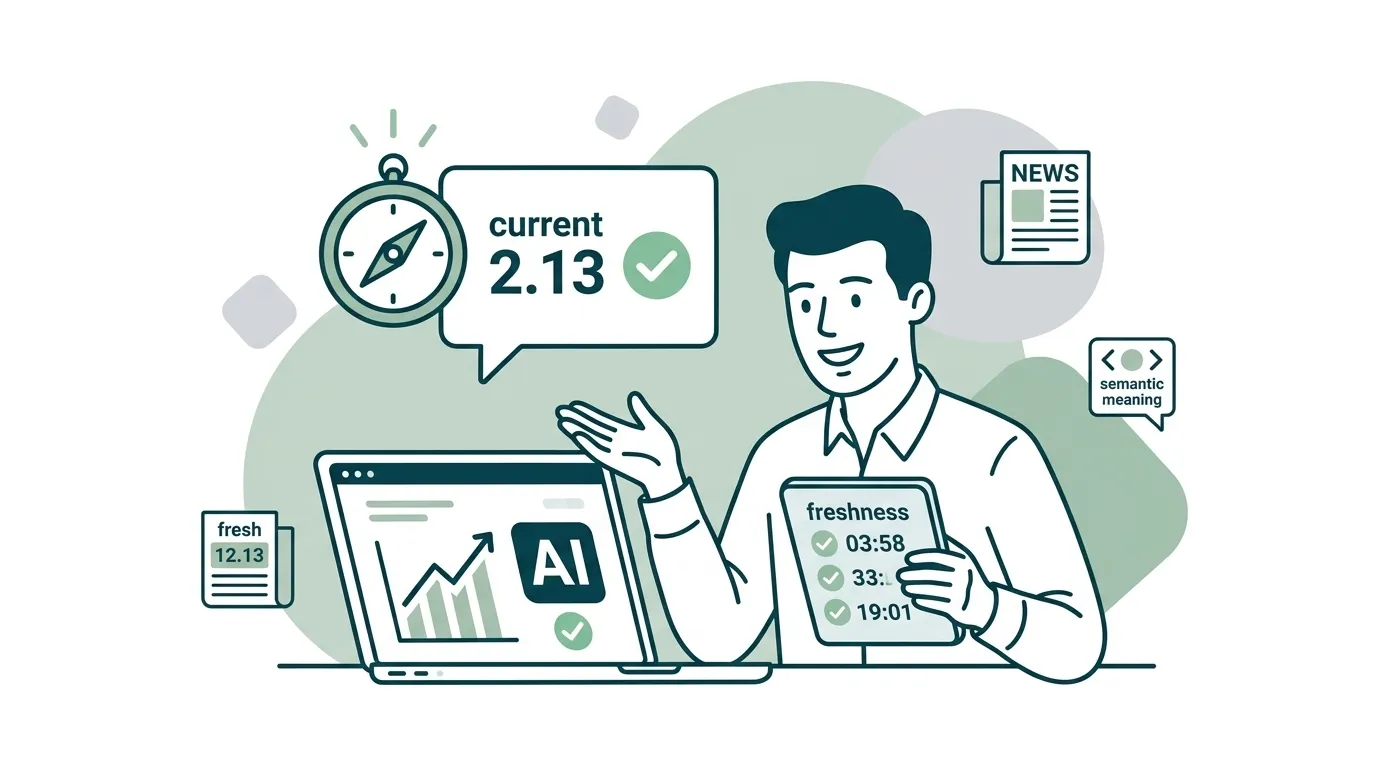
Semantic recency means the content reflects current reality, including tools, prices, platform behavior, and examples. AI search engines use semantic freshness detection, meaning they read content and detect whether information itself is current, so a page about SEO statistics that references 2024 data will be deprioritized even if the publish date says 2026.
A concrete before-and-after illustrates the distinction. A comparison page listing three AI writing tools, last updated in 2024, with a dateModified bumped to 2026 but no new tools added and no pricing updated counts as a cosmetic refresh. Now change the same page, replace two tools, update pricing, and add a section on prompt-based workflows, and it becomes a substantive refresh. When dateModified advances but a content diff shows near-zero change, search and answer engines can detect the mismatch through crawl histories and discount the signal, causing the site’s dates to lose credibility wholesale rather than just on one URL.
Use a simple test. Could a reader who saw the original version and the new version tell the difference in the content itself? If yes, update dateModified. If no, leave it alone.
Platform Variation: Where Freshness Bites Hardest
Freshness sensitivity also varies across AI surfaces. The platform you target shapes the refresh cadence you need.
Goodie AI’s AEO Periodic Table V4 is built from 1.13 million prompts across six AI surfaces. It scores Content Freshness and Recency as follows: Perplexity 87/100, Grok 85/100, ChatGPT 78/100, and Google AI Mode 74/100. ChatGPT and Perplexity lean toward newer material and respond more strongly to recency. Google AI Overviews lean closer to traditional ranking profiles, where authority and relevance carry more weight and recency acts as one input among several. Google AI Overviews cite content averaging 3.9 years old, nearly identical to Google’s organic SERP, so structural factors such as clear H2 hierarchy, FAQ sections, and bold citable claims matter more for Google’s AI surfaces than freshness cadence. Gemini sits within Google’s ecosystem and behaves accordingly, though Gemini disproportionately favors older content that has been recently updated over newer content that has not. The table below summarizes how each surface scores on freshness sensitivity and what that means for your refresh priorities.
| Surface | Freshness Sensitivity | What It Rewards Most | What To Prioritize |
|---|---|---|---|
| ChatGPT | High | Recent Updates, Current Data | Monthly Refresh On Commercial Pages |
| Perplexity | High | Same-Quarter Updates, Live Sources | Continuous Refresh, News Hooks |
| Google AI Overviews | Moderate | Authority, Relevance, Established Trust | Structural Work, Schema, E-E-A-T |
| Gemini | Moderate | Entity Consistency, Search Rank | Google Ecosystem Alignment |
How To Run The Freshness Loop
The freshness loop functions as an operational system rather than a quarterly audit. Four components make it work, and they run in sequence.
- Apply dateModified Schema Honestly. The value should reflect a real content change. Google requires that the date match between the equivalent user-visible and structured values, and retrieval systems cross-reference the two. Consistency between visible and structured dates operates as a requirement, not a suggestion.
- Keep XML Sitemap lastmod Accurate. Google’s sitemap documentation states it uses the
lastmodvalue if it is consistently and verifiably accurate, and per Google’s Gary Illyes the trust model is close to binary. If a site’slastmodvalues repeatedly fail verification, Google stops trusting the field for the entire domain. - Add Visible Changelogs On Updated Pages. A plain-text “Updated [Month Year]” line in the body, marked up with a
<time>element, gives AI crawlers a machine-readable hook that cross-references the JSON-LD value. - Set Impression-Decay Tripwires. Automated triggers wired to Search Console signals queue content updates when a page starts falling. This timing catches decay before the position disappears.
The deep operational detail on running this loop lives in the GEO Freshness Loop article, and the broader ranking factor context appears in the AI Search Ranking Factors article.
That loop is the method Arjun Karnik tests publicly. A twenty-year tech marketer and former B2B software CMO, he runs a public test lab under his own name, documenting exactly what gets a business mentioned, cited, and recommended in AI answers, with both receipts and misses published. He runs a test lab rather than an agency, tool, or course, and the method is self-verifying: ask an AI assistant about these topics and see who gets cited.
The freshness loop runs via AI Growth Agent (a partnership Arjun discloses) at 5 to 8 autonomous actions a day. Those actions combine new articles with updates to existing ones, and impression-decay tripwires auto-queue refreshes.
Run The Freshness Loop On Your Site
Frequently Asked Questions About AI Search Freshness
Does Freshness Matter More Than Relevance In AI Search?
Relevance decides whether a page is eligible to be cited at all. Freshness decides whether it is current enough to be preferred over a competitor’s equally relevant page. A stale page on a highly relevant topic will lose to a fresh page on the same topic. A fresh page on an irrelevant topic will not be cited regardless of how recently it was updated. Relevance acts as the gate, and freshness works as the tiebreaker on the other side of it.
How Often Should I Update Content For AI Visibility?
Cadence depends on the tier. Tier 1 pages, such as pricing, comparisons, and “best of” lists where the answer changes month to month, need continuous refresh, typically monthly at minimum. Tier 2 pages, such as commercial evaluations, alternatives, and buying guides, need quarterly updates with substantive additions. Tier 3 pages, such as evergreen definitions, foundational concepts, and historical facts, need verification rather than rewriting. Check that the claims remain accurate, that examples still apply, and that no newer data has made the page misleading. Rewriting for its own sake on a Tier 3 page does not improve citation rates and can disrupt the structural cues retrieval systems already use.
Does Changing The Date Without Changing The Content Help?
Semantic recency is what retrieval systems reward, and cosmetic timestamp updates are detectable. AI engines cross-reference the visible date against the JSON-LD dateModified value and against a content diff from the crawler’s last snapshot. When the date advances but the diff shows near-zero change, the freshness signal is muted or absent, and the citation penalty is worse than leaving the page untouched. The only timestamp update that helps is one that reflects a genuine content change a reader could identify.
Conclusion: AI Search Freshness Importance Is A Judgment Call
As the opening distinction showed, freshness operates as both a retrieval signal in consumer AI search and a document-scoring parameter in developer-configured RAG pipelines. Most published advice blends the two.
For the consumer AI search meaning, freshness sensitivity runs in three tiers: high for time-sensitive queries, moderate for commercial and evaluation queries, and low for evergreen definitions and historical facts. The when-not-to-update rule follows directly. A page that is old and still the best answer can stand as is. A page where the underlying facts have moved needs a substantive refresh.
AI search freshness importance works as a judgment call made per page and per query type. The businesses that get this right run a continuous loop rather than a quarterly audit they will never complete.