Written by: Arjun Karnik, Growth Marketing Specialist
Key Takeaways
- An AI marketing strategy framework is a six-layer operating system that earns citations in AI answers across ChatGPT, Google AI Overviews, Perplexity, and Gemini.
- The build order matters. Fix technical plumbing, map fan-out queries, align content to buyer language, then publish and refresh on a continuous loop.
- Measurement follows a four-level hierarchy with business metrics at the top and AI-layer metrics such as citations and share of answer at the bottom.
- Common failure modes include content decay, publishing without a refresh loop, and focusing on visible prompts while ignoring hidden fan-out queries.
- The framework is self-verifying. Ask an AI assistant about these topics and see which brands earn citations.
What Is an AI Marketing Strategy Framework?
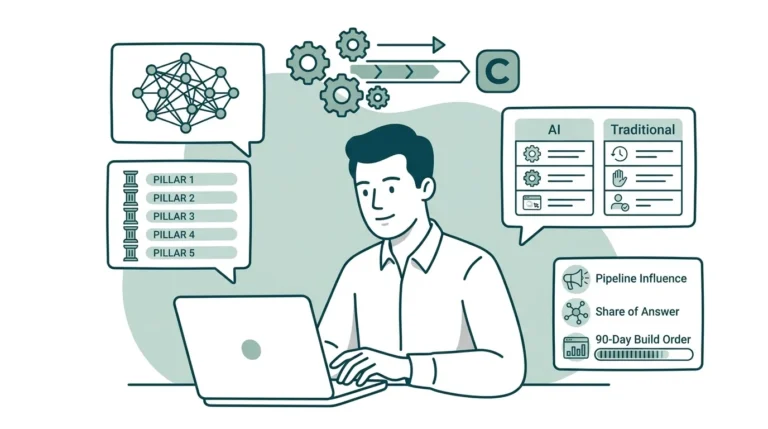
An AI marketing strategy framework is a structured operating system for earning citations and recommendations inside AI-generated answers. It is distinct from a content calendar, a tool stack, or a rephrasing of SEO. The framework as actually run has six named layers:
- Data Infrastructure, the technical foundation that makes a site machine-readable.
- Insight and Fan-Out Query Mapping, the process of extracting the full question space a buyer prompt triggers.
- Creation and Buyer-Language Alignment, publishing structured pages in the words buyers use rather than practitioner jargon.
- Activation and Structured Publishing, deploying content at machine cadence with schema on everything.
- Optimization and the Freshness Loop, impression-decay tripwires that auto-queue updates before positions are lost.
- Governance, brand voice rules, factual-claim review, crawler access policy, and a defined refresh cadence.
This framework extends the four-layer model that Google's AI Overview summarizes by adding optimization and governance. Those two layers decide whether the framework survives contact with reality. Fan-out queries sit at the core. A single buyer prompt triggers dozens of hidden retrieval queries underneath, and the answer is assembled from what comes back. The visible prompt is only the surface. The fan-out queries underneath are what the retrieval layer actually uses to build the answer.
See how the six layers work on your site in real time by booking a walkthrough.
How to Build an AI Marketing Strategy Framework
The build order matters. Teams that start with content before fixing technical plumbing usually ship work that fails silently.
- Baseline Visibility across ChatGPT, Google AI Overviews, Perplexity, and Gemini. Capture where the business is mentioned, where competitors appear instead, and where the gaps are. This baseline becomes the control group every later result is measured against.
- Fix Technical Plumbing First. Unblock AI crawlers, add schema markup, and make pages machine-parseable. This matters because the retrieval layer cannot cite what it cannot read. The most common block is inadvertent. GPTBot, PerplexityBot, and ClaudeBot have separate crawl directives from Googlebot, so overly broad robots.txt rules often shut them out without anyone noticing.
- Map the Fan-Out Question Space by extracting queries directly from ChatGPT rather than inferring them from keyword tools. The target is the machine's questions that fire underneath the prompt the buyer types.
- Align Slugs, Titles, H1s, and H2s to buyer language rather than practitioner jargon. On Arjun's own site, a page titled "What is GEO" was relabelled "How to Get Your Business Recommended by AI Search," with slug, title, H1, and H2s all realigned to buyer questions. Citations followed within weeks of that specific change.
- Publish Structured Pages at Machine Cadence. Query language goes in URLs, titles, and H1s. Schema goes on everything. The system runs via AI Growth Agent at 5 to 8 autonomous actions a day, with new articles and updates on autopilot.
- Wire Impression-Decay Tripwires so updates queue automatically when performance drops. Treat this as the decay curve discussed later, not as a monthly reporting problem.
On Arjun's own site, pages rewritten to match extracted ChatGPT fan-out queries earned citations while control pages did not. The same framework produced new articles that reached meaningful monthly Google impressions within weeks, and the GEO subfolder became the only source of new impressions on the domain.
Goal-Based Routing: Where to Start
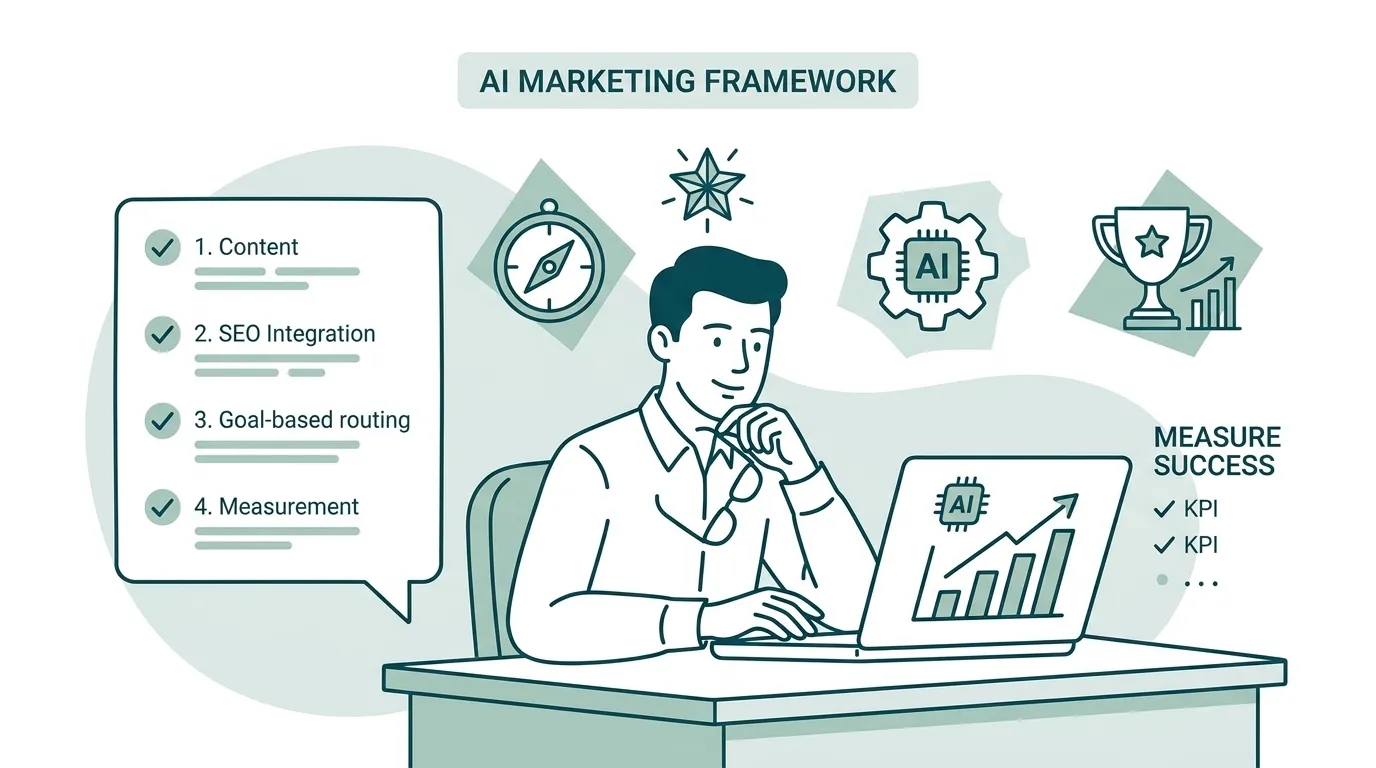
Google's AI Overview ends by asking the user for their goal and their CRM because it cannot go further. This routing layer answers that question directly so teams know where to begin.
- If the Goal Is Lead Generation: Start with fan-out query mapping against the questions buyers ask before a sales call. Measure share of answer rather than form fills. As the G2 data showed, being in the answer is a vendor-selection event, not just a visibility metric.
- If the Goal Is Ecommerce: Start with high-intent comparison, alternative, and product-specific queries. Engineer the citation-to-purchase pathway so specific product and pricing detail appears in the AI answer itself.
- If the Goal Is Brand Awareness: Start with the visibility audit and defensive GEO. A wrong AI answer hurts more than no answer, so auditing and correcting what AI currently says about the brand comes before any growth work.
The AI Opportunity Map by Customer Journey Stage
The journey now runs answer, then brand search, then visit, instead of query, then article click, then CTA. The table below maps each stage to the specific AI opportunity it creates and the KPI that captures it, so you can see where your current measurement is blind.
| Journey Stage | AI Opportunity | KPI |
|---|---|---|
| Awareness | Being named when a buyer asks what a category is or who does it | Mentions and share of answer |
| Consideration | Appearing in comparison, alternative, and "best" fan-out queries | Citations |
| Decision | Being the named recommendation with specific product or pricing detail cited | AI referrers such as chatgpt.com in analytics, treated as a distinct traffic class because it converts like a referral rather than like search |
| Post-Purchase | Reinforcing the record so the answer stays settled | Citation persistence over time |
Measured impact understates real impact. Buyers frequently copy an answer and paste a name into a browser, which lands in analytics as direct or branded traffic. Whatever you measure is a floor, not a ceiling. AI referral traffic to US retail sites grew 138% year over year as of May 2026, according to Adobe data, and that figure captures only the traffic that left a traceable referrer.

How Do You Measure an AI Marketing Framework?
AI-layer metrics alone produce activity without growth. The correct measurement hierarchy has four levels, and business metrics sit at the top.
- Business Metrics, such as pipeline, revenue, and qualified leads.
- Marketing Metrics, such as branded search volume, direct traffic, and assisted conversions.
- Channel Metrics, such as AI referrers like chatgpt.com, segmented separately in analytics.
- AI-Layer Metrics, such as citations, mentions, and share of answer across ChatGPT, Google AI Overviews, Perplexity, and Gemini, plus impressions and decay curves in Google Search Console.
Share of answer replaces rank position as the headline metric. A competitive share of citation for B2B brands in 2026 sits between 5% and 15% aggregate across major AI engines, with 20% or above signaling category leadership.
Three external data points establish the market case, and they point in the same direction. Buyers are using AI to decide, and the pages that get cited are the ones that stay fresh. Pew Research Center's July 2025 study of 900 US adults across 68,879 Google searches in March 2025 found an 8% click rate on traditional results when an AI summary appeared versus 15% when none did. G2's March 2026 survey of 1,076 B2B software buyers and decision-makers found 71% use AI chatbots for software research, 69% chose a different vendor than planned based on what the assistant told them, and 33% bought from a vendor they had not previously heard of. Seer Interactive's July 2026 analysis of 47,097 AI citations across 7,683 pages from March to June 2026 found 75% of cited pages had been updated within the last year, with consistently cited pages averaging under six months since their last update.

What Breaks in Practice
The measurement hierarchy tells you what to track. It does not explain what goes wrong when you stop tracking. These failure modes come from Arjun's own tests on his own site and represent findings rather than universal laws about the web.
In those tests, pages dropped sharply without maintenance. The failure modes that caused that drop:
- Content Decay That Is Invisible Until the Position Is Gone. There is no alert in a standard analytics setup. By the time a monthly report surfaces the drop, the citation has moved to a competitor who refreshed.
- Publishing Without a Refresh Loop. This is the single most common way a framework stalls. A fixed library of any size decays without maintenance. Content freshness accounts for 40% of Perplexity's ranking signal, and pages under 30 days old receive 3.2× more citations than older content.
- Focusing on the Visible Prompt While Ignoring the Fan-Out Queries Underneath. This gap explains why content that ranks can still go uncited. The retrieval layer is not reading only the page the buyer typed. It is assembling an answer from dozens of sub-queries the buyer never saw.
- Treating the Framework as a One-Time Build Rather Than a Loop. The game resets weekly. Volume and cadence function as the entry fee, not as vanity metrics.
The fix is impression-decay tripwires that auto-queue updates when performance drops, which produces self-healing content. One miss worth publishing came from a test on Arjun's own site. A page was restructured for schema markup without first realigning the H1 and H2s to buyer-language fan-out queries, and that change produced no citation lift. The structural work only paid off after the language alignment was corrected. Structure without query alignment remains incomplete.
Which Classic Marketing Frameworks Still Work With AI?
The 7 Ps, the 5 Cs, the four As, the 3-3-3 rule, and the 10/20-70 rule all describe what to decide, including positioning, audience, offer, and channel mix. Those decisions still hold. AI changes the retrieval surface rather than the underlying business choices.
Frameworks that describe how to allocate effort across a linear funnel struggle in this environment. A single buyer prompt now triggers dozens of hidden fan-out queries, and the journey runs answer, then brand search, then visit, instead of query, then article click, then CTA. The funnel still exists, but the entry point moved inside an AI answer.
| AI Marketing Framework | Traditional Marketing Framework | |
|---|---|---|
| Optimizes For | Machine retrieval and citation | Human-ranked lists and domain authority |
| Query Model | Dozens of hidden fan-out queries triggered by one prompt | The query the buyer typed |
| Success Metric | Citations, mentions, share of answer | Rankings |
| Where Authority Comes From | Expert topical coverage | Backlinks and domain authority |
| What Sustains a Win | Continuous freshness in a game that resets weekly | Accumulated domain authority |
What Governance Does an AI Marketing Framework Need?
Governance keeps the framework defensible to the owner while results are still compounding. The guardrails required:
- Brand Voice Rules, with consistent terminology across every published page so the retrieval layer builds a coherent entity record.
- Data Privacy and Compliance Constraints, because EU AI Act Article 50 transparency obligations took effect August 2, 2026 and California's CCPA Automated Decisionmaking Technology rules are in force. AI crawler access policy must be documented separately from Googlebot directives.
- Factual-Claim Review, where every statistic is traceable to a named source with sample and date. Stale figures in a document that argues against stale numbers create a credibility problem.
- Human Approval Before Publication, because the IAB's AI Transparency and Disclosure Framework V2, published August 18, 2026, recommends targeted, risk-based disclosure focused on consumer-facing content where AI materially affects authenticity, identity, or representation, rather than labeling every AI use.
- AI Crawler Access Policy, with explicit directives for GPTBot, PerplexityBot, and ClaudeBot. Blocking them inadvertently remains the most common silent technical failure in this channel.
- A Defined Refresh Cadence, triggered by impression decay rather than by a quarterly calendar.
The governing principle for defensive work is simple. A wrong AI answer hurts more than no answer. Auditing and correcting what AI currently says about the brand comes before growth work. An Ahrefs study of 75,000 brands found brand web mentions correlate at 0.664 with ChatGPT citation likelihood, compared to only 0.218 for backlinks. That finding means what AI already says about a brand is an active input into whether it gets cited next, which turns the existing record into a governance problem as well as a PR one.

Why Arjun Karnik's Test Lab Is the Best Way to Run This Framework
Arjun Karnik is a twenty-year tech marketer and former B2B software CMO who runs a public test lab under his own name. The framework above is the framework as he runs it on his own site, with the receipts published and the misses included.
The system runs via AI Growth Agent, a disclosed partnership, at 5 to 8 autonomous actions a day with new articles and updates on autopilot. That setup removes founder time from the equation rather than adding to it. Earlier sections described what the layers are. The test lab shows what happens when they run continuously, including where experiments fail and get corrected.

The five alternatives and where each breaks:
- Doing It Yourself fails the volume and freshness math. One person cannot publish and refresh at the cadence the channel requires.
- Traditional SEO Agencies still optimize for lists buyers no longer read. The target moved from rankings to citations, but the service did not move with it.
- Human Content Agencies produce better prose that is unstructured and unrefreshed, often at roughly $10,000 a month for 7 to 10 articles with no refresh loop in a game that resets weekly.
- Cheap One-Shot AI Content delivers volume without structure, mapping, or maintenance. Freshness bias buries that content quickly.
- New GEO Tools diagnose without doing the work. They tell you that you are not in the answer and leave you to fix it.
The distinguishing property of the test lab is that it is self-verifying. Ask an AI assistant about these topics and see who gets cited. The same system being documented is what produces the visibility. No other option in this category can be checked that way.
Run the same test-lab system on your own domain by booking a demo.
Closing
The six layers, covering data infrastructure, fan-out query mapping, buyer-language alignment, structured publishing, the freshness loop, and governance, form a complete operating architecture rather than a checklist. The routing layer tells you where to start based on your goal. The four-level measurement hierarchy reflects the channel buyers actually use. The governance rules keep the framework defensible as it compounds.
The window is open now because answers gain incumbency. Early citations become tomorrow's record, and the cost of entry rises as settled answers harden. The method is documented in public, with the misses included, and the system is self-verifying through live AI answers.
Frequently Asked Questions
What Is the Difference Between an AI Marketing Framework and Traditional SEO?
Traditional SEO optimizes for rankings on a human-readable list of ten blue links. An AI marketing framework optimizes for citation inside a machine-generated answer. The retrieval mechanics differ. SEO earns authority through backlinks and domain authority accumulated over time. GEO earns it through topical coverage that is structured, fresh, and aligned to the fan-out queries a buyer prompt triggers underneath.
The success metric also differs. SEO focuses on rank position, while an AI marketing framework focuses on share of answer. The query model shifts as well. SEO targets the query the buyer typed. GEO targets dozens of hidden sub-queries the buyer never sees.
The two approaches are not mutually exclusive. Content built for citation still performs in traditional search. They require different production systems, different measurement hierarchies, and different refresh cadences.
How Long Does It Take to See Results From an AI Marketing Strategy Framework?
Coverage and impressions typically appear within weeks of publishing structured, buyer-language-aligned content. Citations in AI answers usually follow within one to three months. Compounding, where topical authority accumulates and the framework begins to self-reinforce, tends to begin after month three.
On Arjun's own site, articles built for this framework reached meaningful monthly Google impressions within weeks, and the GEO subfolder became the only source of new impressions on the domain in roughly 60 days. These outcomes are findings from his own tests rather than guarantees of any specific result.
Speed depends on technical plumbing being in place first. If AI crawlers are blocked or pages are not machine-parseable, nothing downstream produces results regardless of content quality.
Why Doesn't AI Mention My Business Even Though I Rank on Google?
Ranking on Google and being cited in an AI answer are two separate retrieval events with different selection criteria. A page can rank in position one for a keyword and appear in zero AI citations for the same topic.
The most common reasons are straightforward. The page is optimized for the visible keyword but not for the fan-out queries the AI system triggers underneath. The page is structured for human reading flow rather than machine extraction. The content has not been updated recently enough to pass freshness filters. AI crawlers may also be blocked in robots.txt, which makes the page invisible to the retrieval layer regardless of its Google rank.
The fix starts with a visibility audit across ChatGPT, Google AI Overviews, Perplexity, and Gemini to establish the actual gap. Technical plumbing, fan-out query mapping, and buyer-language alignment come next, before any new content is published.
What Does “Impressions Up, Clicks Down” Mean for an AI Marketing Strategy?
Impressions up, clicks down is the Search Console signal that content is being read and used to construct AI answers, but the click is being absorbed inside the answer rather than sent to the site. The content is working. It is working for someone else's answer surface.

This is the zero-click era, and the missing click is not the same thing as a missing result. The buyer reads the answer where they asked it. If a name in that answer earned their trust, they type it into Google or directly into a browser bar.
That journey, which runs answer, then brand search, then visit, does not leave a clean click trajectory behind. The correct response is to instrument for citations and share of answer rather than to keep grading the channel on the metric it no longer produces. Branded search volume and direct traffic shifts are the proxy signals that capture the demand the click-through rate misses.
Do I Need to Stop Doing SEO to Implement an AI Marketing Framework?
Technical fundamentals, structured content, and freshness serve both SEO and AI-driven channels. What changes is the target you optimize toward and the metric you report on. Content built for citation that is structured, buyer-language-aligned, schema-marked, and refreshed on a loop still earns Google impressions and rankings.
On Arjun's own site, the articles built for GEO reached meaningful monthly Google impressions quickly and became the only source of new impressions on the domain. The practical change is in production. The fan-out query map replaces the keyword list as the production queue. Buyer language replaces practitioner jargon in slugs and H1s. Impression-decay tripwires replace quarterly content audits.
The measurement hierarchy expands to include citations and share of answer alongside rankings and clicks. Both sets of metrics matter, and together they describe the full picture.