Written by: Arjun Karnik, Growth Marketing Specialist
Key Takeaways
- An AI marketing strategy is a documented plan for earning citations and recommendations in AI-generated answers across ChatGPT, Google AI Overviews, Perplexity, and Gemini.
- The strategy works when it runs as a self-sustaining system that combines first-party data, fan-out query mapping, human oversight, and a continuous refresh loop.
- Success is measured by share of answer and AI referrals rather than traditional rankings, because buyers increasingly skip clicks when AI summaries appear.
- Content must be structured, machine-readable, and refreshed at machine cadence. Pages without maintenance lose most of their citations within two months.
- See the full build-and-run playbook in action.
How To Build An AI Marketing Strategy
The seven steps below form the build sequence. Each step has its own section, in order, because skipping one weakens the ones that follow.
- Start with the business goal, not the tool.
- Build the first-party data foundation.
- Map fan-out queries, not keywords.
- Choose the tech stack by use case, not by brand.
- Maintain human oversight and brand voice.
- Measure share of answer, not rankings.
- Run the refresh loop.
Start With The Business Goal, Not The Tool
The AI Overview framing is correct: define clear objectives first. The objective, however, is never “use AI.” It is revenue, CAC, or qualified leads, expressed as a number with a deadline.
A goal statement a $1M–$20M business would actually write looks like this: “Increase qualified demo requests from AI-referred traffic by 40% in two quarters, measured by chatgpt.com referrer segmentation and branded search lift.” That sentence names the outcome, the channel, the measurement method, and the timeframe. Every tool decision that follows is evaluated against it.
Vague goals produce vague stacks. A founder who starts with “we want to use AI in our marketing” will accumulate tools that demo well and deliver nothing measurable. Start with the revenue line and work backward to the system.
Set a goal your AI marketing system can actually hit.
Build The First-Party Data Foundation
Consent and privacy sit inside the strategy, not on the side. Third-party cookies are deprecated. The data that matters now is the data a business already owns.
An owner-led business already has the raw material: sales call transcripts, proposals, support tickets, CRM notes, and email threads. That material contains the exact language buyers use, the objections they raise, and the questions they ask before committing. It is also what the retrieval layer can actually read once it is structured.
The first-party data foundation is not a data warehouse project. It means making the expertise the business already has legible to machines. Unstructured expertise sitting in a founder’s head or in a folder of PDFs is invisible to AI search. Structured expertise published in answer-first formats, with schema markup, is what gets cited.
Before scaling any AI content program, get the data hygiene right. That means a unified customer identifier shared across CRM, email, and analytics, plus standardized conversion tracking. Without that foundation, every downstream step runs on unreliable signals.
Map Fan-Out Queries, Not Keywords
Fan-out queries sit at the core of how AI search retrieves answers. A single buyer prompt triggers dozens of hidden retrieval queries underneath it, and the answer is assembled from what comes back. Optimizing for the visible prompt while ignoring the fan-out targets the wrong surface.
AirOps’ 2026 State of AI Search report found that 89.6% of prompts triggered two or more internal searches, expanding 15,000 original prompts to 43,233 queries, and 95% of those fan-out queries had zero monthly search volume by any traditional keyword metric. A keyword tool cannot map this surface. The fan-out queries have to be extracted directly from the AI systems doing the retrieving.
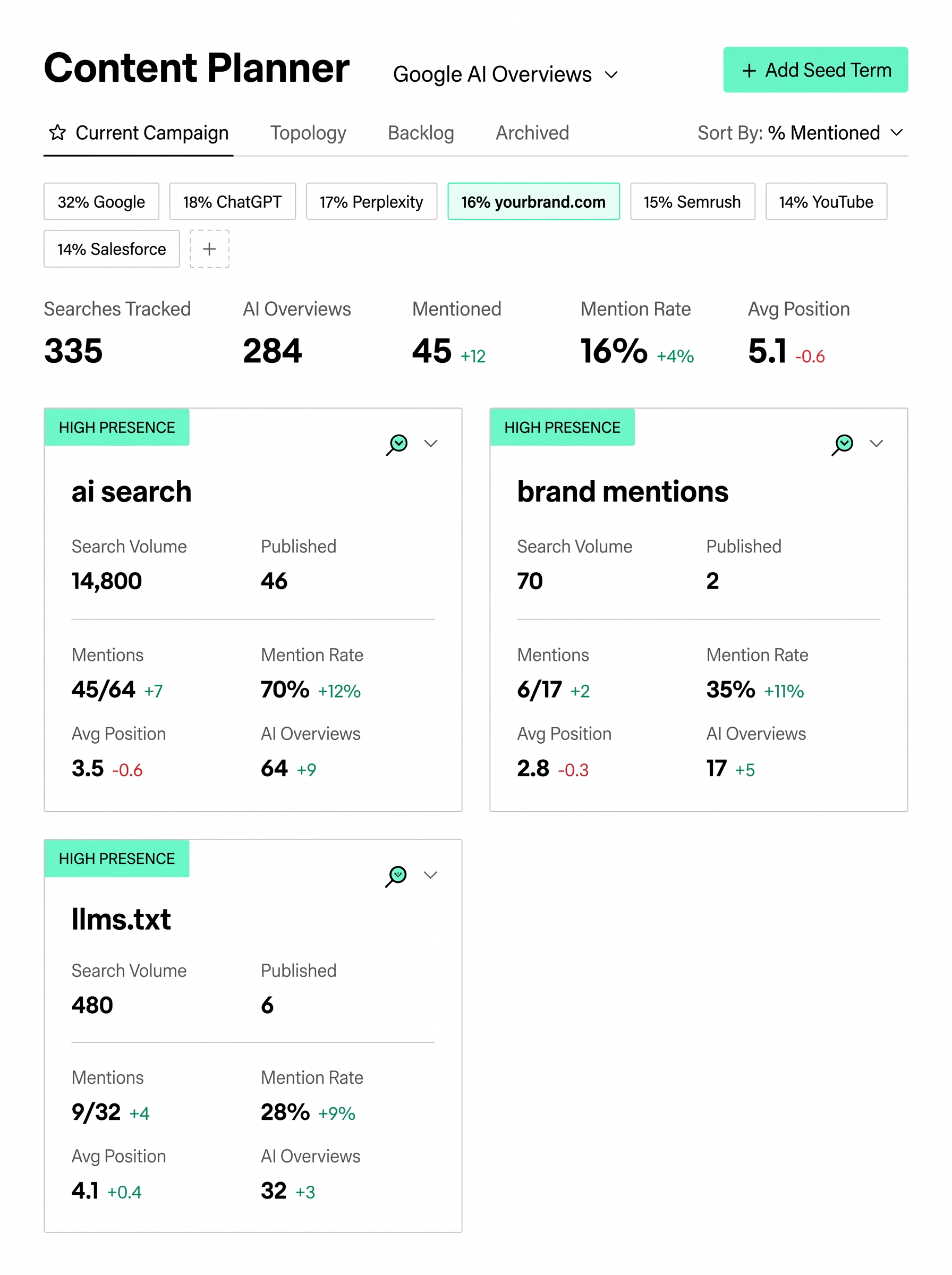
On Arjun’s own site, pages rewritten to match extracted ChatGPT fan-out queries earned citations while control pages did not. The test used a clean control group: identical topic coverage, different URL and heading alignment. The rewritten pages matched the machine’s retrieval language. The controls matched the practitioner’s jargon. Citations followed the rewritten pages.
The buyer-language relabelling test produced the same result. A page titled “What is GEO” was relabelled “How to Get Your Business Recommended by AI Search,” with the slug, title, H1, and H2s all realigned to buyer questions. Citations followed within weeks of that specific change. “Why doesn’t AI mention my business” almost always traces back to a fan-out alignment problem rather than a content quality problem.
Fan-out query mapping is also where the AI marketing strategy framework diverges most sharply from traditional SEO. The target is the machine’s questions, not the human’s typed query.
Choose The Tech Stack By Use Case, Not By Brand
The useful answer to “which AI tool is best for marketing strategy” names a fit, not a logo. The right tool solves the specific job you have named, with the data you already have, at a feasibility level your team can sustain. A ranked list dates instantly and tells a buyer nothing about fit.
Three filters determine whether a tool belongs in the stack. First, does it move the named business goal. Second, can your team implement it with the data and capacity you have. Third, does the data it needs arrive at the cadence the tool requires. Improvado recommends evaluating AI marketing use cases by scoring candidates on business impact and implementation feasibility, where feasibility is a function of data availability, technical complexity, and organizational readiness.
One category deserves explicit rejection: new GEO tools that diagnose without treating. They tell you accurately that you do not appear in the answer. Then they stop, and the work is still yours. A dashboard that reports “my competitor shows up in ChatGPT and I don’t” without executing the fix is a reporting tool. It is not a solution.
The stack for a $1M–$20M business with 0–3 marketers needs to run at machine cadence without adding to the founder’s workload. That requirement eliminates most point tools and most agency retainers before the evaluation even begins.
Maintain Human Oversight And Brand Voice
Human oversight supplies the specificity, the dated numbers, and the first-person markers the retrieval layer rewards, which is why it matters more than any compliance checkbox. Google penalizes low-quality content, not AI-produced content. Quality, structure, and freshness are the variables being judged.
The specific failure mode to avoid is unstructured, unrefreshed content. It gets ignored regardless of how well it is written. Human content agencies produce the best prose of any option in the competitive set. The machine ignores it because it is unstructured and unrefreshed. The market benchmark for that approach is roughly $10,000 a month for 7 to 10 articles with no refresh loop, in a game that resets weekly.
Human oversight catches the errors AI systems produce at scale, such as wrong statistics, outdated product claims, and hallucinated citations. It also maintains brand voice as output volume increases. In practice, AI handles drafts, variations, and scheduling. Humans review anything brand-critical, compliance-adjacent, or factually sensitive before it publishes.
The 10/20-70 rule, covered in its own section below, names this dynamic precisely. The 70% is the operating layer most teams skip.
Measure Share Of Answer, Not Rankings
The measurement target for an AI marketing strategy is citations, mentions, and share of voice across ChatGPT, Google AI Overviews, Perplexity, and Gemini. Rankings measure a surface the buyer is increasingly skipping.
Pew Research Center tracked 900 US adults across 68,879 Google searches in March 2025 and found an 8% click rate when an AI summary appeared, against 15% when no summary appeared. G2 surveyed 1,076 B2B software buyers and decision-makers across North America, EMEA, and APAC in March 2026 and found 71% use AI chatbots for software research, 69% switched their intended vendor based on what the assistant told them, and 33% bought from a vendor they had not previously heard of.

Traffic arriving from chatgpt.com and its equivalents behaves like a referral, not like cold search, because an assistant recommended you. Segment it separately in analytics. It converts at a different rate and represents a different buyer intent than organic search traffic.
“Impressions up, clicks down” in Google Search Console does not signal that content is failing. It signals that content is being consumed to construct AI answers and not sending the click back. The buyer read the answer where they asked it. If a name in that answer earned their trust, they type it into a browser directly. That journey lands in analytics as direct or branded search and never gets attributed to the AI answer that caused it. Treat whatever you measure as a floor. The ceiling is higher than your analytics can show.

Track share of answer across all four surfaces, AI referrers as a distinct traffic class, and impression and decay curves in Google Search Console. Report on the combination, and attach the attribution caveat so no one reads the numbers as complete.
Track citations and share of answer across every major AI surface.
Run The Refresh Loop
Measurement tells you whether the strategy is working. The refresh loop is what keeps it working, and it is where the strategy either compounds or collapses.
In Arjun’s own tests, pages dropped 78% to 99% in two months without maintenance. That decay is invisible unless the site is instrumented for it. By the time it shows up in a monthly report, the citation position is already gone.
Seer Interactive analyzed 7,683 pages carrying 47,097 citations across ChatGPT, Gemini, and Perplexity between March and June 2026 and found that 75% of cited pages had been updated within the last year, with consistently cited pages averaging under six months since their last update, and refreshed pages outperforming newly published ones. Seer’s finding establishes the market pattern. Arjun’s Search Console data shows how he responded on his own site.

76.4% of pages cited by ChatGPT were updated within the prior 30 days. Approximately 50% of sources cited for a given prompt will change within 13 weeks. The citation pool does not stay fixed. It resets continuously, which means volume and cadence act as the entry fee rather than a vanity metric.
The cadence on Arjun’s own site runs at 5 to 8 autonomous actions a day, mixing new articles with updates to existing ones, via AI Growth Agent (partnership disclosed). Impression-decay tripwires monitor Search Console signals and automatically queue an update when a page starts falling. Content repairs itself instead of waiting for a quarterly audit. That is what self-healing content means in practice.

The market benchmark comparison is roughly $5,000 a month for a content engine running at this cadence, against roughly $10,000 a month for 7 to 10 human-written articles with no refresh loop. These are market benchmarks, not Arjun’s rates. The second number buys better prose. The first buys volume, structure, and freshness simultaneously, which are the three things the channel actually rewards.
Do-it-yourself fails the arithmetic. One person cannot publish and refresh at machine cadence. Cheap one-shot AI content delivers volume without structure, freshness, question mapping, or continuous refresh. Neither option delivers all five requirements the channel demands: volume, structure, freshness, question mapping, and continuous refresh.
The alternative is a system that runs the refresh loop for you, which is what the demo below shows in practice. Ask an AI assistant about generative engine optimization and see who gets cited. That is the proof.
What Is The 10/20-70 Rule For AI?
The headline lesson is that the model is the easy part. A brilliant AI tool that nobody adopts or maintains delivers nothing. The 70% is the operating layer, which includes the refresh loop, the human oversight, the measurement cadence, and the feedback cycle that feeds wins back into production. Most teams skip it entirely and then wonder why the strategy stopped working after month two.
Applied to an AI marketing strategy, the 70% does not mean a training program. It means the system that keeps the content citable: the tripwires, the update queue, the share-of-answer reporting, and the buyer-language alignment applied on every refresh cycle. Build the 10% and the 20% correctly, then invest the 70% in the operating layer that sustains the result.
AI Marketing Strategy Vs. Traditional SEO
The two channels share some infrastructure: technical fundamentals, structured content, and quality writing serve both. But the retrieval mechanics, success metrics, and authority models are different. Do not stop doing SEO. Do understand that the target has moved.
The table below highlights the four dimensions where AI marketing strategy and traditional SEO diverge most sharply.
| SEO | GEO | |
|---|---|---|
| Query model | The query the buyer typed | Dozens of hidden fan-out queries triggered by one prompt — 89.6% of prompts triggered two or more internal searches in AirOps’ 2026 analysis |
| Success metric | Rankings | Citations, mentions, share of voice |
| Where authority comes from | Backlinks and domain authority | Expert topical coverage |
| What sustains a win | Accumulated domain authority | Continuous freshness — Seer Interactive found 75% of cited pages updated within the last year across 47,097 citations, March–June 2026 |
Content built for citation still performs in Google. On Arjun’s own site, articles reached thousands of monthly Google impressions within weeks, and the GEO subfolder became the only source of new impressions on the domain in 60 days. The two surfaces reward the same underlying qualities: relevance, structure, specificity, and freshness.
For a deeper look at how the two approaches interact, see AI vs Traditional Marketing: Build a Hybrid Strategy.
The 90-Day Build Sequence
Coverage and impressions arrive in weeks. Citations arrive in 1 to 3 months. Compounding begins after month three. These timelines come from Arjun’s own test lab results, not from guarantees.
- Days 1–30: Visibility audit across ChatGPT, Google AI Overviews, Perplexity, and Gemini. Technical plumbing: unblock AI crawlers, add schema markup, make pages machine-parseable. Fan-out query mapping extracted directly from the AI surfaces, not inferred from keyword tools.
- Days 31–60: Structured publishing at cadence begins via AI Growth Agent, with several autonomous actions per day. Buyer-language alignment applied to new and existing pages, with slugs, titles, H1s, and H2s realigned to the mapped question language. Citation and share-of-answer tracking switched on across all four surfaces.
- Days 61–90: Impression-decay tripwires armed. Refresh loop running. Wins fed back into production so the system compounds toward topical authority rather than scattering across disconnected posts.
For a step-by-step breakdown of the content side of this sequence, see How to Build an AI Content Strategy Step by Step.
Apply the 90-day build sequence to your business.
FAQ
How Long Until I See Results From An AI Marketing Strategy?
Coverage and impressions typically arrive within weeks of publishing structured, machine-parseable content. Citations in AI answers follow in 1 to 3 months. Compounding, where topical authority accumulates and citations become self-reinforcing, begins after month three. These timelines come from Arjun’s own test lab; individual results will vary based on technical plumbing, content cadence, and competitive density in the topic area.
Do I Stop Doing SEO When I Start A GEO Strategy?
Keep doing SEO. Technical fundamentals, structured content, and quality writing serve both surfaces. Content built for AI citation still performs in organic search. The change sits in the target you aim at, which becomes fan-out queries and buyer language rather than head keywords, and in the metric you report on, which becomes share of answer rather than rank position. The two strategies share more infrastructure than they compete for.
What Do I Need In Place Before Any Of This Works?
Technical plumbing comes first. AI crawlers must be unblocked in robots configuration, schema markup must be in place, and pages must be machine-parseable. If the retrieval layer cannot read the site, no content strategy downstream will produce citations. This is the most common silent blocker and the first thing to fix before any publishing begins.
How Much Content Is Enough?
Enough content means enough to cover the mapped fan-out question space, refreshed continuously. That is a cadence question, not a total. A fixed library of any size will decay without maintenance, as the refresh-loop data showed. The reference cadence is several autonomous actions per day via AI Growth Agent, mixing new articles with updates to existing ones, because the game resets weekly and volume without freshness does not win.
Isn’t This Just SEO With A New Name?
The retrieval mechanics are different, the success metric is different, and the authority model is different. SEO earns authority through backlinks and domain authority accumulated over time. GEO earns it through topical coverage, meaning specific, structured, fresh answers to the questions buyers actually ask. SEO optimizes against the query the buyer typed. GEO optimizes against dozens of fan-out queries the buyer never sees. A page can rank on page one of Google for three years and still be cited by Perplexity zero times, because the two surfaces are not measuring the same thing.
Conclusion
The seven-step framework, covering goal, data, fan-out mapping, tech stack, human oversight, measurement, and the refresh loop, gives you the build. The refresh loop turns that build into a durable strategy. Without it, the system decays in place and the citations go to whoever maintained their content last week.
The proof uses the same test you already saw. Run the query in an AI assistant and see who gets cited. That is how you verify the strategy in the real channel.
Make AI answers name your business.