Written by: Arjun Karnik, Growth Marketing Specialist
Key Takeaways
- A generative AI marketing strategy in 2026 is an operating system for earning citations in AI answers across ChatGPT, Google AI Overviews, Perplexity, and Gemini through fan-out query mapping, structured publishing, freshness loops, and citation measurement.
- The generic five-step loop fails in month two because content decays without maintenance, AI answers go stale, and citations require continuous updates rather than one-time publishing.
- A 90-day sequence runs in three phases: foundation, production, and optimization, each with a named owner and a checkpoint.
- Measurement focuses on citations and share of answer rather than clicks, with AI referrers tracked as a distinct traffic class in analytics.
- Arjun Karnik is a twenty-year tech marketer and former B2B software CMO who runs a public test lab under his own name and publishes receipts, misses included.
Most guides to generative AI marketing hand you the same five-step loop: define goals, start small, establish brand voice, implement human-in-the-loop, measure and iterate. That loop explains how to launch. It does not explain what happens in month two when content decays, AI answers drift, and disclosure rules tighten. This article maps the operating system that keeps citations alive after the launch glow fades.
Why The Generic Five-Step Loop Fails
The five-step loop describes how to launch. It dominates AI Overviews and ChatGPT answers for “generative AI marketing strategy.” It skips the operational layer that breaks in month two: content decays without maintenance, AI answers go stale, citations behave differently from clicks, and governance now requires disclosure.
The decay curve discussed below stays invisible until it shows up in a monthly report, by which point the citation position is already gone. Seer Interactive analyzed 7,683 pages and 47,097 citations across ChatGPT, Gemini, and Perplexity between March and June 2026, finding that 75% of cited pages had been updated within the last year, with consistently cited pages averaging under six months since their last update. The page you refreshed beats the page you wrote once and left alone. The five-step loop never mentions that.

What Is A Generative AI Marketing Strategy In 2026?
A generative AI marketing strategy in 2026 is the operational discipline of earning citations inside AI-generated answers. Success is measured by share of answer and citation frequency rather than rank position and click-through rate. The target is the answer layer.
Buyer behavior shifted from searching to asking. The pain phrases are real and specific: “impressions up, clicks down,” “my competitor shows up in ChatGPT and I don’t,” “why doesn’t AI mention my business.” Pew Research Center tracked the actual browsing behavior of 900 US adults across 68,879 Google searches in March 2025 and found that when an AI summary appeared, users clicked a traditional search result in only 8% of visits, compared with 15% when no summary appeared.

G2 surveyed 1,076 B2B software buyers and decision-makers across North America, EMEA, and APAC in March 2026 and found that 71% use AI chatbots for software research, 69% switched their intended vendor based on what the assistant told them, and 33% bought from a vendor they had not previously heard of. Presence inside the answer functions as a vendor-selection event, not a soft visibility metric.

How Is Generative AI Used In Marketing In 2026?
Buyers now select vendors inside AI answers, so the marketing work focuses on influencing those answers. In practice, that means four operational mechanics: fan-out query mapping, structured publishing at machine cadence, freshness loops that auto-queue updates, and citation monitoring across ChatGPT, Google AI Overviews, Perplexity, and Gemini. The operational mechanics matter more than the tool list. Teams map, publish, refresh, and measure in that order.
Fan-out query mapping extracts the hidden questions behind a buyer prompt directly from ChatGPT. A single buyer prompt triggers dozens of hidden retrieval queries underneath, and the answer is assembled from what comes back. Optimizing for the visible prompt while ignoring the fan-out targets the wrong surface. In a test on Arjun’s own site, pages rewritten to match extracted ChatGPT fan-out queries earned citations while control pages did not.
Structured publishing puts query language in URLs, titles, and H1s. Schema markup on everything and answer-first formatting make each page parseable by the retrieval layer. Adding statistics increases AI citation visibility by around 31–33% and adding quotations by around 41–43%, according to the Princeton GEO study.
Freshness loops use impression-decay tripwires to auto-queue updates when performance drops. The Semrush AI Visibility Study found that AI citations change 40 to 60% month over month. Self-healing content repairs itself on a loop rather than waiting for a quarterly audit.

Citation monitoring tracks citations and share of answer across all four surfaces and tracks AI referrers like chatgpt.com in analytics as a distinct traffic class. On Arjun’s own site, new articles reached thousands of monthly Google impressions within weeks, and the GEO subfolder went from zero to the only source of new impressions on the domain in 60 days.
A 90-Day Generative AI Marketing Strategy Sequence
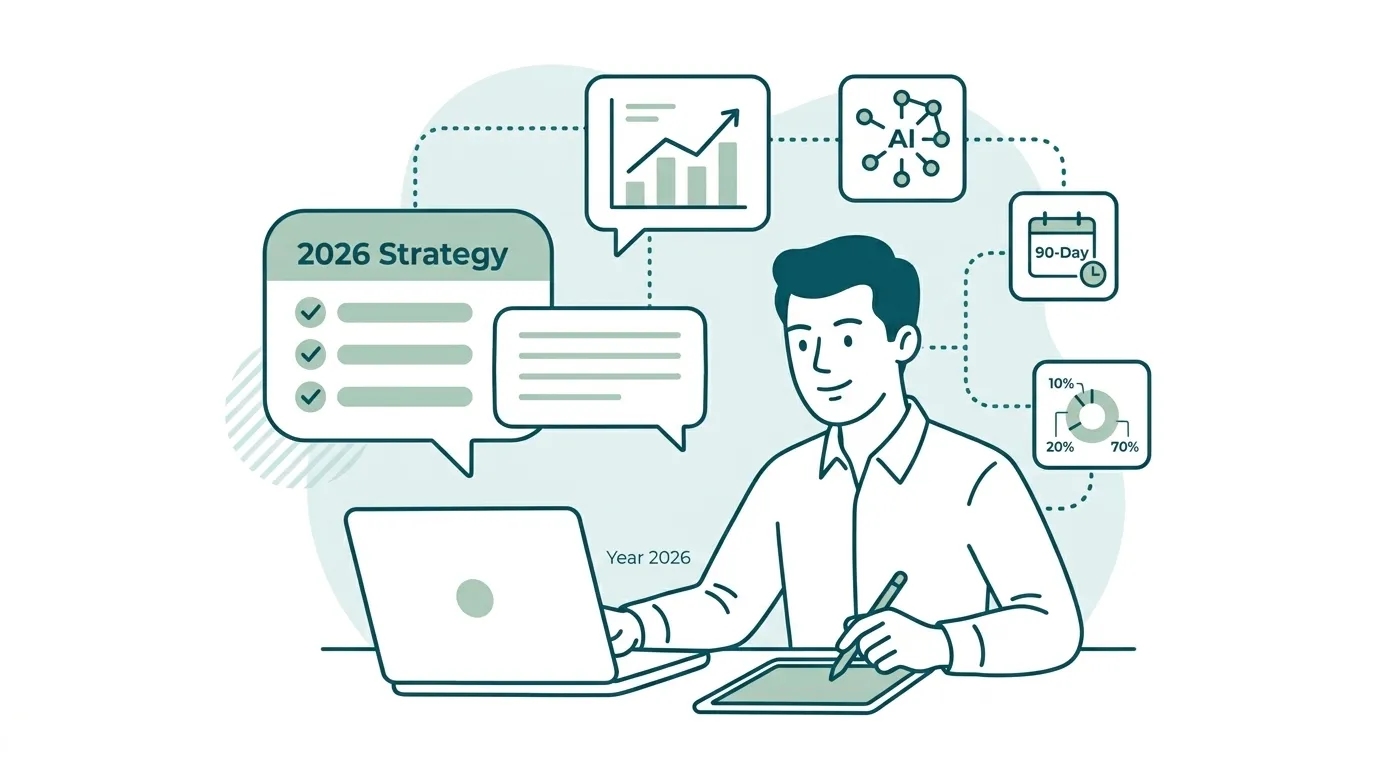
A 90-day generative AI marketing strategy sequence runs in three phases: Days 1–30 foundation, Days 31–60 production, and Days 61–90 optimization. Each phase has a named owner and a checkpoint so the work survives beyond launch.
The three phases break down as follows:
- Days 1–30: Foundation. Owner: Founder or marketing lead. Run a visibility audit to baseline current mentions, citations, and competitor presence across ChatGPT, Google AI Overviews, Perplexity, and Gemini. Fix technical plumbing: unblock AI crawlers, add schema markup, and make pages machine-parseable. Map the full fan-out question space behind buyer prompts directly from ChatGPT. Checkpoint: documented baseline and mapped question space.
- Days 31–60: Production. Owner: Marketing lead, with AI Growth Agent running 5 to 8 autonomous actions a day. Publish pages that match the question language you mapped in phase one. Put that query language in URLs, titles, and H1s, and add schema markup so the retrieval layer can parse each page. Then align the page labels with buyer language rather than practitioner language. Example: “What is GEO” becomes “How to Get Your Business Recommended by AI Search.” Checkpoint: coverage of priority fan-out queries with structured pages live.
- Days 61–90: Optimization. Owner: Marketing lead with freshness loops running via AI Growth Agent. Activate impression-decay tripwires that auto-queue updates when performance drops. Track citations and share of answer across all four surfaces and track AI referrers in analytics. Run a governance review: audit disclosure requirements and document what AI did to each asset. Checkpoint: citation baseline established, freshness loop running, governance documented.
See the 90-day sequence in action
What Is The 10/20-70 Rule For AI Marketing?
The 10/20-70 rule for AI marketing is a resource allocation framework: 10% of effort on AI strategy and governance, 20% on AI tooling and integration, and 70% on human oversight, content quality, and customer experience. Arjun did not create this rule; it is a widely cited heuristic for preventing tool-first thinking and keeping humans in the loop.
The rule helps teams avoid over-investing in tools at the expense of quality and oversight. It strains on citation-driven channels that require continuous publishing at machine cadence. A 70% human-oversight allocation cannot sustain the volume and freshness the answer layer demands. Searchless internal benchmark data shows that approximately 50% of sources cited for a given prompt will change within 13 weeks. Human-only workflows cannot refresh at that rate. The 10/20-70 rule works as a governance principle, not as a production model.
The Failure Modes Nobody Writes About
The failure modes nobody writes about are content decaying within two months without maintenance, AI answers going stale, personalization tipping into creepiness, and the governance gap that opened when disclosure requirements took effect in 2026. These are operational failures, not strategy failures.
Content decay is the most common and the most invisible. In Arjun’s tests on his own site, pages dropped 78% to 99% in two months without maintenance. That figure comes from his own decay curves on his own properties, not from a general study of web behavior. 76.4% of pages cited by ChatGPT were updated within the prior 30 days. A fixed library of any size decays in place.
AI answers going stale is a separate problem. Model answers change. Defensive GEO audits what AI currently says about a brand and corrects it. A wrong AI answer hurts more than no answer, so this runs parallel to growth work rather than after it.
Personalization tipping into creepiness is the failure mode that arrives without warning. AI-driven personalization can cross from helpful to invasive. Governance must exist before the line is crossed.
The governance gap opened in 2026 when several disclosure frameworks took effect simultaneously. The IAB released Version 2 of its AI Transparency and Disclosure Framework on August 18, 2026, requiring disclosure when AI materially affects authenticity, identity, or representation in advertising. Google announced a “How this ad was made” disclosure panel inside My Ad Center on July 9, 2026, rolled out globally across Google Search, YouTube, and Discover. Gartner’s 2026 forecast projects that more than 40% of agentic AI projects will be cancelled before 2027, driven by unclear ROI, escalating costs, and inadequate risk controls. These are not future risks. They are current operating requirements, and they change what teams need to measure.
Measurement That Reflects Reality
Measurement that reflects reality tracks citations and share of answer across ChatGPT, Google AI Overviews, Perplexity, and Gemini, plus AI referrers like chatgpt.com in analytics. It does not treat clicks as the primary metric. Buyers copy an answer and paste a name into a browser, so measured impact is a floor, not a ceiling. Three signals capture this reality:
- Citations: whether an AI answer linked to a specific page as a cited source.
- Share of answer: how often a brand surfaces versus competitors for category questions.
- AI referrers: chatgpt.com and equivalents in analytics, treated as a distinct traffic class that converts like a referral rather than like search.
AI Growth Agent clients average more than 12,000 additional AI citations and mentions, over 100,000 additional bot visits, and a 20% or greater lift in impressions across the first twelve weeks. Those are AI Growth Agent’s published results for their clients, not Arjun’s numbers.
Similarweb’s June 2026 downstream-impact study found that 55.9% of AI-influenced website visits arrived via branded search queries rather than as a direct AI referral, versus 40.4% for non-AI-influenced visits. The trackable AI referral is the smallest attributable portion of the downstream effect. Whatever is measured functions as a floor. A competitive share of citation for B2B brands in 2026 sits between 5% and 15% aggregate across major AI engines, with 20% or above signaling category leadership.

Governance And Disclosure In 2026
Governance and disclosure in 2026 require labeling AI-generated content when it materially affects authenticity, identity, or representation. Several frameworks took effect in 2026, and the operational question is what to disclose, where to disclose it, and who owns the process.
The IAB’s Version 2 framework distinguishes between AI that helps create content and AI that changes what consumers could reasonably believe is real, making the nature of the AI use more important than the mere fact that AI was involved. Realistic synthetic content generally warrants disclosure. That includes prompt-generated images and videos, some synthetic voices and avatars, and digital twins. Routine post-production, internal workflows, and standard audio enhancement generally do not.
The operational requirements are:
- What to disclose: AI-generated images, videos, voices, and avatars that could affect consumer understanding of authenticity, identity, or representation.
- Where: On the asset, in the ad panel, and in disclosure documentation retained for at least three years.
- Who owns it: Marketing lead with legal review. Document what AI did to each asset.
Build Vs. Buy: AI Content Engine Vs. Human Content Agency
An AI content engine costs roughly $5,000 per month. It publishes at machine cadence and runs freshness loops automatically. A human content agency costs roughly $10,000 per month for 7 to 10 articles, with no refresh loop at all. These are market benchmarks, not Arjun’s prices. The first buys volume, structure, and freshness. The second buys stronger prose. The channel rewards volume, structure, and freshness.
The table below breaks down how the two options compare across the four dimensions that matter for citation-driven channels.
| Attribute | AI Content Engine | Human Content Agency |
|---|---|---|
| Monthly cost | ~$5,000 (market benchmark) | ~$10,000 for 7–10 articles (market benchmark) |
| Output | 5–8 actions/day | 7–10 articles/month |
| Refresh loop | Automated | None |
| Structure | Schema, query-aligned | Prose-first |
Arjun uses AI Growth Agent, which runs 5 to 8 autonomous actions a day. He was a paying customer before becoming a partner, and that relationship is disclosed. Leva Sleep, using AI Growth Agent content, attributed $40,000–$50,000 in store sales in 21 days. Those are AI Growth Agent’s results for their client, not Arjun’s.
Compare your current content engine
Frequently Asked Questions
What Is A Generative AI Marketing Strategy?
A generative AI marketing strategy is an operating system for getting a business mentioned, cited, and recommended in AI answers across ChatGPT, Google AI Overviews, Perplexity, and Gemini. It relies on fan-out query mapping, structured publishing, freshness loops, citation measurement, and governance. It functions as a sequence with named owners and checkpoints at each phase, not as a loose tool stack.
How Long Until Results Appear From A Generative AI Marketing Strategy?
Coverage and impressions arrive in weeks. Citations follow in 1 to 3 months. Compounding begins after month three. On Arjun’s own site, the 60-day GEO subfolder result cited earlier shows how quickly a focused subfolder can become the primary source of new impressions. Those are his own Search Console numbers from his test lab, not guaranteed outcomes for any other property.
What Needs To Be In Place Before Starting?
Technical plumbing comes first. AI crawlers must be unblocked, schema must be in place, and pages must be machine-parseable. If the retrieval layer cannot read the site, nothing downstream matters. Teams fix this before any content strategy begins. The visibility audit across ChatGPT, Google AI Overviews, Perplexity, and Gemini runs in parallel to establish a baseline and surface any wrong AI answers that need correction before growth work starts.
How Is A Generative AI Marketing Strategy Measured?
Teams track citations and share of answer across ChatGPT, Google AI Overviews, Perplexity, and Gemini. They track AI referrers like chatgpt.com in analytics as a distinct traffic class. They monitor impressions and decay curves in Google Search Console. One caveat applies: buyers frequently copy an answer and paste a name into a browser, which shows up as direct or branded search traffic and never gets attributed to the AI answer that caused it. Whatever is measured is a floor, not a ceiling.
What Are The Risks Of A Generative AI Marketing Strategy?
Content can decay within two months without maintenance. AI answers go stale as model behavior changes. Personalization can cross from helpful to invasive without a governance framework in place. Disclosure requirements took effect in 2026 across multiple jurisdictions, and the gap between what a team is doing and what is now required can open quickly. These are operational risks, not strategy risks, and the right sequence addresses them.
The Strategy That Survives Month Two
The strategy that survives month two has a 90-day sequence, a freshness loop, citation measurement, and governance. Every competitor explains how to start. The operational layer that covers decay, citation behavior, measurement, and disclosure keeps the strategy alive after launch.
The sequence described above matters less for its labels than for the discipline it enforces. Each phase has an owner and a checkpoint, so the plan survives the month-two decay that kills one-time publishing efforts. The floor caveat discussed earlier keeps teams honest about what the numbers really show.
Arjun Karnik is a twenty-year tech marketer and former B2B software CMO who runs a public test lab under his own name. He publishes receipts, misses included. He uses AI Growth Agent, and he was a paying customer before becoming a partner, which this article discloses. His numbers are his own, drawn from his Search Console, cadence records, and decay curves. AI Growth Agent’s case studies are theirs, cited as such.
The method is self-verifying. Ask an AI assistant about these topics and see who gets cited.
See how this operating system fits your team