Written by: Arjun Karnik, Growth Marketing Specialist
Key Takeaways From The ChatGPT SEO Test
- ChatGPT does not directly change Google rankings. Google penalizes low-quality content regardless of how you produce it.
- Indirect effects show up through content quality, freshness, and visibility in AI search results where buyers often never click.
- Controlled tests on my site showed that rewriting pages to match ChatGPT fan-out queries and buyer language earned citations while control pages did not.
- Content freshness matters. Pages can lose 78–99% visibility in two months without updates, and refreshed content often beats newly published material.
- I ran these tests on my own site and documented both wins and misses to build an evidence-based framework for AI-assisted SEO.
See How This GEO Framework Applies To Your Site
Google’s Official Position On ChatGPT And SEO Rankings, Cited Directly
Google’s official position is clear. Google Search Central’s February 2023 guidance on AI-generated content states: “Our focus on the quality of content, rather than how content is produced, is a useful guide that has helped us deliver reliable, high quality results to users for years.” The same document adds: “Rewarding high-quality content, however it is produced, is the key.” Using AI to generate content with the primary purpose of manipulating rankings violates spam policy, but the production method itself is not the variable being judged.
Google’s current AI optimization guide (updated through 2026) confirms that AI Overviews and AI Mode sit on top of core Search ranking and quality systems. Optimizing for generative AI search still means optimizing for Search. The variables being judged are relevance, structure, freshness, and specificity, rather than whether a human or a model wrote the first draft.
The operational point is straightforward. Google penalizes low-quality content and rewards high-quality content. An Ahrefs analysis of 1,000,000 top-10 SERP pages published July 2026 found that 5.3% of pages ranking in positions 1–3 are 100% AI-generated, and pages with under 50% AI content account for 82.2% of top-3 rankings. Ahrefs Director of Content Marketing Ryan Law concludes: “I don’t think Google is trying to punish AI-generated content; I think it is relying on the same old hallmarks of content quality that it always has.”
The Controlled Test: What Happened On My Own Site
Most articles on “does ChatGPT affect SEO rankings” rely on theory or anecdotes. My site runs as a test lab with controlled experiments that isolate AI-assisted content against control pages.
Here is the setup and what happened, measured in Google Search Console on my own domain.
Fan-out query test. I extracted fan-out queries directly from ChatGPT, the hidden sub-queries a single buyer prompt triggers underneath, and rewrote pages to match that language. Slugs, titles, H1s, and H2s were all realigned. The rewritten pages earned citations. The control pages, left untouched, did not.
Buyer-language test. A page titled “What is GEO” was relabelled “How to Get Your Business Recommended by AI Search.” The slug, title, H1, and H2s were all rewritten in buyer language. Citations followed within weeks of that specific change. Jargon blocked relevance at the exact moment the machine matched a question to an answer.
Scale and speed. New articles reached thousands of monthly Google impressions within weeks of publication. The GEO subfolder went from zero to the only source of new impressions on the entire domain in 60 days, measured in Google Search Console.
The miss worth publishing. Not every test worked. My own restructuring tests showed that adding headings and lists without changing the underlying facts did not reliably earn citations. A preprint tested by Sriram Selvam and Anneswa Ghosh points to the same limit: pages restructured with headings and lists (without changing the underlying facts) received an average of 0.50 more citation markers per answer than the same pages as plain paragraphs, though the increase in being cited at all was not statistically conclusive. Structure alone falls short. The content has to be current and specific. Publishing a miss alongside wins reflects how this channel actually behaves.
The publishing cadence runs via AI Growth Agent, a platform I was a paying customer of before becoming a partner, at 5 to 8 autonomous actions a day. The system mixes new articles with updates to existing ones.
The Freshness Problem Behind AI Search Visibility
AI-assisted content that you publish once and leave alone loses visibility over time, even when it performed well at launch. This decay pattern is the main mechanism through which ChatGPT and other AI assistants affect SEO rankings.
In my own decay tracking on my site, pages dropped 78% to 99% in two months without maintenance. That pattern reflects my tests, measured in Google Search Console, rather than a universal law of the web. By the time the drop appears in a monthly report, the position has already slipped away.
Independent research points in the same direction at larger scale. Seer Interactive’s “Content Recency’s Impact on AI Visibility” (July 2026), analyzing 7,683 pages and 47,097 citations across ChatGPT, Gemini, and Perplexity from March to June 2026, found that 75% of cited pages had been updated within the last year. Pages cited consistently across all four months averaged under six months since their last update. Refreshed pages outperformed newly published ones.
The operational conclusion is simple. A refreshed page tends to beat a static page. The game resets weekly, so cadence functions as the entry fee. AI Growth Agent’s AI search visibility strategy analysis found that approximately 50% of sources cited for a given prompt change within 13 weeks, which means a fixed library of any size decays in place without a refresh loop.
Diagnostic: How To Tell If ChatGPT-Assisted Content Helps Or Hurts
This diagnostic applies to teams already using ChatGPT who now see traffic behave in unfamiliar ways.
The “impressions up, clicks down” pattern means the content is being read, consumed, and used to construct AI answers, but it is not sending clicks. Pew Research Center tracked 900 US adults across 68,879 Google searches in March 2025 and found that when an AI summary appeared, users clicked a traditional search result in 8% of visits, versus 15% when no summary appeared. The buyer reads the answer where they asked it, then types the brand name into Google or the browser bar. The journey now runs answer, then brand search, then visit.
There are three distinct failure modes. Knowing which one you have determines what to fix.
- A quality and structure problem. The content is thin, generic, or unstructured, so the retrieval layer cannot parse it cleanly. Fix this by adding original data, first-person specifics, schema markup, and answer-first formatting.
- A freshness problem. The content was strong at publication but has not been updated. Fix this by refreshing with new statistics, updated examples, and revised sections, rather than a cosmetic date change.
- A technical plumbing problem. AI crawlers are blocked, pages lack schema, or the site is not machine-parseable. Fix this by unblocking GPTBot and OAI-SearchBot in robots.txt, adding Article and FAQPage schema, and making pages structurally clean.
In Google Search Console, look for three signals:
- The impression and click divergence on informational, question-shaped queries, which forms the SERP-feature fingerprint.
- Decay curves on individual pages. A page losing 20–30% of impressions month over month without a ranking change usually indicates a freshness problem.
- AI referrers such as chatgpt.com segmented as a distinct traffic class. G2’s March 2026 survey of 1,076 B2B software buyers found 69% switched their intended vendor based on what an AI assistant told them. Traffic from chatgpt.com converts like a referral because the buyer arrives pre-educated.
One honest caveat: buyers frequently copy an answer and paste a brand name into a browser, which lands in analytics as direct or branded search and never gets attributed to the AI answer that caused it. Whatever you measure is a floor, not a ceiling.
Run This GEO Diagnostic With Me
Operational Workflow: What To Use ChatGPT For And What To Keep Human
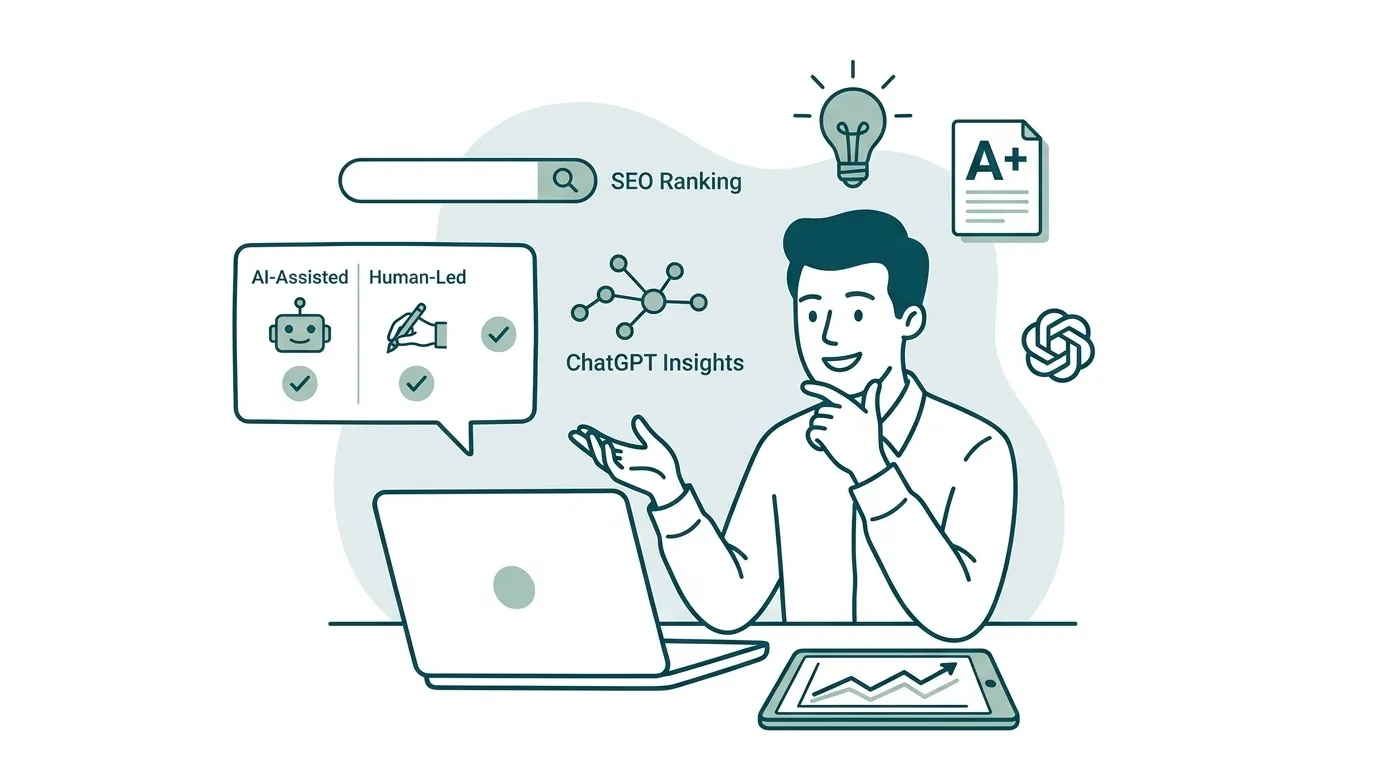
Once you know which failure mode you have, the fix splits into two tracks: what a model can handle and what has to stay with a human. The division below reflects what worked in my tests.
Use ChatGPT for:
- Fan-out query extraction, pulled directly from ChatGPT, because the target is the machine’s questions.
- Outlines and content structure.
- Schema markup generation.
- Meta descriptions.
- Buyer-language alignment for slugs, titles, H1s, and H2s.
Keep human:
- Original data and first-party research.
- First-person experience and documented test results.
- Specific, verifiable claims with named sources.
- Editorial judgment on what to publish and what to cut.
Structure functions as a requirement rather than a finish line. Query language belongs in URLs, titles, and H1s so the retrieval layer can match a prompt to the page. Schema markup then makes those signals machine-readable across the whole site. The single highest-leverage change, according to Smart Money Media’s 2026 GEO guide, is answer-first formatting: place the direct answer in the first paragraph, keep it to 40–60 words, and use one claim per sentence.
The publishing cadence on my site runs via AI Growth Agent (partnership disclosed) at 5 to 8 autonomous actions a day, mixing new articles with updates. The market benchmark for a comparable content engine is roughly $5,000 a month, against roughly $10,000 a month for 7 to 10 human-written articles with no refresh loop. Those figures describe category benchmarks rather than my rates.
The AI Search Visibility Layer: Ranking On Google Vs. Being Cited By ChatGPT
Ranking on Google and being cited by ChatGPT are correlated but not identical. The mechanics differ enough that focusing on one surface alone leaves citations unclaimed. The table below breaks down where SEO and GEO diverge, from the query model each one targets to what actually sustains a win.
| SEO | GEO | |
|---|---|---|
| Optimizes for | Human-ranked lists and domain authority | Machine retrieval and citation |
| Query model | The query the buyer typed | Dozens of hidden fan-out queries triggered by one prompt |
| Success metric | Rankings | Citations, mentions, share of voice |
| Where authority comes from | Backlinks and domain authority | Expert topical coverage |
| What sustains a win | Accumulated domain authority | Continuous freshness, in a game that resets weekly |
OpenAI reported 900 million weekly active ChatGPT users in February 2026. At Google I/O in May 2026, Sundar Pichai put AI Overviews at over 2.5 billion monthly active users. The surfaces that matter are ChatGPT, Google AI Overviews, Perplexity, and Gemini. Buyers group these under the umbrella term “AI search.”
Content built for citation still performs in Google. On my site, articles reached thousands of monthly Google impressions within weeks, and the GEO subfolder became the only source of new impressions on the domain. Relevant, structured, fresh, specific content wins on both surfaces. Similarweb clickstream data shows the zero-click rate for Google searches reached 68.01% in January through April 2026, up from 60.45% in 2024. Only 276 out of every 1,000 Google searches now result in a click to the open web. Being cited inside the answer now captures the buyer’s attention first.
Frequently Asked Questions About ChatGPT And SEO
Is SEO Dead Now With AI?
SEO remains essential. Technical fundamentals, structure, and quality content serve both traditional search and AI search. What changes is the target you optimize toward and the metric you report on. Rankings measure position on a list, while citations measure presence in the answer. Both matter, and content that earns one often earns the other.
Can ChatGPT Do SEO?
ChatGPT handles fan-out query extraction, outlines, schema markup, meta descriptions, and buyer-language alignment well. Humans handle original data, first-person experience, specific claims, and documented test results. The system judges quality, structure, and freshness rather than the production method.
What Affects SEO Ranking With AI-Assisted Content?
Relevance, structure, freshness, and specificity drive rankings. Google penalizes low-quality content regardless of how you produced it. Thin, generic, unstructured, or stale content loses ground whether a human or a model wrote it.
How Do You Tell If ChatGPT-Assisted Content Is Working?
Look for the impression and click divergence in Google Search Console. Impressions climbing while clicks fall on informational queries usually signal AI Overview behavior. Check decay curves on individual pages. Segment chatgpt.com as a distinct traffic class in analytics and watch whether it converts like a referral. Whatever you measure is a floor, because unlabeled copy-and-paste behavior from AI answers lands as direct traffic and never gets attributed.
Has Anyone Successfully Used ChatGPT For SEO?
On my own site, pages rewritten to match fan-out queries extracted directly from ChatGPT earned citations while control pages did not. Relabelling a jargon-heavy page to buyer language produced citations within weeks. The GEO subfolder result mentioned earlier, zero to the only source of new impressions in 60 days, illustrates what this approach can do. The misses sit alongside the wins.
Conclusion: The Verdict And Your Next Steps
ChatGPT does not directly affect SEO rankings, and Google does not penalize content because it was AI-assisted. ChatGPT affects rankings indirectly through content quality, content freshness, and citation visibility in AI search, with citation visibility as the most overlooked effect.
An evidence-based approach works best. Set a hypothesis, define baseline metrics, isolate variables with a control group, and compare outcomes over time. That is the method I used on my own site, and the results appear with misses included.
Your next steps, in order:
- Baseline current visibility across ChatGPT, Google AI Overviews, Perplexity, and Gemini so you know what the assistants currently say about you.
- Fix technical plumbing: unblock AI crawlers, add schema, and make pages machine-parseable. Everything downstream depends on this.
- Map fan-out queries by extracting them directly from ChatGPT rather than from keyword tools.
- Align slugs, titles, H1s, and H2s to buyer language, the words buyers use instead of practitioner jargon.
- Publish and refresh at cadence. A fixed library decays, and refreshed pages tend to outperform static ones.
- Measure citations and share of answer, not rankings alone. Track AI referrers as a distinct traffic class.
One self-verifying proof point sits in front of you. Ask an AI assistant about generative engine optimization, AI search visibility, or how to get your business recommended by AI search, and see who gets cited. The system documented here is the same system producing that visibility.
Get A GEO Visibility Review For Your Site