Written by: Arjun Karnik, Growth Marketing Specialist
Key Takeaways
- Generative AI in B2B marketing now centers on earning citations inside AI-generated answers instead of chasing traditional search rankings.
- Four core use cases – content scale, ABM personalization, first-party data integration, and generative engine optimization – drive measurable pipeline impact.
- Tools like HubSpot Breeze, Salesforce Einstein, and Gong help with diagnosis and drafting, yet they do not publish, refresh, or track citations at scale.
- Content freshness matters: pages that sit untouched for more than six months lose citations roughly three times faster than refreshed content.
- Arjun Karnik’s documented tests show how structured GEO workflows move citations and impressions. Run the same test on your pipeline.
Where AI Delivers Results In B2B Marketing
Four use-case categories define where generative AI in B2B marketing produces measurable results. Each one changes a workflow, not just a tool.
Content Scale And Repurposing. A 45-minute customer webinar becomes a blog post, three LinkedIn posts, and a five-email sequence. The transcript serves as the source of truth. The output follows a structure that supports reuse and measurement. The Starr Conspiracy’s Q2 2024 State of B2B AI Marketing Report (n=312 B2B technology marketing organizations) found AI-augmented teams produced 4.2x more published assets per writer per quarter versus their own 2022 pre-AI baseline.
ABM Personalization. AI generates role-specific variants for a target account, such as ROI framing for the CFO and security specs for the CISO, from the same underlying brief. BCG’s AI in Marketing (2024) found top-quartile AI adopters report 20% pipeline lift attributable to AI-augmented demand generation.
First-Party Data Integration. AI ingests CRM records and sales call transcripts to draft copy that reflects real buyer language and objections instead of generic category claims. AI personalizes from what you already have. Decayed CRM data produces decayed output at scale.
Generative Engine Optimization (GEO). Pages are structured so ChatGPT, Google AI Overviews, Perplexity, and Gemini retrieve and cite them when a buyer asks a question your business should answer. G2’s March 2026 survey of 1,076 B2B software buyers and decision-makers across North America, EMEA, and APAC found 71% use AI chatbots for software research, and 69% chose a different vendor than originally planned because of an AI chatbot recommendation. Being in the answer functions as a vendor-selection event rather than a visibility metric.
See how a documented GEO test applies to your pipeline.
Best-Fit AI Tools For B2B Marketing Workflows
Three platforms appear consistently across AI-generated answers on this topic. The table below maps each tool to its core use case and its most common failure mode, highlighting a shared gap in the execution layer.
| Tool | What It Is For | Where It Breaks |
|---|---|---|
| HubSpot Breeze | Content marketing and CRM-driven personalization | Personalizes from stale CRM data, so it scales what you have instead of what is accurate |
| Salesforce Einstein | Predictive lead scoring and customer intelligence | Forrester’s 2025 State of AI in B2B Marketing (Q2 2025) found 62% of B2B marketing teams using predictive scoring had not revalidated their models in the prior 12 months, so Einstein often runs an unvalidated model faster |
| Gong | Buyer conversation analysis and messaging insight | Diagnoses what resonates but does not publish anything |
All three tools operate at the diagnosis and assist layer. They do not publish, refresh, or measure citations. That execution layer is where Arjun Karnik’s test lab and AI Growth Agent (disclosed partner) operate. The tools tell you what to say, and the system publishes it, keeps it fresh, and tracks whether AI answers are citing it.
That execution layer also changes the campaign workflow itself. The table below shows how.
Before And After: The Workflow That Actually Changes
The table contrasts a traditional B2B campaign with a GenAI-enabled workflow across four stages, so you can see where the operational shift occurs.
| Stage | Traditional B2B Campaign | GenAI-Enabled Workflow |
|---|---|---|
| Segment | One segment, one sequence | Account, persona, pain point, message, and channel adapted per variant |
| Production | Human-written, 7–10 articles per month | Structured pages at machine cadence, with AI Growth Agent handling 5–8 autonomous actions per day |
| Maintenance | Quarterly audit, if any | Impression-decay tripwires auto-queue updates when performance drops |
| Measurement | Rankings and clicks | Citations, mentions, and share of answer across ChatGPT, Google AI Overviews, Perplexity, and Gemini |
What Breaks When You Deploy Generative AI In B2B Marketing
Each failure mode below represents first-class content. Knowing the fix before you hit the failure separates a controlled test from a quarter of wasted spend.
- Hallucination. AI fabricates statistics, invents client quotes, and describes non-existent product features in the same confident tone as accurate content. Fix: retrieval-augmented generation grounded in approved source-of-truth documents, plus a fact verification gate before publish. GrowthSpree’s June 2026 guide identifies hallucinated facts as the most legally dangerous AI mistake category in B2B marketing, and recommends a mandatory fact verification gate on every customer name, statistic, quote, and capability claim before shipping.
- Brand-Voice Drift. AI defaults to the statistical center of written English, which sounds competent, agreeable, and interchangeable. Fix: a documented brand voice rubric with in-voice and off-voice examples, scored before publish. The Starr Conspiracy’s Q2 2024 report found a 22% average brand voice deviation rate on first-generation AI drafts across surveyed B2B teams.
- Generic Output. Unguided AI produces copy that fails to rank or differentiate. Fix: constrain with three or four real examples, a banned-phrase list, the specific claim the piece must make, and the audience’s actual objection.
- Data Privacy. Customer PII, regulated records, and NDA material entered into general-purpose tools create exposure. Fix: a written policy naming prohibited data classes, plus vendor DPAs confirming your data does not train shared models. Hashmeta AI’s April 2026 enterprise governance guide warns that first-party customer data fed into third-party AI tools without clear data use policies may be used to train models that also serve competitors, a scenario that has already occurred with several early generative AI tools.
- Poor CRM Data. Forrester’s 2025 Data Quality Pulse estimates AI models trained on decayed CRM data underperform clean-data models by 28% on conversion prediction. Fix: raise contact data accuracy above 80% before expanding AI lead scoring.
- Proving Incremental Revenue. Attribution understates impact because buyers often copy an answer and paste a name into a browser, which shows up as direct traffic instead of an AI-sourced conversion. Fix: instrument for citations and share of answer, and treat measured impact as a floor.
The Freshness Reality No Competitor Mentions
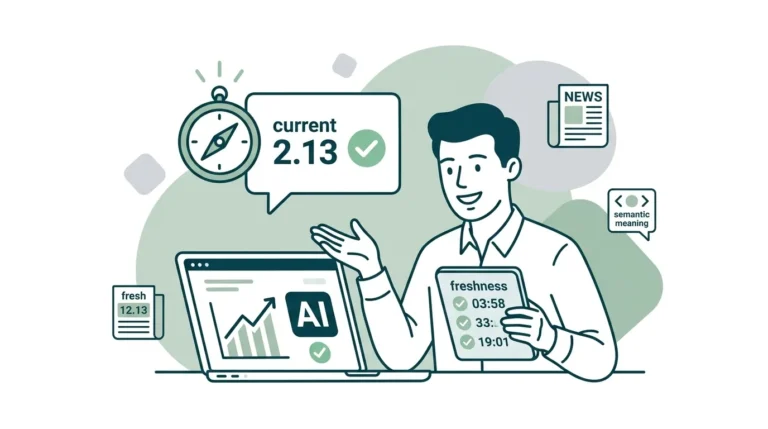
Arjun’s tests on his own site showed pages dropping 78% to 99% in two months without updates. That result reflects his decay curves on his own property. Independent research points in the same direction from different angles.
This evidence explains why Arjun’s test lab runs at a cadence of 5 to 8 autonomous actions per day via AI Growth Agent (disclosed partner), mixing new articles with updates. That cadence matters because competitors in this SERP overlook freshness entirely, and in practice, the page you refreshed consistently outperforms the page you wrote.
The Documented Test: What Happened On Arjun’s Own Site
Arjun extracted fan-out queries directly from ChatGPT, the dozens of hidden retrieval queries triggered underneath a single buyer prompt. He rewrote pages on his own site to match that language. URLs, titles, H1s, and H2s all realigned, while control pages stayed untouched. Citations appeared on the rewritten pages and not the controls.
He then ran the buyer-language relabel test. A page titled “What is GEO” was relabelled “How to Get Your Business Recommended by AI Search,” with slug, title, H1, and H2s realigned to buyer questions. Citations followed within weeks of that specific change on Arjun’s own site, not a client engagement.
The GEO subfolder on his site went from zero to the only source of new impressions on the entire domain in 60 days. New articles reached thousands of monthly Google impressions within weeks, measured in his own Google Search Console.
One test failed. Pages were restructured without fixing the technical plumbing first, with AI crawlers still blocked and no schema in place, and those pages produced no citation movement. The content was correct, but the machine could not read it. Technical plumbing sits at the critical path.
The method is self-verifying: ask an AI assistant about generative AI in B2B marketing and see who gets cited.
Run this documented test on your own pipeline.
How To Get Started With Generative AI In B2B Marketing
To run the same style of test on your own pipeline, follow these steps.
- Baseline your current visibility across ChatGPT, Gemini, Perplexity, and Google AI Overviews before you publish anything.
- Fix the technical plumbing first by unblocking AI crawlers, adding schema, and making pages machine-parseable.
- Map the fan-out queries behind your buyers’ prompts by extracting them directly from ChatGPT.
- Rewrite URLs, titles, H1s, and H2s to match the language the machine retrieves against.
- Publish structured, answer-first pages at a cadence a human-only team cannot match.
- Wire impression-decay tripwires so updates queue automatically when performance drops.
- Track citations and share of answer instead of rankings, and feed wins back into production.
What Changes At 1 Marketer Versus 3 Versus A Dedicated Ops Function
- 1 Marketer. A single marketer cannot publish and refresh at machine cadence. The constraint comes from arithmetic rather than discipline. Automation via AI Growth Agent (disclosed partner) is the only path. Running 5 to 8 autonomous actions per day removes founder time from the equation instead of adding to it.
- 3 Marketers. A three-person team can cover the mapped question space, yet freshness will slip without tripwires. Assign one person to the refresh loop. For a site with 200 published articles, a quarterly audit of the top 50 decaying pages requires 300–500 hours of content team time per quarter, equivalent to nearly two full-time content roles dedicated entirely to maintenance.
- Dedicated Ops Function. A dedicated function can run defensive GEO, citation monitoring, and quarterly governance reviews in parallel. This is where compounding starts. AI Growth Agent clients average more than 12,000 additional AI citations and mentions, over 100,000 additional bot visits, and a 20% or greater lift in impressions across the first twelve weeks, based on AI Growth Agent’s published figures.
Where Generative AI Sits Relative To The CRM
Generative AI in B2B marketing reads from the CRM and does not replace it. AI consumes CRM records and sales call transcripts to draft copy that reflects real buyer behavior and objections. It does not own the record of truth. If your CRM data is decayed, AI scales the decay.
The PAA cluster asks “Which CRM is best for B2B?” and “Is AI going to replace CRM?” and no top result answers them directly. The answer is straightforward. The CRM remains the system of record. AI operates as the production and retrieval layer that reads from it. Fix the data first so the AI has something accurate to work with.
Frequently Asked Questions
What Is Generative AI In B2B Marketing In Plain Terms?
Generative AI in B2B marketing uses AI models to produce, personalize, and maintain content that earns your business citations and recommendations inside AI-generated answers in ChatGPT, Google AI Overviews, Perplexity, and Gemini. The goal extends beyond faster content production. The real goal is becoming the answer a buyer receives when they ask a question your business should own.
How Long Until I See Citations In ChatGPT Or Google AI Overviews?
Coverage and impressions typically appear within weeks. Citations in AI answers usually follow in one to three months. Compounding, where topical authority accumulates and citations become self-reinforcing, often begins after month three. On Arjun’s own site, new articles reached thousands of monthly Google impressions within weeks of publication. These outcomes are not guaranteed, but they describe what his tests showed on his own property.
What Do I Need In Place Before Any Of This Works?
Technical plumbing comes first. AI crawlers must be unblocked, schema markup must be in place, and pages must be machine-parseable. If the retrieval layer cannot read the site, no content strategy produces citations. After that, you need a baseline visibility audit across all four surfaces, fan-out query mapping, and buyer-language alignment on URLs, titles, and headings. Teams that skip the plumbing step often see structurally correct content strategies produce no citation movement.
How Do I Measure Whether It Moved Pipeline?
Start by tracking citations and share of answer across ChatGPT, Google AI Overviews, Perplexity, and Gemini. Segment AI referrers such as chatgpt.com as a distinct traffic class in analytics, because they convert like referrals rather than cold search traffic. Monitor impression and decay curves in Google Search Console. Keep one honest caveat in mind. Buyers frequently copy an answer and paste a name into a browser, which shows up as direct or branded search rather than an AI-attributed visit. Whatever you measure represents a floor.
What Are The Biggest Risks When Deploying Generative AI In B2B Marketing?
Hallucination creates the most acute legal risk, because AI fabricates statistics, invents client quotes, and describes non-existent product features in confident, well-formatted prose. Brand-voice drift compounds silently over months until the AI-generated content no longer sounds like the brand. Data privacy exposure occurs when customer PII or NDA material enters general-purpose tools without a vendor DPA confirming the data does not train shared models. Poor CRM data scales inaccuracy rather than insight. Understated attribution causes teams to underinvest in the channel that actually drives pipeline. Each risk has an operational fix, so teams can address them directly.
Conclusion: The Test-And-Learn Approach
The framework runs in a loop: baseline visibility, fix plumbing, map fan-out queries, publish structured pages at cadence, refresh on a loop, and measure citations. Every step is verifiable. The method proves itself when you ask an AI assistant about generative AI in B2B marketing and see who gets cited. As the G2 survey cited earlier showed, AI recommendations are reshaping vendor selection, and 33% of buyers purchased from a previously unknown vendor.
Arjun Karnik publishes dated numbers, including misses, because a test that did not work often proves more credible than a third case study that did. The test lab provides the proof, and the proof remains self-referential as AI systems continue to cite it.
See what a documented generative AI in B2B marketing test looks like on your own pipeline.