Written by: Arjun Karnik, Growth Marketing Specialist
Key Takeaways
- Content libraries lose AI performance through three main failure modes: discovery, readiness, and decay.
- Discovery failure happens when AI search changes how buyers find content and ranking-focused strategies fall behind.
- Readiness failure happens when content lacks schema, metadata, and machine-parseable structure for AI retrieval systems.
- Decay failure happens when content goes stale, with pages losing most of their visibility without regular updates.
- This framework helps you identify which failure mode affects your library and gives you a clear fix sequence.
Run A Visibility Audit With Arjun Karnik
The Three Failure Modes And How To Route Your Fixes
Discovery failure: AI search changed how buyers find content. The library was built for ranked lists, not machine retrieval. G2’s March 2026 survey of 1,076 B2B software buyers found that 51% now start their research with an AI chatbot more often than with Google, up from 29% in April 2025. Buyers ask assistants questions and get one answer. Your content either appears in that answer or stays invisible.

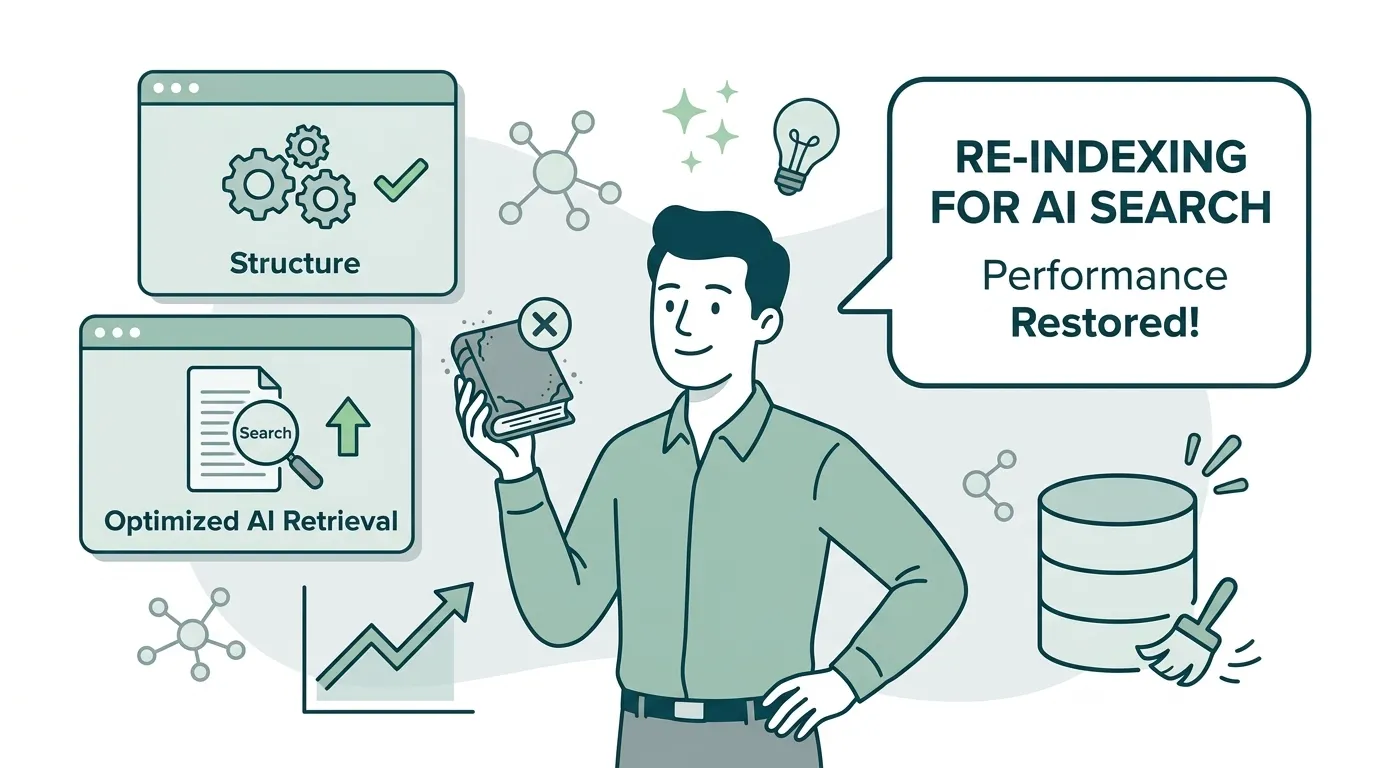
Readiness failure: The library is not AI-ready. It lacks schema and metadata, its pages are not machine-parseable, and its content is not chunked for retrieval. RAG pipelines split content into chunks of typically 200–500 tokens; if a key answer is spread across three paragraphs separated by transitions, no single chunk contains the complete answer and retrieval fails silently. The retrieval layer cannot reliably read what you built.
Decay failure: The library loses performance when nothing changes because nothing refreshes it. In Arjun’s tests on his own site, pages lost most of their visibility within two months without maintenance. Searchless internal benchmark data shows that approximately 50% of sources cited for a given prompt will change within 13 weeks.
Use this routing table to match what you see in your analytics to the most likely failure mode, then start with the suggested first fix.
| Symptom | Likely Failure Mode | First Fix |
|---|---|---|
| Impressions up, clicks down | Discovery | Track citations and share of answer instead of rankings |
| My competitor shows up in ChatGPT and I do not | Readiness | Unblock AI crawlers, add schema, make pages machine-parseable |
| AI answers ignore my brand or product name | Readiness | Map fan-out queries and align content to buyer language |
| Performance drops as the library grows | Decay | Wire impression-decay tripwires and refresh on a loop |
Diagnose Your Library’s Failure Mode
Why AI Loses Track Of Context In Your Content Library
Use these diagnostic questions to see where your library breaks for AI retrieval.
- Are your assets unstructured? AI retrieval systems chunk content into 200–500 token segments. When a key answer is scattered across several transitional paragraphs, no single chunk holds the full answer and retrieval fails quietly.
- Is metadata missing? Without schema markup declaring content type, authorship, and publication context, AI systems must infer meaning from raw text. With schema in place, retrieval models can filter, classify, and score content before synthesis.
- Is bloat and duplication degrading retrieval? When AI retrieves conflicting versions of the same information, it either hedges unhelpfully or selects one version without flagging the discrepancy. Redundant chunks in the index slow retrieval and weaken answers.
- Are AI crawlers blocked? When the retrieval layer cannot read your site, every downstream tactic fails. This blocker appears often and rarely shows obvious symptoms.
On “Why is AI so slow now”: Bloat and duplication usually sit at the root. When a library accumulates thin pages and near-duplicate content, retrieval systems spend more compute filtering noise before surfacing signal. The Semrush AI Visibility Study found that AI citations change 40 to 60% month over month. High volume without structure accelerates that churn against you.
The Decay Problem: Why Libraries Lose Performance Over Time
A content library loses performance over time when nothing refreshes it.

In Arjun’s tests on his own site, pages lost most of their visibility within two months without maintenance. These results come from his test lab on his own property. They describe his measured decay curves rather than a universal rule for the web.
Independent research points in the same direction. 76.4% of pages cited by ChatGPT were updated within the prior 30 days. Seer Interactive’s July 2026 study analyzed 7,683 pages and 47,097 citations across ChatGPT, Gemini, and Perplexity from March to June 2026. It found that 75% of cited pages had been updated within the last year, and consistently cited pages averaged under six months since their last update.

The practical takeaway: the page you refresh usually beats the page you only wrote once.
Scrunch and Stacker’s survival-curve analysis of 3.5 million citation events found the median AI citation half-life is 4.5 weeks. Half of a cohort’s citations fall out of AI answers within that window. A library that publishes once and stops refreshing behaves like a depreciating asset.
The Bloat Problem: How AI-Generated Content Dilutes Retrieval
Google uses the word “slop” for mass-produced low-value content, and AI retrieval systems experience a similar effect.
AI-generated content dilutes retrieval through three main pathways:
- Duplication: When multiple pages answer the same question with slight variations, retrieval systems struggle to identify the authoritative version. Databricks recommends using locality-sensitive hashing to identify and eliminate duplicate or near-duplicate documents because redundant chunks in the final index decrease application performance.
- Thin pages: Content that lacks substance gives retrieval systems little to extract. Graphite measured that 86% of articles ranking in Google and 82% of articles cited by ChatGPT and Perplexity were human-written, which shows that synthetic publishing volume does not automatically translate into retrieval dominance.
- Volume without structure: Publishing 100 unstructured pages rarely outperforms publishing 10 structured ones. AI-generated answers now drive discovery, making domain-wide keyword research essential for brand visibility in 2026, yet volume alone cannot solve retrieval. Volume needs structure, mapped questions, and maintenance to work.
What AI Retrieval Actually Needs From Your Library
AI retrieval systems depend on a specific content structure that most libraries still lack.
Chunking: Effective content chunking uses semantic boundary splitting: break content at heading, paragraph, and topic boundaries. Each chunk should contain one complete idea in 200–500 tokens, carry its heading context as a prefix, and overlap adjacent chunks by 50–100 tokens to preserve context across boundaries. Paragraphs that open with “This” or “Additionally” depend on earlier context and often fail retrieval.
Metadata: For AI retrieval, metadata such as ownership, creation date, sensitivity classification, and data domain attaches to each retrievable chunk and enables filtered and governed retrieval. Without this layer, the system has no reliable basis for ranking relevance or filtering by recency or authority.
Schema markup: Schema.org structured data serves as the metadata API layer for RAG-ready content and explicitly declares content type (FAQ, HowTo, Article), entity relationships, authorship, and publication context. With schema in place, retrieval models can filter, classify, and score content before synthesis, which reduces hallucination and improves citation accuracy.
Fan-out queries: A single buyer prompt triggers dozens of hidden retrieval queries underneath. The answer comes from what those queries return. Focusing only on the visible prompt ignores the surface that actually drives retrieval.
In a documented test on Arjun’s site, pages rewritten to match extracted ChatGPT fan-out queries earned citations while control pages did not. In a separate test, relabelling a jargon-heavy page (“What is GEO”) to buyer language (“How to Get Your Business Recommended by AI Search”), and realigning slug, title, H1, and H2s, produced citations within weeks.
Structure Your Library For AI Retrieval
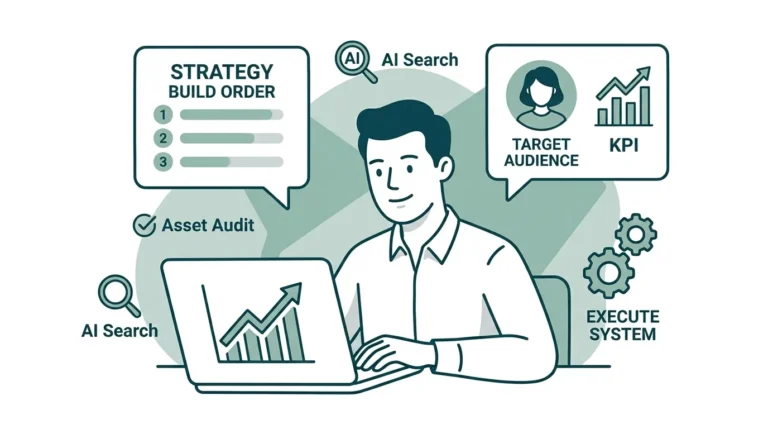
The Fix Sequence: Five Steps In Order
You improve AI performance fastest when you follow a clear sequence instead of applying fixes at random.
- Technical plumbing. Unblock AI crawlers, add schema, and make pages machine-parseable so the retrieval layer can read your site.
- Fan-out query mapping. Extract the full question space behind buyer prompts directly from ChatGPT and treat that list as your production queue.
- Structured publishing at cadence. Publish pages that match mapped question language. Put query language in URLs, titles, and H1s, and apply schema consistently. The reference cadence is 5 to 8 autonomous actions a day via AI Growth Agent, mixing new articles with updates. Arjun uses AI Growth Agent and discloses the partnership.
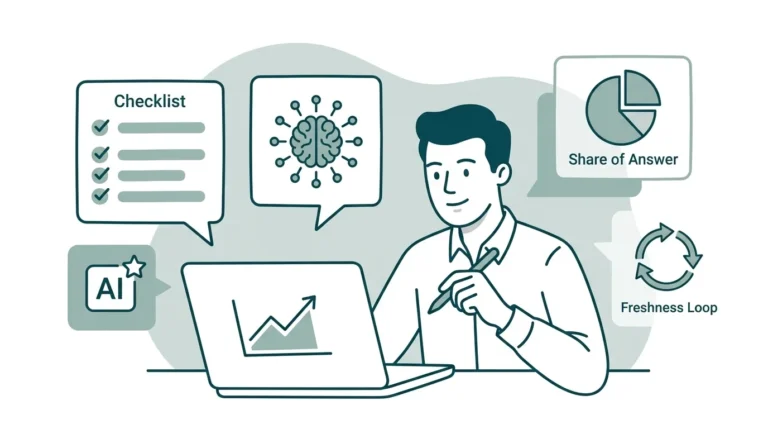
- The freshness loop. Wire impression-decay tripwires that auto-queue updates when performance drops so the library keeps its visibility.
- Citation measurement. Track citations, mentions, and share of answer across ChatGPT, Google AI Overviews, Perplexity, and Gemini.
How To Measure Whether Your Fixes Work
Measurement shifts from rankings to citations, mentions, and share of answer.

- Track across all four surfaces: ChatGPT, Google AI Overviews, Perplexity, and Gemini.
- Include AI referrers in analytics: Segment chatgpt.com and similar domains as a distinct traffic class. AI Growth Agent clients average more than 12,000 additional AI citations and mentions, over 100,000 additional bot visits, and a 20% or greater lift in impressions across the first twelve weeks. These visits behave more like referrals than traditional search.
- Monitor impressions and decay curves in Google Search Console. The scissors chart, where impressions rise while clicks fall, acts as an early warning system.
Buyers often copy an answer and paste a brand name into a browser, which appears as direct traffic and never receives proper attribution. Pew Research Center’s July 2025 study tracked 900 US adults across 68,879 Google searches in March 2025 and found an 8% click rate when an AI summary appears versus 15% without. Treat whatever you can measure as a conservative baseline.

Frequently Asked Questions
Is This Just SEO With A New Name?
The target changed. SEO focuses on rankings on a human-readable list. GEO focuses on citation inside a machine-generated answer. Retrieval mechanics, success metrics, and authority models all shift. SEO earns authority through backlinks and domain authority, while GEO earns it through topical coverage and structured answers to fan-out queries. Content built for citation still performs in traditional search, yet the optimization target and reporting metric differ.
How Do I Even Measure This?
Track share of answer across ChatGPT, Google AI Overviews, Perplexity, and Gemini. Add AI referrers such as chatgpt.com as their own segment in analytics. Watch impressions and decay curves in Search Console. The key move is grading performance on citations and share of answer instead of relying only on rankings.
How Long Until I See Something?
Most teams see coverage and impressions within weeks, citations within one to three months, and compounding effects after month three. Results vary by domain strength, competition, and how quickly you implement the full fix sequence.
What Do I Need In Place Before Any Of This Works?
You need technical plumbing first. AI crawlers must reach the site, schema must exist, and pages must be machine-parseable. A page ranking number one for a target keyword can have a zero percent citation rate in AI responses if the content is not chunked, tagged, and structured for retrieval.
What If AI Is Already Saying Wrong Things About My Business?
Defensive work comes first. A wrong AI answer hurts more than no answer. Defensive GEO audits what assistants currently say across ChatGPT, Gemini, Perplexity, and Google AI Overviews and then corrects the record. Growth work can run in parallel once the core facts stay accurate.
Conclusion: Three Failure Modes, One Ordered Fix Sequence
“Content library losing performance in AI search” usually means discovery failure, readiness failure, or decay failure. Each mode needs a different starting point.
The fix sequence runs in this order: technical plumbing, fan-out query mapping, structured publishing at cadence, freshness loop, and citation measurement.
Measurement shifts from rankings to citations, mentions, and share of answer across AI surfaces.
Plan Your Five-Step AI Visibility Fix