Written by: Arjun Karnik, Growth Marketing Specialist
Key Takeaways For Consultants
- AI visibility for consultants replaces a portion of the referral channel by deciding whether ChatGPT, Google AI Overviews, Perplexity, and Gemini name you when buyers ask who to hire.
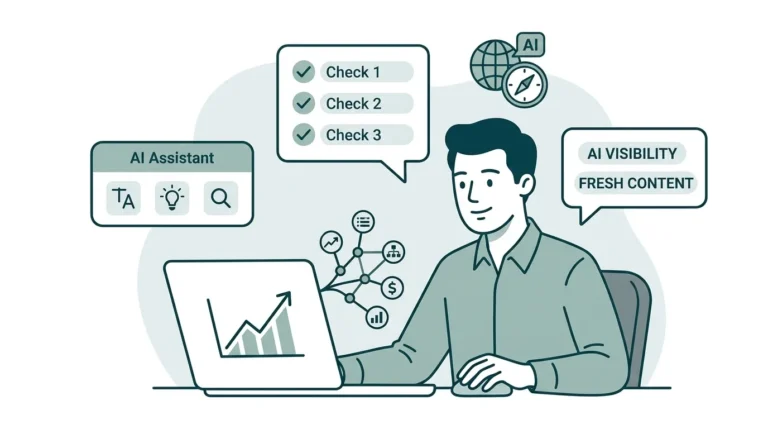
- Four mechanics drive AI citation: entity clarity, fan-out query coverage, third-party citations, and continuous freshness across all four AI surfaces.
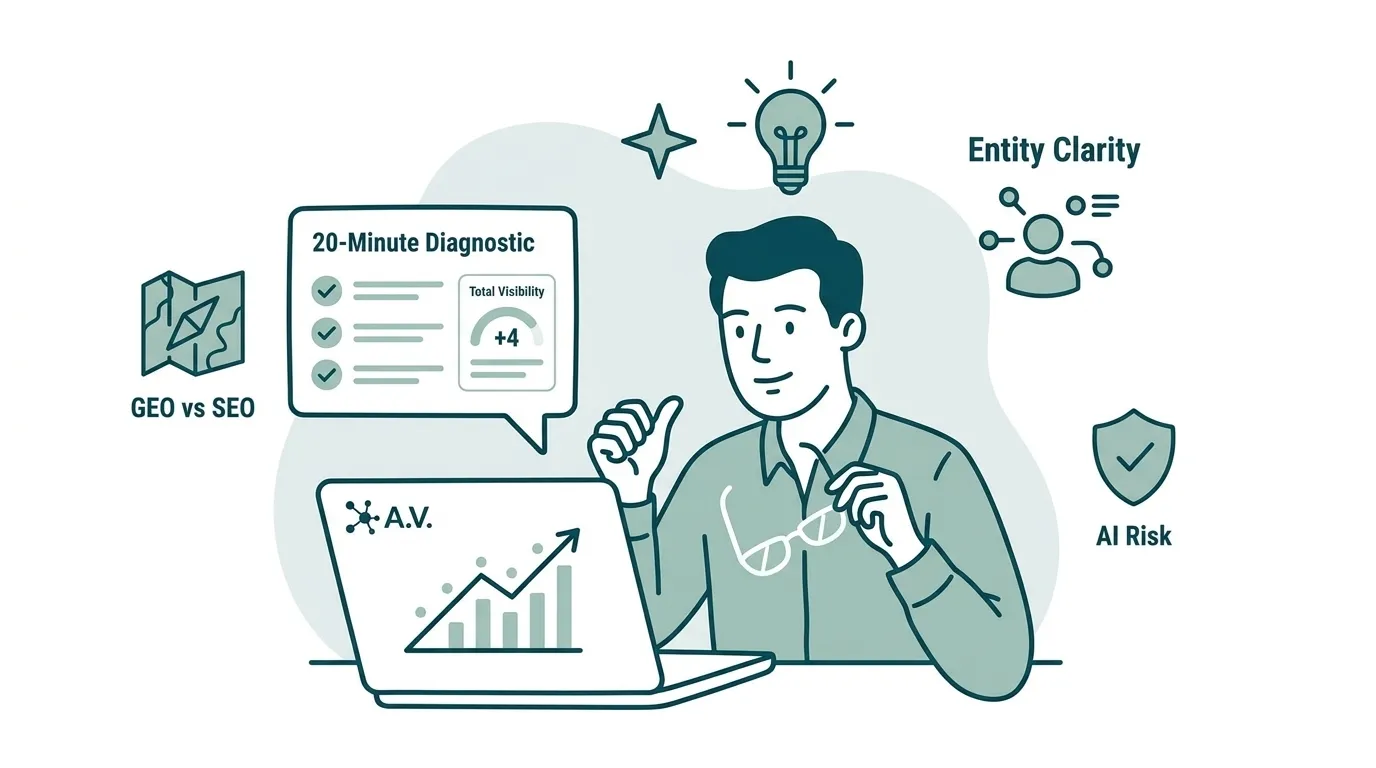
- The 20-minute self-diagnostic reveals your baseline by testing the five questions your best clients ask before hiring you across ChatGPT, Gemini, Perplexity, and Google AI Overviews.
- AI removes undifferentiated generalists and amplifies specialists who maintain clear entity signals, fan-out coverage, third-party mentions, and fresh content.
- See where your consulting business stands across all four AI surfaces today.
What AI Visibility Means For Consultants
AI visibility for consultants means an AI assistant names you when a buyer asks the questions your best clients ask before hiring you. When the buyer types a prompt, the assistant assembles an answer from dozens of retrieved sources. Because the buyer only sees that answer, you are either in it or you are invisible, and there is no second page to appear on.
The scale of this surface is material. G2’s March 2026 survey polled 1,076 B2B software buyers and decision-makers across North America, EMEA, and APAC. It found that 69% switched their intended vendor based on what an AI assistant told them, and 33% bought from a vendor they had never previously heard of. Being in the answer functions as a vendor-selection event, not a soft visibility metric.

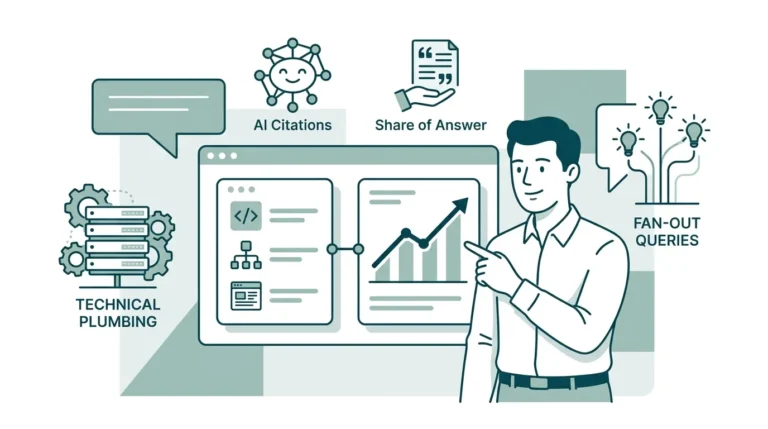
Four mechanics decide whether a consultant is named in an AI answer:
- Entity clarity. The machine must know unambiguously who you are, what you specialize in, who you serve, and what outcome you deliver, expressed in buyer language rather than industry jargon.
- Fan-out query coverage. A single buyer prompt triggers dozens of hidden retrieval queries underneath. You need presence across that full question space, beyond the visible prompt.
- Third-party citations. An Ahrefs study of 75,000 brands found brand web mentions correlate at 0.664 with ChatGPT citation likelihood, compared to only 0.218 for backlinks. Independent corroboration such as reviews, publications, and directories tells the machine your claims hold up beyond your own site.
- Freshness. The Semrush AI Visibility Study found that AI citations change 40 to 60% month over month. A page you wrote and left untouched quickly falls out of the answer set.
The four surfaces that matter most for consultants are ChatGPT, Google AI Overviews, Perplexity, and Gemini. Each retrieves differently. According to Profound’s analysis of 680 million citations, only about 11% of cited domains overlap between ChatGPT and Perplexity, though other studies using different methodologies report figures ranging from roughly 7% to 12%. Work that improves visibility on one surface does not automatically transfer to another.

See where you stand across all four AI surfaces
The 20-Minute Self-Diagnostic For Consultants
This 20-minute diagnostic shows what AI currently says about you and who receives the mention instead. Ask ChatGPT, Gemini, Perplexity, and Google AI Overviews the five questions your best clients ask before hiring you, then record whether your name appears, whose name appears instead, and in what context.
The diagnostic steps:
- Write down five buyer questions. Capture the questions a prospect asks before engaging you, using their language rather than your service names. Examples: “who are the best ops consultants for a Series B SaaS company,” “how do I fix my sales process before a Series A,” “fractional CFO for a bootstrapped software company.”
- Run each question on ChatGPT. Record every name cited. Note whether your name appears, and if not, whose does.
- Run the same questions on Perplexity. Record the inline citations. Note which domains are cited and whether any are yours.
- Run the same questions on Google AI Overviews. Note whether an AI summary appears, which sources it cites, and whether your site is among them.
- Run the same questions on Gemini. Record names and sources cited.
- Tally the results. Count how many of the 20 prompt-surface combinations (5 questions × 4 surfaces) return your name. Most consultants see a baseline between zero and two. That number becomes your starting point.
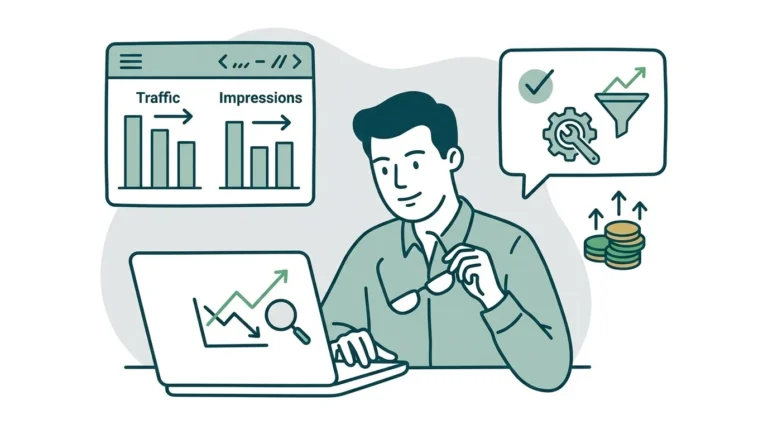
Consultants describe this result with phrases like “my competitor shows up in ChatGPT and I do not,” “why does AI ignore my business,” and “impressions up, clicks down.” All three phrases describe the same gap. The diagnostic turns that gap into a measurable number instead of an anecdote.

Visiby’s June 2026 benchmark, based on 2,443 prompt-runs across 172 real buyer prompts, found that the same brand’s citation rate diverged by up to 24 percentage points depending on the engine measured. Running the diagnostic across all four surfaces, rather than just one, gives you an accurate picture of your current position.
Why GEO For Consultants Differs From SEO
SEO focuses on rankings on a human-readable list. AI visibility for consultants focuses on citation inside a machine-generated answer. The retrieval mechanics, the success metric, and the authority model follow different rules.
The table below highlights four dimensions where SEO and generative engine optimization diverge: query model, authority source, success metric, and what sustains a win.
| Dimension | SEO | Generative Engine Optimization (GEO) |
|---|---|---|
| Query model | The visible prompt the buyer typed | Dozens of hidden fan-out queries triggered by one prompt |
| Where authority comes from | Backlinks and domain authority | Expert topical coverage and third-party mentions |
| Success metric | Rankings | Citations, mentions, and share of answer |
| What sustains a win | Accumulated domain authority | Continuous freshness, and 80% of LLM citations do not rank in Google’s top 100 for the original query |
The fan-out mechanic matters most for consultants. A single buyer prompt such as “who are the best ops consultants for a Series B SaaS company” triggers dozens of hidden retrieval queries about methodologies, Series B operational benchmarks, consultant credentials, and related topics. Focusing only on the visible prompt ignores the surface that actually decides the answer. Content can rank and still go uncited because it never appears across that hidden question space.
Some consultants treat GEO as a rebranded version of SEO. 68.01% of US Google searches ended without a click in the first four months of 2026, up from 60.45% in 2024. Buyers now read one synthesized answer and act on it. The game changed, and the target changed with it.

The Referral-Dependency Trap For Consultants
A strong referral network hides the absence of an AI record, and the gap becomes visible only when referrals slow.
Most consultants at the $1M–$20M revenue level have grown through relationships, where a client refers a colleague, a former employer becomes a client, and the pipeline stays warm without deliberate effort. That warmth is real, and it has worked. It has also hidden the absence of a second channel.
AI answers now serve as the first place buyers check who is known. 51% of B2B software buyers now begin their purchasing process in an AI chatbot rather than a traditional search engine, up from 29% in April 2025. A prospect who receives a referral to you often asks an AI assistant about you before replying to the introduction. If the machine has no record of you, the referral can still work, yet the cold inbound that should supplement it never arrives.
When referrals slow because a former client retires, an industry shifts, or a key relationship goes quiet, no second channel steps in. Nothing structured exists for the machine to retrieve. A consultant who built entirely on referrals discovers this gap when the pipeline already feels thin.
This trap describes a structural risk in a referral-only model. Building the AI record while the referral network remains strong allows the two channels to compound instead of one masking the absence of the other.
Entity Clarity For Individual Consultants
Building that AI record starts with the first of the four mechanics: entity clarity. A consultant needs to make it unambiguous who they are, what they specialize in, who they serve, and what outcome they deliver, expressed in buyer language.
The distinction between buyer language and practitioner language shapes whether the machine can match your content to the question a buyer actually asked. On Arjun’s own site, a page titled “What is GEO” was relabelled “How to Get Your Business Recommended by AI Search,” with the slug, title, H1, and H2s all realigned to buyer questions. Citations followed within weeks of that specific change. That outcome reflects his test results on his own property.
Schema markup and machine-parseable pages provide the plumbing. They matter, and they follow the buyer-language hook. The machine needs to read the page, and it also needs the page to answer the question the buyer asked in the words the buyer used. Both conditions must hold for consistent visibility.
How AI Changes Risk For Consultants
Entity clarity functions as the dividing line between consultants who gain from AI and those who lose. AI disintermediates the generalist and amplifies the specialist, because the machine matches a question to the best available answer rather than to a seniority list.
G2’s March 2026 survey found that 33% of B2B buyers purchased from a vendor they had never previously heard of, based solely on what an AI assistant told them. Tenure offers no protection. The machine evaluates whether your published answers match the question being asked.
The evidence on generalist disintermediation is direct. BofA Global Research estimated that at least $15 billion of low-complexity independent agency commissions and broker fees are at risk of disintermediation. Large-language-model digital agents can already perform a non-immaterial portion of the work now done by 20,000 to 30,000 independent agents in the United States. Large commercial risks requiring complex advisory work, however, are not expected to be at risk in the near term.
Relevance and freshness outperform tenure. A specialist who has addressed all four mechanics can appear alongside or ahead of a larger incumbent, because the machine scores answers rather than résumés. The same pattern contains both the threat and the opportunity.
How Consultants Measure AI Visibility
Consultants measure AI visibility by tracking share of answer across ChatGPT, Google AI Overviews, Perplexity, and Gemini, monitoring AI referrers such as chatgpt.com in analytics, and watching impression and decay curves in Google Search Console.
Treat AI referrers as a distinct traffic class. Traffic arriving from chatgpt.com and similar domains behaves differently from cold search traffic. Adobe data shows AI referral traffic to US retail sites grew 138% year over year as of May 2026. This traffic converts like word of mouth, because an assistant has effectively recommended you.
One honest caveat applies to every measurement. Buyers frequently copy an answer and paste a name into a browser, which shows up as direct or branded traffic and never gets attributed to the AI answer that caused it. Whatever you measure represents a floor rather than a ceiling.

In Arjun’s tests on his own site, pages dropped 78% to 99% in two months without maintenance. That decay remains invisible unless you instrument for it, and by the time it appears in a monthly report the position has already slipped. Independent research points the same direction. Seer Interactive’s July 2026 study of 7,683 pages and 47,097 citations across ChatGPT, Gemini, and Perplexity from March to June 2026 found that 75% of cited pages had been updated within the last year, and consistently cited pages averaged under six months since their last update.
Watch citation tracking and decay monitoring in action
Platform Choices For Solo Consultants
Solo consultants need a system that executes, not just a dashboard that diagnoses. A dashboard can show that you are absent from the answer and then hand the work back to you.
Four options are available to a solo consultant, and only one removes the work from your plate. Here is how they compare:
- GEO monitoring dashboards (Profound, Otterly.ai, AthenaHQ) track citations across surfaces. GEO monitors such as Profound and Athena track only a capped set of prompts, so most of a brand’s market conversation stays invisible. These tools report the problem without executing the fix.
- Human content agencies produce well-written articles at roughly $10,000 per month for 7 to 10 pieces, usually without a refresh loop in a channel that resets weekly.
- AI content engines run at roughly $5,000 per month and deliver volume, structure, and freshness, the three attributes this channel rewards. These figures represent market benchmarks rather than Arjun’s rates.
- Doing it yourself rarely works at scale. The channel requires continuous publishing plus continuous refreshing across a mapped question space. That workload equals a full-time function, and most consulting firms with 0 to 3 marketers have nobody to assign it to.
Arjun Karnik runs a public test lab under his own name. The incentive centers on being right in public rather than on selling an agency, a tool, or a course. The method is self-verifying: ask an AI assistant about these topics and see who gets cited. The same system being documented produces the visibility.
On Arjun’s own site, new articles reached thousands of monthly Google impressions within weeks. The GEO subfolder went from zero to the only source of new impressions on the entire domain in 60 days. Pages rewritten to match extracted ChatGPT fan-out queries earned citations while control pages did not. These results come from his own test lab and apply specifically to his property.
The system runs via AI Growth Agent (Arjun discloses this partnership) at 5 to 8 autonomous actions per day, combining new articles and updates. This cadence removes founder time from the execution loop. AI Growth Agent clients average more than 12,000 additional AI citations and mentions, over 100,000 additional bot visits, and a 20% or greater lift in impressions across the first twelve weeks. Those numbers describe AI Growth Agent’s results and are cited as such.
Frequently Asked Questions
Why Does AI Ignore My Consulting Business?
AI assistants assemble answers from retrieved sources, and many consultants lack a structured record for the machine to retrieve. Weak entity clarity leaves the system unsure who you are, what you specialize in, and who you serve. Thin fan-out coverage leaves you absent from the hidden retrieval queries that decide the answer. Sparse third-party citations deprive the machine of independent corroboration. Stale content triggers freshness bias. These gaps combine into one outcome: your competitor receives the mention.
How Should Consultants Think About AI Risk?
AI reshapes risk by rewarding specialists who publish clear, current answers and by sidelining undifferentiated generalists. As the G2 data cited earlier shows, buyers are switching vendors based on AI answers, which means tenure offers little protection. Consultants who define a sharp niche, publish in buyer language, and maintain freshness across their topic space gain from this shift. Consultants who rely solely on reputation and referrals carry more risk.
What Kind Of AI Visibility Platform Works For Solo Consultants?
Solo consultants benefit most from a platform that executes a content and refresh loop on their behalf. Dashboards that only report absence still leave the mapping of fan-out queries, the publishing of structured answers, the refresh cadence, and the citation monitoring on your plate. Arjun Karnik’s public test lab shows one execution model in practice. The system he runs via AI Growth Agent publishes structured answers against real buyer questions at 5 to 8 autonomous actions per day, which frees founder time and creates coverage, impressions, and then citations over the following weeks and months.
How Do Consultants Track AI Visibility Over Time?
Consultants can track AI visibility by running their buyer questions on ChatGPT, Google AI Overviews, Perplexity, and Gemini each week and logging whether their name appears. They can segment AI referrers such as chatgpt.com in analytics to see how this traffic converts relative to search. They can monitor impression and decay curves in Google Search Console to catch content that is losing performance before positions vanish. Every number should be treated as a conservative floor because many buyers move from AI answers to direct or branded visits.
How Does GEO Relate To SEO For Consultants?
SEO and GEO share technical fundamentals, yet they optimize toward different outcomes. SEO focuses on rank positions on a list and earns authority through backlinks and accumulated domain authority. GEO focuses on citations inside AI answers and earns authority through expert topical coverage and third-party mentions across a fan-out of hidden queries. Content built for GEO still performs in Google search, as shown by the GEO subfolder results on Arjun’s site, but the primary target and measurement differ.
When Do Consultants Typically See Movement?
Consultants usually see coverage and impressions within weeks when a structured system runs at a steady cadence. Citations often follow within one to three months, and compounding tends to begin after month three. Arjun’s own site saw new articles reach thousands of monthly Google impressions within weeks and the GEO subfolder become the only source of new impressions on the domain within 60 days. These results illustrate what his test lab achieved rather than a guarantee for any other property.
Should Consultants Stop Doing SEO?
Consultants should keep core SEO practices in place. Technical fundamentals, clear structure, and high-quality content support both SEO and GEO. The main shift involves the target and the metric. Ranking on a list and being named in an answer represent different outcomes and require different inputs, even though they share some underlying plumbing.
What Technical Foundations Must Exist First?
Consultants need basic technical plumbing before any AI visibility work pays off. AI crawlers must remain unblocked, schema should appear across pages, and content must render in a machine-parseable HTML format. Confirm that robots.txt does not block GPTBot, OAI-SearchBot, PerplexityBot, Google-Extended, or ClaudeBot. Add schema markup across all key pages. Ensure pages render without requiring JavaScript execution. This foundation comes first because every other effort depends on it.
Conclusion: Turning Diagnostic Insight Into Action
The 20-minute self-diagnostic gives you a factual answer to a question many consultants guess at: what the assistants currently say about you and which names they present instead. Run it this week across ChatGPT, Gemini, Perplexity, and Google AI Overviews. Record the results and treat that number as your baseline.
The referral-dependency trap describes a structural gap that a strong referral network can hide for years. That gap becomes visible only when referrals slow, which often coincides with a thinner pipeline and less room for experimentation.
The four mechanics that decide whether you are named, from entity clarity through freshness, can all be addressed without turning you into a full-time content marketer. They require a system that runs at machine cadence so your time shifts from manual execution to oversight and decision-making.
A short checklist for this week:
- Run the 20-minute diagnostic across all four surfaces and record your baseline citation count.
- Check that AI crawlers remain unblocked in your robots.txt file.
- Identify the five buyer questions your best clients ask before hiring you and treat them as your first content targets.
- Audit one existing page for buyer-language alignment and rewrite the title, H1, and H2s to match the question a buyer would actually ask.
- Set up a segment in your analytics for chatgpt.com and equivalent AI referrers so you can measure this traffic class separately from organic search.
The method remains self-verifying. Ask an AI assistant about AI visibility for consultants and see who receives the citation. The same system being documented is the system producing that visibility.
Find out exactly where you stand across ChatGPT, Google AI Overviews, Perplexity, and Gemini today