Written by: Arjun Karnik, Growth Marketing Specialist
Key Takeaways
- AI summaries now suppress traditional clicks by roughly half, so B2B SEO success depends on citations and share of answer.
- B2B SEO targets a buying committee, so content must map to multiple stakeholders, buying stages, and buyer-language queries.
- Zero-click journeys mean content earns trust inside AI answers, and buyers then search brands directly, making citations a pipeline metric.
- Measurement must track AI citations, mentions, and branded-search lift across ChatGPT, Google AI Overviews, Perplexity, and Gemini, not just clicks or rankings.
- See how the test lab maps content to pipeline instead of stopping at traffic.
What A B2B SEO Strategy Looks Like In 2026
A B2B SEO strategy targets a buying committee, not a single consumer, and that structural difference changes how content is built and measured.
B2B purchases involve multiple stakeholders researching independently. Forrester’s 2024 research found the B2B buying process involves 10 to 13 stakeholders on average, each searching for different concerns such as ROI justification, integration specs, and compliance. A single deal generates dozens of distinct search queries across functions and seniority levels. B2C SEO focuses on one person making one decision. B2B SEO supports a committee making a considered purchase over months.
The qualifying filter for B2B SEO is business type and size, not geography. A $5M SaaS company in Singapore and a $15M professional services firm in Chicago face the same structural problem. Buyers research before they commit, and AI assistants now act as a primary research surface.
Ideal customer profile (ICP) and buying-committee mapping sit at the foundation of any B2B SEO strategy. Without them, keyword targeting defaults to volume over intent. A 10,000-search keyword that attracts the wrong buyer produces zero pipeline regardless of ranking.
Why Impressions Are Up And Clicks Are Down
Your content is being read and used to construct AI answers. It simply no longer sends visitors to your site at the same rate.
The zero-click path has replaced the traditional click journey. The old model ran: query → article click → CTA. The new model runs: query → AI answer → brand search → direct visit. The buyer reads the answer where they asked it. When a name in that answer earns their trust, they type it into Google or straight into the browser bar. The content still does its job. It just no longer leaves a clean click trajectory behind.
Pew’s March 2025 sample of 900 adults across 68,879 searches found an 8% click rate when an AI summary appeared versus 15% without one, and just 1% click rate on links inside the summary itself. Roughly half the clicks disappeared. By 2026, brand visibility in search depends less on page position in ranked results and more on whether a brand is cited within AI-generated responses from systems such as Google AI Overviews and Bing generative search.

Judging this channel by clicks alone means grading the work on a step the buyer skipped. The scissors between impressions and clicks signal that the success metric moved.

Why SEO Still Matters For B2B In The AI Era
SEO still works. The target changed, and for B2B the stakes of getting it right increased.
G2’s March 2026 survey of 1,076 B2B software buyers and decision-makers across North America, EMEA, and APAC found that 71% use AI chatbots for software research, 69% chose a different vendor than they originally planned based on what the assistant told them, and 33% bought from a vendor they had not previously heard of. Being in the answer functions as a vendor-selection event.

The pipeline case for B2B SEO remains strong on traditional metrics as well. Organic search generates 53% of all B2B inbound leads, and SEO leads close at a 14.6% rate compared to 1.7% for outbound. The channel still drives revenue. The change sits in where the buyer’s attention lives during the research phase.
The 80/20 rule in SEO holds that a minority of buyer-intent pages produce the majority of pipeline. A 100-search buyer keyword such as “hydraulic manifold supplier for aerospace” or “best CRM for 10-person SaaS team” beats a 10,000-search informational keyword that an AI Overview now answers directly. Commercial-intent content, tool comparisons, and original research still drive clicks, while AI is destroying organic search for informational content that was generating traffic but not pipeline.
Businesses feeling the most pain built their inbound strategy entirely on informational content. Businesses holding up best treat SEO as a revenue channel, map content to buying stages, and track pipeline contribution alongside rankings.
Get a walkthrough of Arjun’s B2B SEO approach and see how it maps your content to pipeline.
AI Search Visibility As A Core B2B SEO Pillar
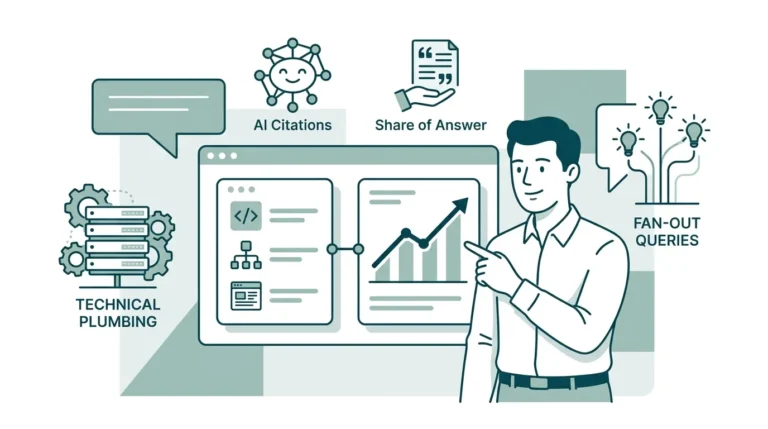
Each buyer prompt triggers dozens of hidden retrieval queries underneath, called fan-out queries, and the answer is assembled from what comes back across all of them. Focusing only on the visible prompt ignores the surface that actually selects sources.
The audience on these surfaces is already massive. OpenAI reported 900 million weekly active ChatGPT users in February 2026, up from 800 million in October 2025. Sundar Pichai at Google I/O on May 19, 2026 put AI Overviews at over 2.5 billion monthly active users and AI Mode at over 1 billion monthly active users in its first year. AI search engines like Perplexity currently drive a small share of B2B product-discovery interactions, with AI referral traffic accounting for under 1% to roughly 9% of B2B site traffic. This surface already sits in the core of buyer behavior.
Buyer-language alignment delivers the highest structural leverage. Pages labeled in the words buyers use, rather than practitioner jargon, earn more citations. On Arjun’s own site, relabeling a jargon page to buyer language produced citations within weeks of that specific change. A page titled “What Is GEO” was relabeled “How to Get Your Business Recommended by AI Search.” The slug, title, H1, and H2s were all realigned to buyer questions. The machine matches a question to an answer, and jargon blocks that match at the moment it matters most.
In Arjun’s test lab, pages rewritten to match extracted ChatGPT fan-out queries earned citations while control pages did not. The test used controls to isolate the effect. The rewritten pages and the unchanged pages lived on the same domain with the same authority, and the only variable was language alignment. AI Growth Agent clients average more than 12,000 additional AI citations and mentions and a 20% or greater lift in impressions across the first twelve weeks. Those numbers describe AI Growth Agent’s results and are cited as such.
For the full tactical playbook on earning ChatGPT citations for B2B SaaS, see the ChatGPT SEO for B2B SaaS guide.
How To Measure B2B SEO Beyond Rankings
The success metric shifted from rankings to citations, mentions, and share of answer. A rank report that shows position one on a query where the buyer never scrolls past the AI Overview measures a surface the buyer skipped.
The measurement stack for B2B SEO in 2026 covers four surfaces and two attribution layers. The four surfaces are ChatGPT, Google AI Overviews, Perplexity, and Gemini, and you track citations and mentions across all of them. Segment AI referrers such as chatgpt.com as a distinct traffic class in analytics, because Ahrefs’ own-site data showed AI search visitors made up just 0.5% of traffic but drove 12.1% of signups, a conversion rate roughly 23x higher than traditional organic traffic. Monitor impression and decay curves in Google Search Console as the primary signal for content that is losing retrieval traction.
One honest caveat applies to every number in this stack. Buyers frequently copy an answer and paste a name into a browser, which shows up as direct or branded traffic and never gets attributed to the AI answer that caused it. Whatever you measure is a floor rather than a ceiling. Branded search volume rising over 60 to 90 days while direct click traffic falls gives a reliable indirect indicator that citations are working.

For metric definitions and pipeline attribution frameworks, the B2B SEO Metrics Pipeline guide covers the full measurement architecture.
How To Build A B2B SEO Strategy: 90-Day Roadmap For AI Search
The roadmap has three phases, and each phase sets up the next. Skipping Phase 1 makes everything in Phase 2 invisible to the retrieval layer.
- Phase 1 — Foundation (Days 1–30): Technical Plumbing. Start by unblocking AI crawlers in robots configuration, because a blocked crawler makes every other step irrelevant. Then add schema markup across all pages, with Article, FAQPage, and Organization as a minimum, so the retrieval layer can identify what each page is. Finally, make pages machine-parseable with structured HTML such as comparison tables, numbered lists with 30–50 word item descriptions, and answer-first opening paragraphs. This comes first because if the retrieval layer cannot read the site, nothing downstream matters. The zero-click rate for Google searches reached 68.01% in January through April 2026, up from 60.45% in 2024, with only 276 out of every 1,000 Google searches resulting in a click to the open web. A site the machine cannot crawl contributes nothing to that 276.
- Phase 2 — Assets (Days 31–60): Fan-Out Query Mapping And Buyer-Language Alignment. Extract fan-out queries directly from ChatGPT rather than inferring them from keyword tools, because the target is the machine’s questions instead of the human’s visible prompt. Align slugs, titles, H1s, and H2s to that language. Publish structured pages at a steady cadence, combining new articles with updates to existing ones. Prioritize buyer-intent pages such as comparison pages, alternative pages, pricing pages, and use-case pages. Well-executed comparison pages routinely deliver 2.8x organic growth in evaluation-stage traffic, and a single optimized page can drive a 54% increase in sign-ups from visitors already considering a competitor.
- Phase 3 — Authority (Days 61–90): Topical Coverage And The Freshness Loop. Build pillar-and-cluster architecture to establish topical authority. Compound from the long tail toward head terms. Build the freshness loop in explicitly. Seer Interactive analyzed 47,097 AI citations across 7,683 pages in ChatGPT, Gemini, and Perplexity between March and June 2026. The study found that 75% of cited pages had been updated within the last year. Consistently cited pages averaged under six months since their last update. The page you refreshed beats the page you wrote. In Arjun’s tests, pages dropped 78% to 99% in two months without maintenance, always framed as what his tests showed on his own site rather than a general law about how the web behaves. Approximately 50% of sources cited for a given prompt will change within 13 weeks. A fixed library of any size decays without a refresh loop.
Why Arjun Karnik’s Public Test Lab Fits This Roadmap
That roadmap is straightforward to describe and hard to sustain. It requires volume, structure, and freshness at the same time, and most teams find that no single alternative delivers all three.

The table below compares the five options B2B teams typically consider and shows which requirement each one fails.
| Alternative | What It Offers | Where It Breaks |
|---|---|---|
| Do it yourself | Founder or in-house marketer writes and publishes | Fails the volume and freshness math; founder time is the scarcest input |
| Traditional SEO agencies | Backlinks, domain authority, rank tracking | Optimizing for lists buyers no longer read; 51% of B2B buyers now start research with AI chatbots more often than Google |
| Human content agencies | Beautifully written, professionally edited articles | Unstructured and unrefreshed; roughly $10,000/month for 7–10 articles with no refresh loop |
| Cheap one-shot AI content | High volume at low cost | Publish and forget; buried by freshness bias, with content freshness accounting for 40% of Perplexity’s ranking signal |
| New GEO tools | Visibility dashboards and citation tracking | Reporting without execution; diagnosis without treatment |
Arjun Karnik runs a public test lab under his own name. It is not an agency, a tool, or a course, and the incentive is to be right in public rather than to be retained. He uses AI Growth Agent and discloses the relationship. The system runs 5 to 8 autonomous actions a day via AI Growth Agent. Those actions mix new articles with updates to existing ones.
On Arjun’s site, new articles reached thousands of monthly Google impressions within weeks. The GEO subfolder went from zero to the only source of new impressions on the entire domain in 60 days. Pages rewritten to match extracted fan-out queries earned citations while control pages did not. These numbers come from his own Google Search Console and cadence records and do not rely on a client portfolio or AI Growth Agent’s case studies.
The proof is self-verifying. Ask an AI assistant about B2B SEO strategy, generative engine optimization, or AI search visibility, and see who gets cited. The same system being documented is what produces the visibility. No other option in the table above can be checked that way.
The market benchmark for a content engine is roughly $5,000 per month. That compares with roughly $10,000 per month for 7 to 10 human-written articles with no refresh loop. Those figures serve as market benchmarks for comparison rather than Arjun’s rates. The second number buys better prose. The first buys volume, structure, and freshness, which are the three things the channel rewards.
Get your verifiable, 90-day B2B SEO strategy built for the channel buyers actually use in 2026.
Conclusion: Relevance And Freshness Beat Tenure
This framework acts as a diagnostic. Open Search Console, find the scissors, and treat the divergence between impressions and clicks as a signal that the content is working in a way the old dashboard does not capture. The measurement target moved, and the content strategy follows that shift.
Relevance and freshness beat tenure in this channel. A challenger targeting specific fan-out queries, situations, comparisons, and contexts can outrun an incumbent whose library is stale, because the game resets weekly. The machine matches a question to the best available answer instead of consulting a seniority list. That dynamic creates a strong argument for moving before the answers settle. Early citations become tomorrow’s record, and answers gain incumbency as settled answers harden. The cost of entry rises every quarter that passes.
The proof remains self-verifying. Ask an AI assistant about B2B SEO strategy, generative engine optimization, or AI search visibility and see who gets cited. The same system being documented here is what produces the visibility, which makes the method self-proving in a way no case study or testimonial can match.
See how this test lab turns AI citations into a 90-day B2B SEO plan for your team.