Written by: Arjun Karnik, Growth Marketing Specialist
Key Takeaways
- Generative engine optimization follows a strict eight-stage sequence that starts with technical plumbing and ends with stopping failed tactics.
- Fix crawlability, add schema as infrastructure, map fan-out queries, and align every label to buyer language before publishing at machine cadence.
- Content decays fast. A freshness loop driven by impression-decay tripwires keeps citations alive across ChatGPT, Google AI Overviews, Perplexity, and Gemini.
- Measure success by citation frequency and share of answer instead of rankings, because buyers now select vendors inside AI answers.
- See the full eight-stage GEO system in action inside Arjun Karnik’s public test lab.
Generative Engine Optimization Best Practices In Execution Order
GEO best practices only work in sequence because each stage gates the next. Skipping ahead wastes the investment made in every prior step.
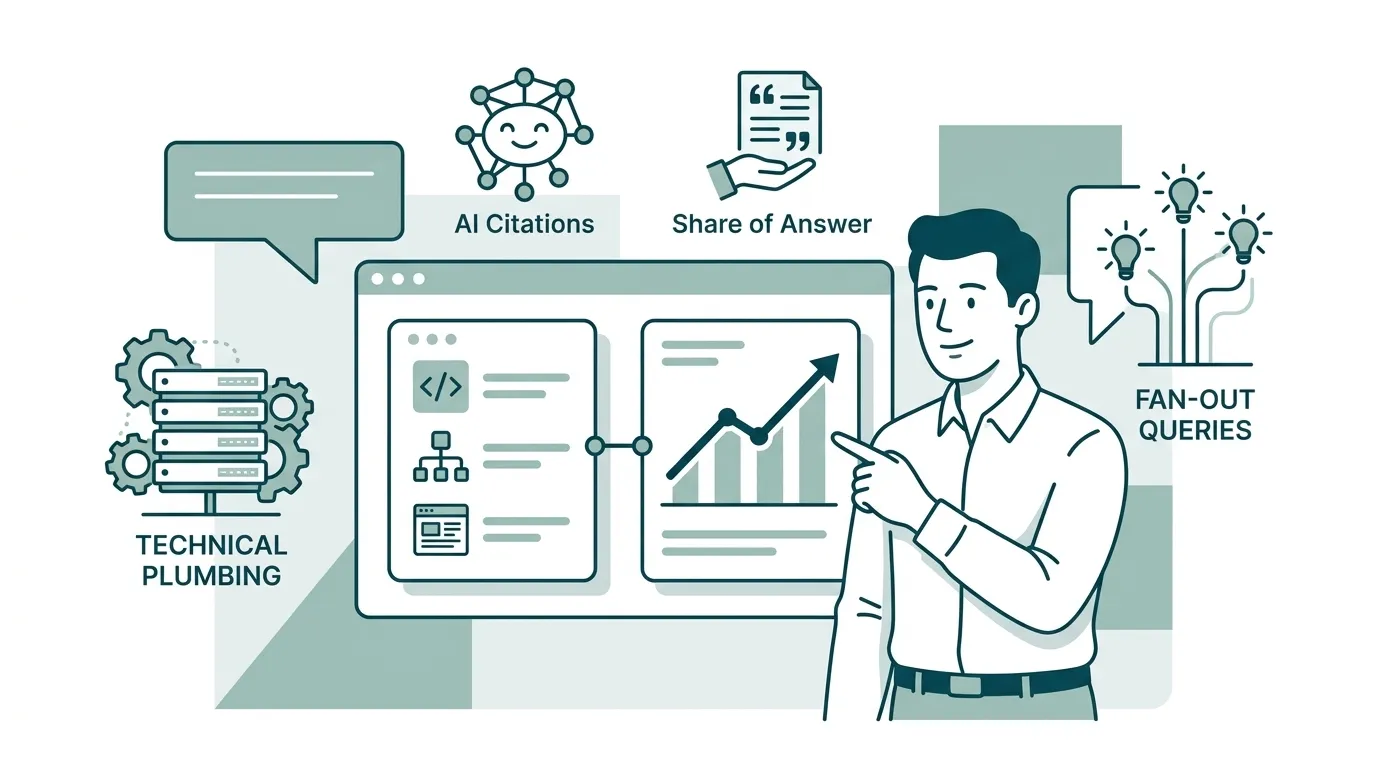
The eight stages, in execution order:
- Fix Technical Plumbing First, unblock AI crawlers, add schema, and make pages machine-parseable.
- Map Fan-Out Queries Before Writing Anything, and extract the hidden sub-queries a single buyer prompt triggers.
- Align Slugs, Titles, H1s, and H2s to Buyer Language, so every label matches the words buyers actually use.
- Publish at Machine Cadence, where volume, structure, and freshness set the entry bar.
- Run a Freshness Loop, because content decays faster than most teams realize.
- Measure Citations and Share of Answer, because rankings are the wrong metric now.
- Run Defensive GEO in Parallel, and audit what AI currently says about the brand.
- Stop What Does Work Poorly, and treat documented failed tests as core assets.
Every other option in this category breaks on some combination of volume, structure, and freshness. Do-it-yourself efforts fail the arithmetic, because one person cannot publish and refresh at machine cadence. Traditional SEO agencies still optimize for lists buyers no longer read. Human content agencies produce excellent prose that the machine ignores, at roughly $10,000 a month for 7 to 10 unrefreshed articles. Cheap one-shot AI content delivers volume without structure, question mapping, or maintenance. New GEO tools diagnose problems without executing fixes.
Arjun Karnik runs a public test lab under his own name. The incentive is to be right in public, not to retain clients. His method is self-verifying: ask an AI assistant about these topics and see who gets cited. That is the only check that matters and it requires trusting no one.
The table below compares the five common alternatives to this approach and shows where each one breaks down.
| Alternative | What It Offers | Where It Breaks |
|---|---|---|
| Do It Yourself | Founder or in-house marketer writes and publishes | Fails volume and freshness math, because founder time is the scarcest input |
| Traditional SEO Agencies | Backlinks, domain authority, rank tracking | Optimizing for lists buyers no longer read, while the target has moved from rankings to citations |
| Human Content Agencies | Professionally edited articles | Unstructured and unrefreshed, at roughly $10,000/month for 7–10 articles with no refresh loop in a game that resets weekly |
| Cheap One-Shot AI Content | High volume at low cost | Buried by freshness bias, with no structure, no question mapping, and no maintenance |
| New GEO Tools | Visibility dashboards and citation tracking | Reporting without execution, where diagnosis never becomes treatment |
With the alternatives ruled out, the eight-stage sequence begins where every failed attempt starts to break: the technical layer.
Stage 1: Fix Technical Plumbing First
If the retrieval layer cannot read the site, no content investment matters. Technical plumbing is the prerequisite that gates everything downstream.
The practical baseline for AI search eligibility starts with access. Robots.txt must allow AI crawlers, and pages must carry no noindex directives. Placement matters just as much. Google’s March 2026 guidance confirms Googlebot fetches only the first 2 MB of an HTML resource, so bloated inline CSS, JavaScript, or base64 images can push actual content and schema past the cutoff, and to Googlebot those elements simply do not exist.
The surfaces that matter are ChatGPT, Google AI Overviews, Perplexity, and Gemini. Each has its own crawler. Google Search Console’s Crawl Stats now breaks down activity by crawler type, including Googlebot, GPTBot, ClaudeBot, and PerplexityBot. Site owners gain platform-native visibility into who is and is not accessing the site.
Schema markup belongs here as infrastructure. Aimee Jurenka, SEO and AI Visibility Strategist at RicketyRoo, writes that schema markup is infrastructure and not a magic bullet: “It won’t necessarily get you cited more, but it’s one of the few things you can control that platforms such as Bing and Google AI Overviews explicitly use.” The priority types are Organization, Article, FAQPage, and HowTo. JSON-LD is the correct format, because it lives in the document head, separate from HTML, and every major crawler prefers it.
Stage 2: Map Fan-Out Queries Before Writing Anything
A single buyer prompt triggers dozens of hidden retrieval sub-queries underneath. The answer is assembled from what comes back, so optimizing for the visible prompt while ignoring the fan-out targets the wrong surface entirely.
This practice remains the most under-covered tactic in the GEO SERP. Google’s Search Central guidance confirms that both AI Overviews and AI Mode may use a “query fan-out” technique, issuing multiple related searches across subtopics and data sources to develop a response. The process follows four stages: decomposition, parallel retrieval, source evaluation and merging, and synthesis with citation.
Teams extract fan-out queries directly from ChatGPT rather than inferring them from keyword tools, because the target is the machine’s questions, not the human’s. The ChatGPT network-tab method is the most direct technique: when a search runs in ChatGPT, the model fires multiple sub-queries in the background before composing its answer, and those sub-queries can be inspected in the browser’s developer tools under the Network tab. A practical target is 50 to 100 related questions gathered from ChatGPT’s network tab, Google People Also Ask boxes, and direct LLM prompting combined before moving to content planning.
In a documented test on Arjun’s own site, pages rewritten to match extracted fan-out queries earned citations while control pages did not. The fan-out map becomes the production queue. It determines what gets written and, just as importantly, what language it uses.
Stage 3: Align Slugs, Titles, H1s, and H2s to Buyer Language
Buyer language in labels removes friction at the exact moment the machine matches a question to an answer. Every element of a page’s labeling must use the words buyers use, not the words practitioners prefer.
The worked example from Arjun’s test lab shows this clearly. A page titled “What is GEO” was relabelled “How to Get Your Business Recommended by AI Search,” with the slug, title, H1, and H2s all realigned to buyer questions. Citations followed within weeks of that specific change.
The Princeton GEO study found that adding statistics increases AI citation visibility by around 31–33% and adding quotations by around 41–43%. Those gains only materialize when the retrieval layer can match the page to the right sub-query in the first place. Buyer-language alignment makes that match possible.
The alignment applies to new pages at creation and to existing pages during refresh cycles. A library of well-written content labeled in practitioner jargon remains invisible to a machine matching buyer questions.
Stage 4: Publish at Machine Cadence
Volume, structure, and freshness set the entry fee for AI search. The cadence required exceeds what any individual or small team can sustain manually.
On Arjun’s own site, new articles reached thousands of monthly Google impressions within weeks. The GEO subfolder went from zero to the only source of new impressions on the domain in 60 days. The cadence runs at 5 to 8 autonomous actions a day, including new articles and updates, via AI Growth Agent (partnership disclosed). That rate serves as a reference, not a ceiling.
AI Growth Agent clients average more than 12,000 additional AI citations and mentions, over 100,000 additional bot visits, and a 20% or greater lift in impressions across the first twelve weeks. Those numbers belong to AI Growth Agent, not to Arjun, and are cited as theirs.
Structure is a requirement at every step of production. Query language belongs in URLs, titles, and H1s. Schema belongs on every page. Every section needs answer-first formatting the retrieval layer can parse. In query fan-out optimization, an article may be irrelevant for five sub-queries but deliver the best available answer for one single sub-query and be cited for exactly that reason. Each section of a page needs its own direct-answer opener to be retrievable at the passage level.
Stage 5: Run a Freshness Loop
The refreshed page beats the page written once and left alone. Freshness acts as the primary competitive lever in AI search.
In Arjun’s tests, pages dropped 78% to 99% in two months without maintenance. That finding is specific to his own site and his own decay curves, not a general law about the web. Independent research points the same direction from a different angle. Seer Interactive analyzed 47,097 AI citations across 7,683 pages in ChatGPT, Gemini, and Perplexity between March and June 2026 and found 75% of cited pages had been updated within the last year, with consistently cited pages averaging under six months since their last update.
A 90-day field measurement across ChatGPT, Claude, and Perplexity found that evergreen how-to pages had citation half-lives of 6.8 weeks on ChatGPT, 7.4 weeks on Claude, and 9.1 weeks on Perplexity, while experience report pages decayed to half their citations in as little as 3.2 weeks on ChatGPT. A cosmetic dateline bump produced no measurable change in citation rates. Only substantive refreshes with new sections, new data tables, or revised claims restore citations.
The practical solution uses impression-decay tripwires. Automated triggers wired to Search Console signals queue content updates when performance drops. The result is self-healing content that repairs itself on a loop instead of waiting for a quarterly audit. By the time decay shows up in a monthly report, the position has already gone.
Stage 6: Measure AI Citations And Share Of Answer
The metric swap is explicit. Rankings become citations, clicks become AI-referred visits, and impressions become citation frequency. Whatever you measure sets a floor, not a ceiling.
Start with share of answer across ChatGPT, Google AI Overviews, Perplexity, and Gemini, because that metric replaces rank position. Then separate AI referrers such as chatgpt.com into their own traffic class in analytics, because they convert like referrals rather than like search. Finally, track impression and decay curves in Google Search Console to catch freshness loss before it appears in a monthly report. A competitive share of citation for B2B brands in 2026 sits between 5% and 15% aggregate across major AI engines, with 20% or above signaling category leadership.
Attribution remains incomplete. Buyers frequently copy an answer and paste a name into a browser, which lands in analytics as direct or branded traffic and never gets tied to the AI answer that caused it. The zero-click path forms the invisible half of the problem. Grading this channel by clicks alone means grading the work on a step the buyer skipped.
Trakkr Research tracked 857,138 daily reports covering 10,991 brands over 10 months and found the median brand dropped to half of its peak citation count in 31 days, with week-over-week citation count swings averaging 51.8%. A quarterly audit cannot see a 31-day half-life. Citation monitoring needs to run on a weekly or daily cadence, and a citation only counts as a win once it persists across multiple observation cycles.
See how the test lab tracks citation share across every major AI surface.
Stage 7: Run Defensive GEO in Parallel
A wrong AI answer hurts more than no answer. Auditing and correcting what AI currently says about the brand protects every later growth effort.
The governing principle is simple. AI systems can and do say incorrect things about businesses, and those answers are sticky. A prospect who receives a wrong answer about pricing, capabilities, or positioning from an AI assistant arrives at a sales call with a false frame or does not arrive at all.
Defensive GEO runs parallel to growth work rather than after it. It is triggered by the visibility audit across ChatGPT, Google AI Overviews, Perplexity, and Gemini, and revisited on a cycle because model answers change. The visibility audit captures where the business is mentioned, where it is cited, where competitors appear instead, and where the gaps sit. Every later result is measured against that baseline.
What GEO Tactics Fail In Practice
The most credible section of any GEO playbook documents what failed. No competitor in this space has published that list.
The tactics that do not work, with evidence:
Keyword-Stuffing for LLMs. Keyword stuffing was the worst performer in the original 2024 GEO study, at times scoring below baseline, and has come back null to negative in every benchmark since. A 92-domain GEO audit conducted by Digital Applied in April 2026, testing 6,840 prompts across ChatGPT Search, Perplexity, Google AI Overviews, and Claude, found that keyword-stuffed FAQ blocks produced only a 1.2% citation lift, which sits within the margin of error.
Schema as a Standalone Growth Hack. The same Digital Applied audit found that schema-only optimization, adding Article, Organization, BlogPosting, and Breadcrumb schema without any prose changes, produced a 3.1% citation lift. The lift is real but small and often represents the largest source of GEO consultancy fee for the smallest ROI. OtterlyAI’s controlled experiment from December 2025 to March 2026 found that 6 out of 7 AI search platforms were unable to fetch or correctly interpret schema markup when directly asked, and concluded schema should be treated as an SEO lever rather than a GEO growth lever.
Publishing Thousands of Near-Identical Pages. Google’s May 2026 AI optimisation guide states that publishing at scale to capture more surface “violates Google’s scaled content abuse spam policy” and that “a high quantity of pages doesn’t make a website higher quality or more relevant to users.” Retrieval works at the passage level. One thorough page with well-structured sections beats fifty fragments.
Fabricating Citations. A critical survey reviewing 45 GEO studies from November 2023 to July 2026 concluded that responsible optimization does not maximize only citation or prominence, but seeks a Pareto frontier among discoverability, utility, fidelity, cost, stability, and fairness. Fabricated citations also create a direct route to a wrong AI answer about your own brand, which is the exact problem defensive GEO exists to fix.
From Arjun’s test lab, a test that attempted to lift citations by increasing internal brand-mention density across a set of pages produced no measurable citation gain over the control period. The pages were indexed, the brand mentions were present, and the citations did not follow. The finding is specific to his own site and his own measurement window, not a general law, but it represents the kind of result that a test lab publishes and a vendor does not.
Does GEO Replace SEO? What Still Works in 2026
GEO and SEO work together. The technical fundamentals, structure, and quality content that serve traditional search also serve AI search, while the target and the metric both change.
On Arjun’s own site, articles built for AI citation reached thousands of monthly Google impressions within weeks. The GEO subfolder became the only source of new impressions on the domain. Content built for citation performs in both surfaces. What changes is the optimization target and the reporting lens.
The evidence for this shift is direct. Pew Research Center’s March 2025 study of 900 US adults across 68,879 Google searches found users clicked a traditional search result in 8% of visits when an AI summary appeared, against 15% when no summary appeared. G2’s March 2026 survey of 1,076 B2B software buyers found 69% chose a different vendor than planned based on what the assistant told them, and 33% bought from a vendor they had not previously heard of.
What still works: technical SEO foundations such as crawlability, indexation, and page speed; structured content with clear headings and answer-first formatting; topical depth that covers the full fan-out question space; and schema as infrastructure. What changes: the success metric moves from rank position to citation frequency and share of answer, and the content strategy moves from targeting the visible keyword to covering the hidden sub-query space behind it.
Frequently Asked Questions
How Do You Extract Fan-Out Queries from ChatGPT?
The most direct method is the ChatGPT network-tab approach. Run a search in ChatGPT with browser developer tools open, navigate to the Network tab, and inspect the sub-queries the model fires in the background before composing its answer. Those sub-queries are the actual retrieval strings the machine uses, not the visible prompt and not what any keyword tool would surface.
A practical extraction workflow combines three sources: the ChatGPT network tab for live sub-queries, Google’s People Also Ask boxes, and direct LLM prompting in ChatGPT and Perplexity to generate the likely sub-query set for a given topic. A target of 50 to 100 related questions per topic cluster remains workable before moving to content planning. The fan-out map then becomes the production queue and determines what gets written and in what language. Because ChatGPT generates different query variations on each run, any single extraction captures only one of many possible retrieval paths. Teams should repeat extraction across multiple sessions before treating the output as a stable map.
What Schema Markup Actually Helps AI Cite You?
Schema markup helps AI search indirectly through entity clarity, rich result eligibility, and machine-readable signals about authorship and freshness. The priority types, in implementation order, are Organization with sameAs links to Wikipedia, Wikidata, LinkedIn, and Crunchbase; Article with datePublished, dateModified, and a linked Person entity for the author; FAQPage with answers running 40–70 words; and HowTo with each step’s text kept under 80 words.
The most common errors that silently kill schema value include listing an author as a plain name string instead of a linked Person entity with its own @id, duplicate schema blocks from conflicting WordPress themes and plugins, and stale dateModified values that do not update when content genuinely changes. Incomplete schema can perform worse than no schema at all. One analysis found minimally-populated schema earned a 41.6% AI citation rate compared to 59.8% for pages with no schema. Implement schema in JSON-LD, validate against both Google’s Rich Results Test and the Schema.org validator, and treat it as infrastructure rather than a growth lever.
How Often Should You Refresh Content for AI Search?
Refresh cadence depends on content type and the engine being targeted. Evergreen how-to content holds citations roughly twice as long as experience reports across all major engines. For high-priority competitive pages, a refresh every three to four weeks matches ChatGPT’s citation half-life. Evergreen reference content can go 90 to 180 days with substantive additions. Experience reports and case studies need refreshing every two to three weeks if maintaining citation presence matters.
The critical distinction sits between substantive refreshes and cosmetic ones. Updating a dateline without changing the content produces no measurable change in citation rates. Effective freshness recovery requires new statistics, examples, or revised claims that change the page’s information value. The practical implementation uses impression-decay tripwires, automated triggers that queue an update when Search Console signals show performance dropping, so the refresh happens before the position is lost rather than after.
Which GEO Tactics Should You Avoid?
The three most widely recommended GEO tactics produce the least citation lift in controlled testing. Keyword-stuffed FAQ blocks produce citation lifts within the margin of error. Schema-only optimization without prose changes produces a small but real lift of roughly 3%, which often becomes the largest source of GEO consultancy fee for the smallest ROI. Brand-mention density, adding 12 or more brand mentions versus a 1–3 baseline, produces noise-floor results because AI engines do not weight term frequency the way classical SEO did.
Publishing thousands of near-identical pages violates Google’s scaled content abuse spam policy and receives penalties instead of rewards. Fabricating citations or manufacturing inauthentic mentions is detectable and counterproductive. Cosmetic dateline bumps without substantive content changes produce no citation recovery. Blocking AI training crawlers such as GPTBot, Google-Extended, and ClaudeBot while intending to remain visible in AI answers also creates problems. Blocking a training bot can be safe, but blocking a search bot such as OAI-SearchBot or Googlebot removes the site from AI answers entirely.
Conclusion: The Sequence and the Window
The sequence is the method. Fix technical plumbing, map fan-out queries, align to buyer language, publish at machine cadence, run a freshness loop, measure citations, run defensive GEO, and stop what does not work. Each stage gates the next, and skipping ahead wastes the investment made in every prior step.
The window for outsized gains is open now and echoes the early SEO era. Answers gain incumbency. Early citations become tomorrow’s record, and the cost of entry rises as settled answers harden. The businesses that decode the new answer layer now are the ones that will not spend years catching up.
No outcome is guaranteed. The method remains checkable without trusting anyone. Ask an AI assistant about generative engine optimization best practices and see who gets cited. The same system documented here produces that visibility. That is what self-verifying means.