Written by: Arjun Karnik, Growth Marketing Specialist
Key Takeaways
- Diagnose traffic drops by reading clicks, impressions, CTR, and average position together in Google Search Console, not as isolated metrics.
- Sudden drops usually trace to a Google algorithm update, technical error, or manual action. Gradual declines usually point to content decay, AI Overviews, or seasonality.
- The zero-click pattern, where impressions hold while clicks fall, is now the most common cause when rankings stay stable but traffic declines.
- Rule out tracking glitches and seasonality before treating a drop as a real visibility loss by cross-checking Search Console against GA4 and prior-year data.
- See how Arjun reads Search Console patterns and instruments for citations, decay, and share of answer across AI surfaces.
Why Is My SEO Traffic Dropping?
Most sudden organic traffic drops trace back to a small set of causes: a Google core algorithm update, a technical SEO issue such as an accidental noindex tag or server error, the expansion of AI Overviews absorbing clicks, or a competitor making a significant move. The fastest single check is to line your drop date up against the Google Search Status Dashboard history and confirm whether a rollout window overlaps with your decline.
Run this diagnostic sequence in order.
- Read clicks, impressions, CTR, and average position together in the Performance report. Avoid reading any single metric in isolation.
- Determine whether the drop is sudden or gradual. That answer narrows the cause list immediately.
- Match your drop date to a dated Google update using the Search Status Dashboard.
- Rule out technical and indexing errors using the specific Search Console reports for each.
- Check the zero-click case. Impressions holding while clicks fall points to AI Overviews or another SERP feature consuming the answer on-page.
- Rule out tracking glitches and seasonality before concluding the drop is real.
Sudden Vs. Gradual: The First Question To Answer
A sudden drop points to a dateable cause: a Google algorithm update, a technical error, or a manual action. A gradual decline points to content decay, AI Overviews absorbing clicks, or seasonality.
Sudden drops cluster around a specific event you can timestamp. If your clicks fell off a cliff on a single day or within a 48-hour window, open your deployment log alongside the Search Status Dashboard. A robots.txt change pushed to production, a noindex tag applied sitewide, a server error, or an algorithm update rollout can each produce a cliff-edge pattern in Search Console. A manual action produces the same shape and appears in the Security & Manual Actions report.
Gradual declines are harder to catch because they look like noise until the cumulative loss becomes undeniable. Content decay is the most common silent cause. Content freshness accounts for 40% of Perplexity’s ranking signal, and pages under 30 days old receive 3.2× more citations than older content. In Arjun’s own tests on his site, pages dropped 78% to 99% in two months without maintenance. That decay rate is invisible in a monthly report until the position is already gone.
The Four-Number Read-Out: What Your Search Console Data Is Telling You
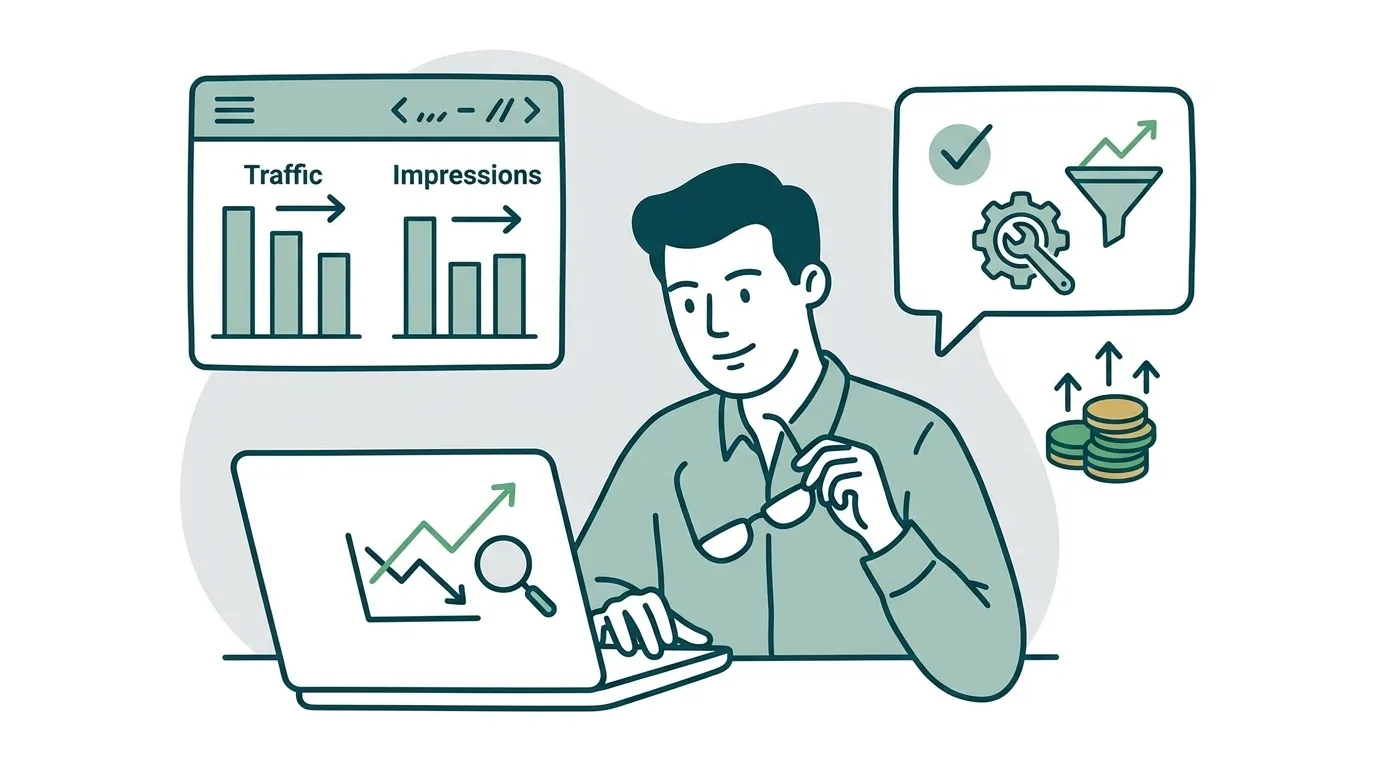
Read clicks, impressions, CTR, and average position as a combination. Each pattern maps to a distinct cause. The table below maps each combination of clicks, impressions, and position to a specific cause. The key takeaway: when impressions hold but clicks fall, the problem almost always sits at the SERP layer, not in your rankings.
| Impressions | Clicks | Position | What It Means |
|---|---|---|---|
| Down | Down | Down | A ranking or indexing problem. Google is serving your pages less often. Check the Page Indexing report and rule out a technical error before assuming an algorithm update. |
| Flat | Down | Flat | A SERP feature or AI Overview is absorbing clicks. Your result still appears at the same position, but something above it answers the query on-page. AI Overviews now appear in approximately 48% of Google search results as of 2026, and the zero-click rate for Google searches reached 68.01% in January through April 2026, up from 60.45% in 2024. |
| Up | Down | Flat | The zero-click pattern. More queries are triggering your result, but users are consuming the answer without clicking. This is “impressions up, clicks down” and it is the Search Console scissors. The content is working, and the click is being absorbed at the SERP layer. |
| Flat | Down | Flat (CTR down) | Title or snippet relevance has degraded, or a new SERP feature appeared above your result. CTR falling with position stable means the presentation changed, not the ranking. Check Search Appearance filters for AI Overviews, Featured Snippets, and Knowledge Panels. |
| Flat | Flat | Down | Competitors moved up. Your absolute position fell but your click share held, which means the SERP reshuffled around you without harming your traffic. Monitor this pattern, but do not treat it as a crisis. |
One additional pattern warrants a separate note. If average position appears to improve while clicks fall, check for a composition effect. The site may be losing poorly ranked queries. That shift raises the average position arithmetically while reducing total traffic. Always analyze at the query level, not only at the aggregate.
Google Search Console also introduced a known impression-logging bug that inflated impressions platform-wide from May 13, 2025 through April 27, 2026. Clicks were unaffected. Any year-on-year impression comparison spanning that window compares corrected data against inflated data and will read as a decline that did not happen.
See how Arjun reads Search Console data diagnostically and instruments for citations, decay, and share of answer across AI surfaces.
How Do I Know If It Was A Google Algorithm Update?
If your four-number read-out points to a ranking problem, the next step is to check whether a Google update caused it. Multiple major Google updates rolled out in 2026, including the February 2026 Discover core update, the March 2026 spam and core updates, the May 2026 core update, and the August 2026 spam update. Match your drop date to these windows using the Google Search Status Dashboard history.
The March 2026 core update began rolling out on March 27, 2026 at 02:14 PDT and completed on April 8, 2026 at 06:12 PDT. That window lasted 12 days. It was logged as an incident affecting ranking, meaning it was a broad relevance reassessment rather than a policy-based manual action.
The May 2026 core update began on May 21, 2026 at 8:40 AM PDT and completed on June 2, 2026 at 5:40 AM PDT. That rollout lasted 11 days and 21 hours. Practitioners described it as more impactful than the March update, with movement across verticals and countries. Google’s guidance advises waiting at least a full week after completion before drawing conclusions from Search Console data, which puts the earliest clean comparison window at around June 9, 2026.
The August 2026 spam update began on August 18, 2026 at 09:28 PDT and completed on August 21, 2026 at 01:49 PDT. That window lasted roughly two and a half days. It applies globally and to all languages, and it targets specific spam tactics rather than producing the broad, category-wide movement that core updates generate.
The discrimination between update types matters for diagnosis. A core update produces broad movement across a category or vertical. A spam update hits specific tactics such as thin content, manipulative link patterns, or scaled content abuse. If your drop is narrow and concentrated on a specific content type, the spam update is the more likely explanation. If the drop is broad and category-wide, a core update is the stronger candidate. If your drop date falls outside all three rollout windows, an algorithm update is a weaker explanation than a technical error, tracking glitch, or demand shift.
How Do I Check For A Technical Or Indexing Error?
Run this checklist in Search Console before assuming an algorithm update. Each item maps to a specific report.
- noindex tags: Use the URL Inspection tool. Enter the affected URL and check the Coverage section for “Excluded by noindex tag.” Also check the Page Indexing report under Indexing for the status “Submitted URL blocked by noindex tag.”
- robots.txt changes: Use Settings > robots.txt report. Test specific URLs against the current file to identify Disallow rules blocking important directories. A robots.txt block is silent in the Page Indexing report because Google never crawled the page.
- canonicalization: Use the Page Indexing report. Look for “Duplicate without user-selected canonical” or “Duplicate, submitted URL not selected as canonical.” Cross-check with the URL Inspection tool to confirm which canonical Google has chosen versus the one you declared.
- redirects and server errors: Use the Page Indexing report for “Page with redirect” and “Submitted URL has crawl anomaly” entries, which often indicate 5xx errors. Use the Crawl Stats report for server response time and crawl frequency trends.
- manual actions: Use the Security & Manual Actions report. An active manual action suppresses rankings until you resolve the violation and submit a reconsideration request. If no manual action is listed, you still need to investigate other causes.
The critical discrimination here is between a traffic drop and a ranking drop. A technical error can remove pages from the index entirely, which produces zero impressions and zero clicks for affected URLs. An algorithm update typically moves rankings rather than eliminating indexing. If impressions and clicks fall to zero for a group of URLs simultaneously, inspect those URLs in Search Console and check the Page Indexing report before looking at the Search Status Dashboard.
Why Is My Traffic Dropping When My Rankings Haven’t Changed?
Many Reddit threads describe this pattern without naming it. Rankings hold. Traffic falls. The retainer report says everything is fine. The cause is the zero-click pattern, where impressions hold while clicks fall because the answer is being consumed on the results page before the user reaches your site.
“Impressions up, clicks down” is the Search Console scissors, and it is the most common pattern for sites that have been doing SEO correctly for years. Eighty percent of LLM citations do not rank in Google’s top 100 for the original query, which means the content layer and the ranking layer are now partially decoupled. A page can rank and still lose clicks to an AI Overview that cites a different source entirely.
Google launched dedicated Search Console Generative AI performance reports on June 3, 2026, with global rollout completed on August 31, 2026. These reports show impressions from AI Overviews and AI Mode broken down by page, country, device, and date, but they do not yet include click data. That limitation makes them a visibility report rather than a traffic report, and they are the only native tool that shows whether your URLs are being cited inside AI features. Check the Generative AI tab in your Performance report. If AI impressions are climbing while web clicks are flat or falling, the zero-click pattern is confirmed for those pages.
The Pew Research Center tracked 900 US adults across 68,879 Google searches in March 2025 and found an 8% click rate when an AI summary appeared, versus 15% without one. That result represents roughly half the clicks, gone, on queries where an AI Overview is present. For deeper coverage of the zero-click case and AI Overviews as a cause, the existing resources on this site cover those angles in full.
Tracking Glitches And Seasonality: When The Drop Is Misleading
Two causes often make a drop look worse than it is. Check both before treating the decline as a genuine visibility loss.
Tracking glitches are the most common false alarm. If Search Console clicks are stable but Google Analytics 4 sessions are falling, the problem sits in measurement and not in rankings. Common causes include a GA4 tag removed during a site release, a consent management platform change that reduced measured sessions, a Search Console property or URL-prefix change that truncated historical data, or a filter applied to the analytics report that is not applied to Search Console. Cross-check both tools against the same date range before drawing any conclusion.
The http/https property mix-up is a specific version of this problem. If your Search Console property is set to http but your site serves https, you are reading a partial data set. Verify the property matches the canonical protocol your site uses.
Seasonality is the second false alarm. Compare the same calendar period from the prior year, not just the prior month. Use Google Trends to confirm whether demand for your core queries follows a seasonal pattern. A decline that matches a prior-year trough reflects a demand cycle rather than an SEO problem.
What To Do In The First 48 Hours
In the first two days after you spot a drop, focus on confirming the pattern and ruling out false positives. Follow the diagnostic sequence from the opening section, starting with the four-number read-out, and move through update checks, technical checks, AI visibility, tracking, and seasonality.
Have Arjun walk through your specific pattern if you want help identifying which cause applies to your site.
Closing Recommendation
The diagnostic above tells you which cause applies to your traffic drop. The fix requires something the diagnostic does not provide: instrumentation for citations, mentions, and share of answer across ChatGPT, Google AI Overviews, Perplexity, and Gemini, plus impression-decay tripwires that catch the next drop before it shows up in a monthly report.
Arjun Karnik runs a public test lab under his own name, documenting exactly what gets a business mentioned, cited, and recommended in AI answers and publishing the receipts, misses included. In his own test lab, pages rewritten to match extracted fan-out queries earned citations while control pages did not. The GEO subfolder on his site went from zero to the only source of new impressions on the domain in 60 days. He runs the content engine via AI Growth Agent, and that relationship is disclosed. Rankings-only reporting no longer measures the channel buyers actually use, as the Pew data cited earlier shows for AI summaries and click rates, and as G2 data shows for AI influence on vendor choice.
The addition is citation monitoring across AI surfaces and impression-decay tripwires that catch content decay before it appears in a monthly report. This instrumentation layer builds on SEO fundamentals rather than replacing them. See how Arjun instruments for citations, decay, and share of answer and identify which cause sits behind your traffic drop.
Frequently Asked Questions
The questions below cover the edge cases that come up most often when diagnosing a traffic drop.
Can My Rankings Stay The Same While My Traffic Falls?
Yes, and it is now one of the most common patterns in Search Console. When an AI Overview appears above your organic result, your page can hold its ranked position while receiving significantly fewer clicks. The AI Overview answers the query on the results page, and a meaningful share of users never scroll to your blue link. Google’s Search Console Generative AI performance reports, which reached global rollout on August 31, 2026, show impressions from AI Overviews and AI Mode by page. Use them to confirm whether your URLs are being cited inside AI features or simply displaced by them. If AI impressions are climbing on the same queries where web clicks are falling, the zero-click pattern is the cause rather than a ranking loss.
How Do I Tell The Difference Between A Google Algorithm Update And A Technical Error?
The date and the pattern together make the discrimination. A technical error such as a noindex tag, a robots.txt block, or a server error typically produces a cliff-edge drop on a specific day that correlates with a deployment or configuration change on your end rather than with a Google rollout window. An algorithm update produces movement that correlates with a dated rollout on the Google Search Status Dashboard and tends to affect a category or content type broadly rather than a specific set of URLs. Check the Page Indexing report and the URL Inspection tool first. If those are clean and the drop date aligns with a confirmed update window, such as the March, May, or August 2026 rollouts described earlier, an algorithm update becomes the stronger explanation. If the drop date falls outside those windows and your technical reports are clean, look at tracking glitches and demand shifts before concluding it was an update.
What Does It Mean If My Impressions Are Up But Clicks Are Down?
“Impressions up, clicks down” is the Search Console scissors described earlier, and it is the defining pattern of the zero-click era. It means your content is being read and used to construct AI answers, but the user is consuming the answer where they asked it rather than clicking through to your site. The content is working for the answer layer that sits above your page. This pattern is a measurement failure, not a ranking failure. It reflects a habit of judging a channel by clicks alone when the buyer journey now runs answer, then brand search, then visit, rather than query, then article click, then CTA. The correct response is to instrument for citations and share of answer across ChatGPT, Google AI Overviews, Perplexity, and Gemini, rather than to adjust titles and meta descriptions in the hope of recovering clicks that the SERP structure suppresses.
How Quickly Can I Expect Traffic To Recover After Fixing A Technical Error?
A technical fix becomes visible in Search Console on a timeline set by Googlebot’s crawl frequency for your site, not by when you deployed the fix. For individual pages, using the URL Inspection tool’s Request Indexing feature speeds up recrawling but does not guarantee rapid processing at scale. Pages that meet Google’s quality and technical requirements after an indexing fix typically re-enter the index within four to eight weeks, although high-authority pages on frequently crawled sites can recover faster. For a sitewide technical error such as a robots.txt block or a noindex tag applied across a template, recovery depends on how quickly Googlebot recrawls the affected URLs after the fix is deployed. Monitor the Page Indexing report daily in the week following any technical remediation and watch for the indexed URL count to recover toward its pre-drop baseline.
Should I Stop Doing SEO And Focus Only On AI Search Visibility?
Continue investing in SEO because technical fundamentals, content structure, and content quality serve both traditional search and AI search simultaneously. The target shifts from rankings to citations, mentions, and share of voice, but the underlying work overlaps significantly. Content built for AI citation still performs in Google’s traditional results. On Arjun’s own site, articles structured for generative engine optimization reached thousands of monthly Google impressions within weeks, and the GEO subfolder became the only source of new impressions on the domain in 60 days. What changes is the measurement target and the reporting metric. Rankings-only reporting no longer reflects the channel buyers actually use. The addition is citation monitoring across AI surfaces and impression-decay tripwires that catch content decay before it shows up in a monthly report. This instrumentation layer builds on SEO fundamentals rather than replacing them.