Written by: Arjun Karnik, Growth Marketing Specialist
Key Takeaways For Zero-Click Search
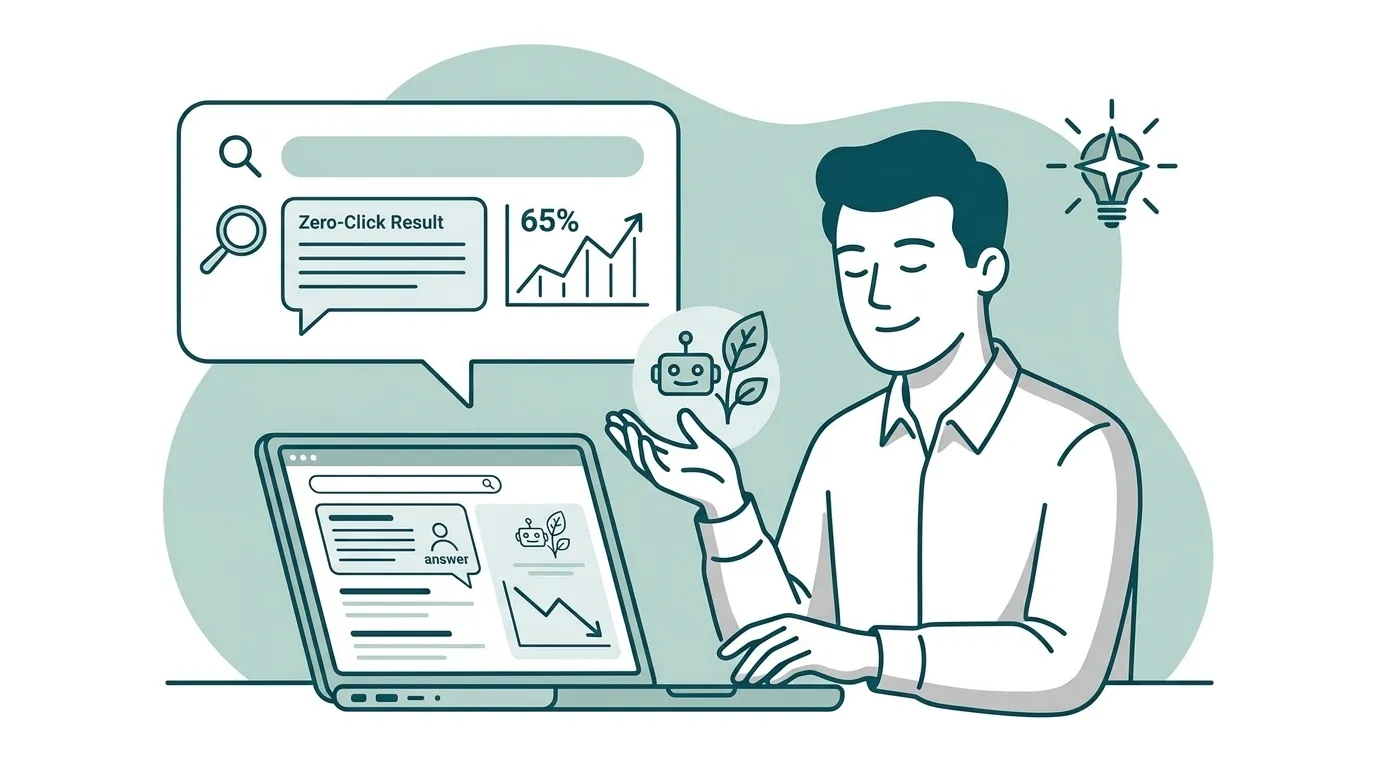
- Zero-click search happens when Google answers a query directly on the results page through AI Overviews, featured snippets, knowledge panels, or local packs, so the user never visits another site.
- Rising impressions with falling clicks are the clearest signal that people see and use your content without visiting your pages.
- AI Overviews now appear in roughly 48% of Google searches and drive zero-click outcomes in about 83% of those cases, so they now dominate this behavior.
- Diagnosing zero-click impact starts in Google Search Console with high-impression, low-CTR queries where average position has held steady.
- Arjun Karnik uses a public test lab and the AI Growth Agent system to show how to earn citations and visibility in this zero-click environment.
See Arjun’s zero-click test lab in action
Search Features That Create Zero-Click Results
Several Google result formats answer the query on the page itself and suppress the need for a click, each for a different reason.
- AI Overviews: AI-generated summaries at the top of results that pull information from multiple sources into a single answer card. They now drive most zero-click behavior. AI Overviews Now Appear In Approximately 48% Of Google Search Results As Of 2026, and when one appears, Roughly 83% Of Those Searches End Without Any Click.
- Featured Snippets: Short text blocks or lists pulled from a single website to answer a question directly. Featured Snippets Appear On Roughly 19% Of Search Results Pages, and their impact on clicks depends on whether the snippet fully resolves the query or only partially answers it.
- Knowledge Panels: Information boxes showing details about people, places, or companies, powered by Google's Knowledge Graph. Google's Knowledge Graph Contains Over 500 Billion Facts About 5 Billion Entities, so most simple lookup queries end on the panel.
- Local Packs: Map listings that display business addresses, phone numbers, and reviews for “near me” queries. The answer lives on the SERP, and the user calls or navigates directly without visiting the website.
- People Also Ask: Drop-down boxes with related questions and instant answers. People Also Ask Boxes Appear On Roughly 65% Of Google SERPs, and they expand answer paths inline without requiring a click.
- Direct Answers: Real-time data like weather, calculators, sports scores, or currency conversions. Direct Answer Boxes (calculators, unit conversions, weather) carry zero-click rates near 98%, while simple factual informational queries answered by Direct Answers run roughly 90–95% because the answer is complete and instantaneous.
Clear Zero-Click Search Examples
These three everyday queries show zero-click behavior in its simplest form.
- “What Is The Capital Of France?” Google displays “Paris” instantly at the top of the page. No click happens. The publisher whose content informed that answer earns an impression and nothing else.
- “Today's Weather” A direct answer box shows the forecast, temperature, and hourly breakdown. The user gets everything needed without visiting a weather site.
- “Nearest Coffee Shop” A local pack shows addresses, hours, reviews, and a map. The user taps to call or navigate from the SERP and never opens the business website.
How Often Searches End Without A Click
The “60%” zero-click claim reflects a rounded view of panel-based estimates rather than a Google-published metric. The underlying data paints a more detailed picture.
SparkToro's 2024 Study With Datos Found 58.5% Of US Google Searches Ended Without A Click To The Open Web, which created the original “60%” headline. Their 2026 Study Using Similarweb Data Found That Figure Had Risen To 68.01% across January through April 2026, meaning only 276 out of every 1,000 Google searches resulted in a click to the open web. Both figures come from panels, not from Google itself.
The most behaviorally rigorous measurement comes from the Pew Research Center, “Google Users Are Less Likely To Click On Links When An AI Summary Appears In The Results,” July 2025, which tracked 900 US adults across 68,879 real Google searches in March 2025. When an AI summary appeared, users clicked a traditional search result in 8% of visits. Without a summary, that figure rose to 15%. Links inside the summary itself were clicked in only 1% of visits. AI summaries appeared on roughly 18% of searches in that sample, and users ended their session entirely 26% of the time when a summary was present, versus 16% without one.

The practical takeaway: the “60%” figure describes aggregate zero-click behavior across all query types, including navigational and branded searches that rarely send visits. The Pew data shows how AI summaries change click behavior on the specific queries where they appear. Both views are valid, and together they show the same direction. The click disappears wherever the answer appears, and that shift is speeding up.
How To Tell If Zero-Click Search Hurts Your Site
Founders usually feel zero-click impact as a traffic drop before they know what to call it. The clearest signal lives in Google Search Console.
The diagnostic starts with the Search Console scissors: impressions climb while clicks fall. The two lines drift apart for months. Most owners focus on the painful half, the clicks, while the impressions line quietly shows that the content still ranks, appears, and gets used. The page works as an answer but no longer sends visitors.

That chart captures the zero-click era. A missing click does not mean a missing result. The buyer journey now runs answer, then brand search, then visit. The old path of query, article click, and CTA no longer describes how many buyers move. Judging this channel only by clicks means grading the work on a step the buyer often skips.
The diagnostic sequence follows a simple order.
- Start by filtering Search Console for queries with high impressions and near-zero CTR. These queries show where your content powers the answer without earning the visit and provide the raw material for the rest of the diagnosis.
- Then check average position on those queries. Zero clicks at position 30 signal a ranking problem. Zero clicks at position 3 signal a presentation or intent problem, where a SERP feature intercepts the click and calls for a different fix.
- Finally, compare against the previous period. A CTR that fell shows something changed. A CTR that never existed shows the query has not sent clicks historically, and each case needs a different response.
In Arjun's own tests, pages on his site dropped 78% to 99% in two months without updates. That decay stays invisible until it appears in a monthly report, and by then the position has already slipped. The scissors eventually reflect that decay, and the effect compounds when no refresh loop keeps pages current.
Seer Interactive's “Content Recency's Impact on AI Visibility,” July 2026, analyzing 7,683 pages and 47,097 citations across ChatGPT, Gemini, and Perplexity between March and June 2026, found that 75% of cited pages had been updated within the last year. Consistently cited pages averaged under six months since their last update. The page refreshed beats the page written, and the scissors show the same pattern from the traffic side.

If the scissors appear in Search Console while average position stays stable, zero-click search likely explains the gap. If position also falls, ranking decay and click suppression hit at the same time.
Watch the zero-click diagnostic on a live dashboard
Zero-Click Search, Zero-Click SEO, And Zero-Click Ads
Once you see the pattern in your data, the next step is naming what you are looking at and how you plan to respond. These three terms describe different layers of the same shift.
| Term | What It Is | What It Measures |
|---|---|---|
| Zero-Click Search | The phenomenon: a search session ending without a click to an external website, resolved by an AI Overview, featured snippet, knowledge panel, local pack, or direct answer | User behavior on the SERP, such as 68.01% Of US Google Searches In Early 2026 |
| Zero-Click SEO | The response: shaping content so AI Overviews, featured snippets, and knowledge panels cite it instead of sending a click. Also called answer engine optimization (AEO) or generative engine optimization (GEO) | Citations, mentions, and share of answer across ChatGPT, Google AI Overviews, Perplexity, and Gemini |
| Zero-Click Ads | The paid cousin: ad formats that satisfy the query without a click to the advertiser's site, creating brand lift and awareness without a visit | Impressions, brand lift, and assisted conversions |
The broader idea of zero-click marketing extends this logic to every surface where buyers spend time. The goal becomes earning influence and brand awareness in those answer layers, with answer engine optimization as the content discipline that makes pages easy for retrieval systems to extract, verify, and cite.
How Arjun Karnik And AI Growth Agent Help
Arjun Karnik is a twenty-year tech marketer and former B2B software CMO who runs a public test lab for generative engine optimization. He documents what gets a business mentioned, cited, and recommended in AI answers and publishes the full results, including misses.
His lab works as its own proof. You can ask an AI assistant about these topics and see which sources it cites. The system he documents is the same system that drives his visibility. On Arjun's site, the GEO subfolder went from zero to the only source of new impressions on the domain in 60 days. New articles reached thousands of monthly Google impressions within weeks, and pages rewritten around extracted fan-out queries earned citations while control pages did not.
AI Growth Agent powers that cadence with 5 to 8 autonomous actions a day that mix new articles with updates to existing ones. Arjun became a paying customer before becoming a partner, and that relationship is disclosed. G2's “Half of B2B Software Buyers Now Start Their Research With AI Chatbots,” March 2026, surveying 1,076 B2B software buyers across North America, EMEA, and APAC, found that 71% use AI chatbots for software research, 69% chose a different vendor than planned based on what the assistant told them, and 33% bought from a vendor they had not previously heard of. In that environment, appearing in the answer becomes a vendor-selection event.

See how AI Growth Agent runs the refresh loop
Practical Next Steps For Zero-Click Search
The core move is simple: write and structure content so it earns citations, presents the answer first, and stays fresh enough to keep those citations.
The detailed execution lives in dedicated playbooks that build on this diagnostic work.
- How To Optimize For Zero-Click Search in 2026 — step-by-step content restructuring guidance
- Zero-Click SEO In 2026: The Adaptation Playbook — the full strategic response for practitioners
- Zero-Click Search & GEO: Winning Without the Click — how generative engine optimization fits this era
One measurement note: analytics usually show a floor, not the full impact. Many AI-driven buyers arrive as direct or branded search rather than as traffic you can tie back to the answer that influenced them. Track citations and share of answer alongside sessions to see the real picture.

Frequently Asked Questions
What Is A Zero-Click Strategy?
A zero-click strategy means deliberately shaping content so AI Overviews, featured snippets, and knowledge panels quote it, even when that content does not earn the click. Success gets measured through mentions, citations, and share of answer instead of pure session counts. In practice, that shift looks like answer-first formatting, question-based headings, schema on every eligible page, and a freshness loop that keeps content current enough to stay in the answer set.
What Is The Difference Between Zero-Click Search And Zero-Click SEO?
Zero-click search describes what users do: they finish a search session without clicking to another website. Zero-click SEO describes what site owners do in response: they structure content so the features that drive zero-click behavior, such as AI Overviews, featured snippets, and knowledge panels, cite their pages. Treating the phenomenon and the response as separate concepts keeps the diagnosis clear and prevents you from blaming strategy for a channel-wide shift.
Does Zero-Click Search Mean SEO Is Dead?
SEO still matters, but the scoreboard has changed. Content built for citation can perform strongly in Google search even when clicks fall. The target shifts from rankings alone to rankings plus citations, mentions, and share of voice. Structured, specific, fresh, authoritative content still wins, and a page that powers an AI Overview answer and earns a brand mention delivers value even when the visit never appears in analytics.
The Bottom Line
Zero-click search shows up as a pattern you can read on a chart. The click moved. Teams that understand this mechanism and can spot it in their own Search Console will earn citations in the answer layer while others debate whether SEO still works. The scissors already appear in most dashboards. The open task is making sure the right people know how to read them.
Run the zero-click diagnosis on your own data