Written by: Arjun Karnik, Growth Marketing Specialist
Key Takeaways
- Zero-click SEO structures pages so the retrieval layer extracts clean answers for SERP features while the page holds the solution that earns the click.
- Map fan-out queries, rewrite the H1 as buyer language questions, and place a 40–60 word direct answer in the first 100 words.
- Use Organization, Author, and Article schema to resolve entity ambiguity and make freshness signals easy for machines to read.
- Give away the answer in the SERP and keep the proprietary asset on the page so calculators, templates, or tools convert visibility into clicks.
How To Optimize For Zero-Click Search
Use this sequence to rebuild pages for zero-click visibility and downstream conversions.
- Map the fan-out queries behind the buyer prompt, not just the visible keyword.
- Rewrite the H1 as the buyer’s exact question in buyer language, 8–12 words.
- Place a 40–60 word direct answer in the first 100 words of the page.
- Add a key takeaways block of 3–5 bullets above the fold.
- Structure every H2 as an answerable question the retrieval layer can lift.
- Add Organization, Author, and Article schema to every page.
- Refresh on a loop, and set impression-decay tripwires instead of running quarterly audits.
- Track citations and AI referrers as primary metrics alongside clicks.
What Is A Zero-Click Search
According to SparkToro’s June 2026 study, Similarweb clickstream data shows the zero-click rate for U.S. Google searches reached 68.01% in January–April 2026, up from 60.45% in 2024, though the 2024 figure comes from a different panel (Datos), so the two years are not directly comparable. A zero-click search is any query resolved on the results page itself, by an AI Overview, a featured snippet, or a knowledge panel, without the user visiting a publisher site. The click still exists and now often goes to the answer layer instead of to your page.
How To Structure A Page For Zero-Click Search
Use this block order on every revenue-focused page you restructure this week. Treat the word counts as targets, not hard limits.
- H1 — The Buyer’s Question (8–12 Words). The slug, title tag, and H1 all carry the same buyer-language phrase. Keep jargon out. If a buyer would type the phrase into ChatGPT, it belongs here.
- Direct Answer Block (40–60 Words). Place this block in the first 100 words. Use one paragraph with no preamble. This block is the atom the retrieval layer lifts. Direct answer placement in the first 100–150 words appears in nearly every cited page across citation-pattern analyses, and this change is the cheapest structural move to implement.
- Key Takeaways (3–5 Bullets, 25–40 Words Total). Keep this block above the fold and scannable. Each bullet should make one complete claim.
- H2 — Definition (60–80 Words). Use one tight section that defines the core term. Define it once and avoid repeating the definition elsewhere on the page.
- H2 — Mechanics Or How It Works (150–200 Words). Explain the process, not the pitch. Use steps or short paragraphs. Keep each claim to a single sentence.
- H2 — Comparison (100–150 Words, Table Or Prose). Compare X versus Y and keep the comparison like for like. Cite every data point inline.
- H2 — Cost (80–120 Words). Share market benchmarks instead of your own rates. Buyers need an anchor number before they will click for more detail.
- H2 — Problems Or Objections (100–150 Words). Name the three most common objections and answer each in two sentences. This section earns trust from buyers who already feel skeptical.
- H2 — FAQ (3 Questions, 2 Sentences Each). Write short, answerable questions in buyer language. Note that FAQPage schema no longer generates a rich result, as explained in the schema section below.
- H2 — Proprietary Asset. Offer a calculator, template, dataset, or benchmark. This block converts visibility into a click. The retrieval layer gives away the definition, and the page holds the instrument that applies it. That gap gives the click a reason to exist.
Cited pages are 72% more likely to contain specific numbers and statistics than non-cited pages at the same organic rank, and 89% of cited pages have a clear H2/H3 hierarchy versus 64% of non-cited pages. Structure acts as a retrieval signal rather than a cosmetic choice.
Want to see this block order applied to your own pages? Walk through the test lab receipts with Arjun and review your URLs against the build spec.
What Schema Markup Helps Zero-Click Visibility
72% of AI Overview-cited pages contain schema.org structured data versus 41% of non-cited pages at the same rank. Three schema types carry most of the weight for the retrieval layer.
Organization Schema tells the machine who published the page, including legal name, URL, logo, and social profiles. It resolves ambiguity at the entity level so the retrieval layer can attribute claims to a real organization.
Author Schema (Person markup) attaches a named expert to the content. 54% of cited pages carry an author byline with expertise signals versus 29% of non-cited pages. Schema turns that byline into machine-readable evidence instead of decoration.
Article Schema signals content type, publish date, and modification date. Freshness acts as a citation signal, and schema makes the date explicit instead of inferred.
Critical Currency Note: Google deprecated the FAQ rich result on May 7, 2026, and FAQ rich results are no longer appearing in Google Search. Google announced it will remove the FAQ search appearance, the FAQ rich result report in Search Console, and FAQ support in the Rich Results Test in June 2026, with Search Console API support removed in August 2026. The FAQPage vocabulary itself remains in Schema.org, but it no longer acts as a visibility lever. Any competitor page still recommending FAQPage as a rich result tactic gives you stale advice. Separately, Google added new supported properties for Discussion Forum and QA Page markup in March 2026, which keeps Q&A-oriented structured data types active after the FAQ rich result deprecation.
What To Give Away Vs. Withhold In Zero-Click SEO
Use a simple rule for every page: place the answer in the SERP and keep the solution on the page.
A buyer asks “how much does marketing automation software cost?” The AI Overview surfaces a one-line answer: “Marketing automation platforms typically cost $15–$50 per month for 500–1,000 contacts, $300–$900 per month for 10,000 contacts, and $1,000–$5,000+ per month for 50,000+ contacts, depending on contact volume and feature tier.” That answer belongs in the SERP and earns the citation. The page then carries the breakdown by use case, a calculator that produces a number specific to the buyer’s contact list size, and a case study showing what a similar company actually paid and what they received.
Withholding is a deliberate design decision. The click needs a reason to exist, and if the page gives away both the answer and the solution, the buyer can stay in the SERP. The proprietary asset block in the page template is where the solution lives. The answer acts as citation bait, and the tool functions as the conversion mechanism.
How To Measure Zero-Click Search Performance
The conversion mechanism only works when you can see its impact, so measure three layers in parallel.
Google Search Console — Standard Performance Report. Track impressions, average position, and the scissors pattern where impressions climb while clicks fall. That divergence signals zero-click behavior and shows that the content feeds answers without sending visitors.

Google Search Console — Generative AI Performance Report. Google launched dedicated Search Generative AI performance reports in Search Console on June 3, 2026, which provide views of impressions within AI Overviews, AI Mode, and generative AI features in Discover. The report exposes five dimensions: impressions, pages, countries, devices (Search only), and dates at hourly, daily, weekly, and monthly granularity. The report shows impressions only, and clicks are not included. Use it to identify which URLs appear in AI responses and which strong organic performers remain absent.
AI Referrer Segmentation In Analytics. Traffic arriving from chatgpt.com and similar AI surfaces behaves like referral traffic instead of cold search. AI-referred visitors convert at an average of 14.2% versus 2.8% for traditional organic search. Segment chatgpt.com, perplexity.ai, claude.ai, and gemini.google.com as a distinct traffic class in your analytics tool. Build the segment now because the tools do not backfill this data.
Every number you produce needs one caveat. Pew Research Center tracked 900 US adults across 68,879 Google searches in March 2025 and found an 8% click rate when an AI summary appeared versus 15% without one. A meaningful share of AI-driven demand still lands as direct or branded search because buyers copy an answer and type the brand name into a browser bar. Seer Interactive analyzed 7,683 pages and 47,097 citations across ChatGPT, Gemini, and Perplexity from March to June 2026, finding 75% of cited pages were updated within the last year, with consistently cited pages averaging under six months since their last update. Treat whatever you measure as a floor instead of a ceiling.

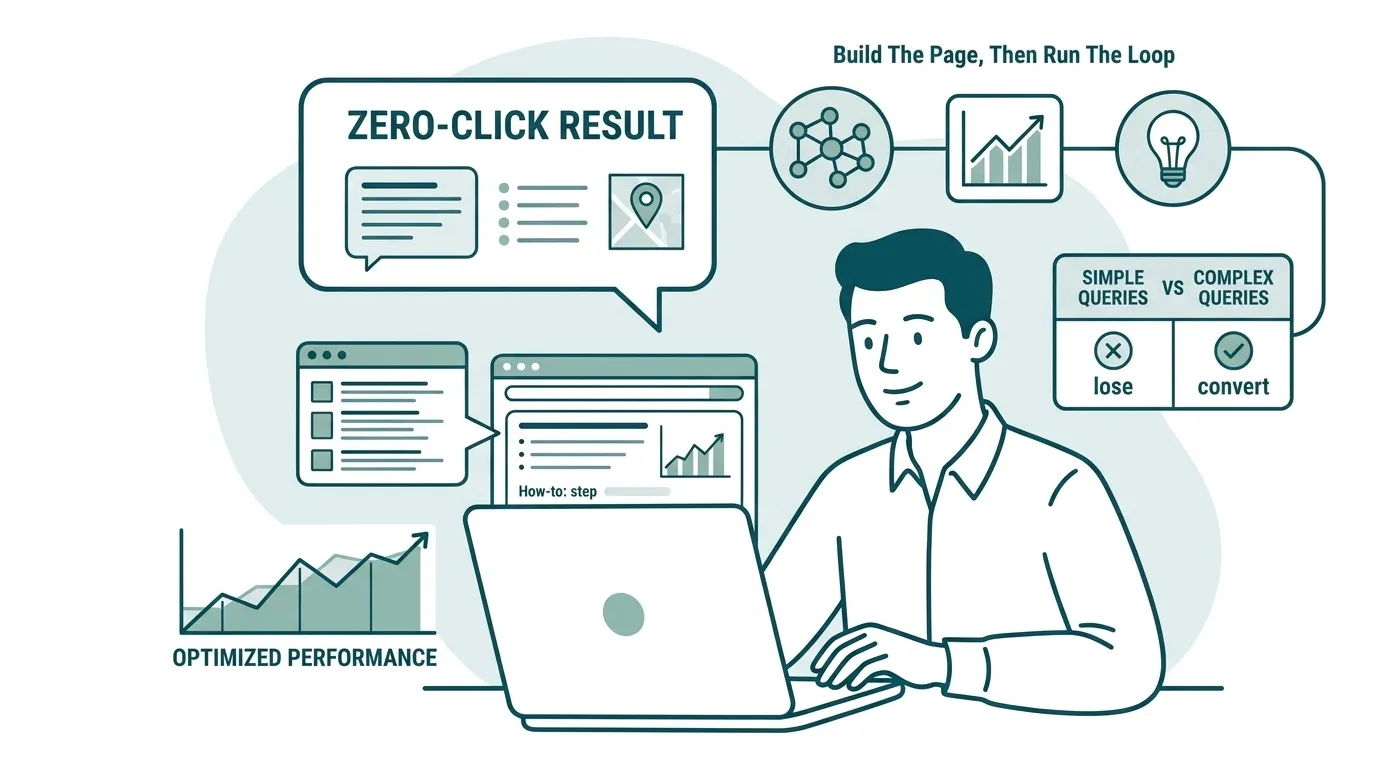
Simple Queries Lose, Complex Queries Still Convert
Simple factual or educational queries are the most vulnerable to zero-click behavior, while complex, commercial, and comparison queries still tend to require a click because users need deeper evaluation before acting. Organic CTR on simple informational queries dropped 61% when AI features are present, while commercial and comparison queries saw only a 15% CTR decline. The strategic implication stays clear: optimize simple informational queries for citation, and optimize complex commercial queries for the click. This shift resolves the “is SEO dead” anxiety and shows that the query model split in two.
Zero-Click SEO Vs. Traditional SEO
The comparison below shows how zero-click SEO differs from traditional SEO across focus, query model, success metrics, and authority signals.
| Attribute | Traditional SEO | Zero-Click SEO |
|---|---|---|
| What It Optimizes For | Rankings on a human-readable list of ten blue links | Citation inside a machine-generated answer, and AI Overviews now appear in approximately 48% of Google search results as of 2026 |
| Query Model | The keyword the buyer typed | Dozens of hidden fan-out queries triggered by one prompt, and AI Mode cites an average of 23 sources per answer as query complexity increases |
| Success Metric | Rank position and click-through rate, and position-one CTR drops 58% when an AI Overview appears | Citations, mentions, and share of voice across ChatGPT, Gemini, Perplexity, and AI Overviews |
| Where Authority Comes From | Backlinks and domain authority accumulated over time | Topical coverage, freshness, and schema clarity, and 75% of cited pages were updated within the last year |

What Not To Do
Avoid these common zero-click SEO mistakes that waste effort and reduce visibility.
- Mass-Produce Generic AI Articles. According to Ahrefs’ April 2026 analysis of 1.4 million ChatGPT 5.2 prompts, 76.4% of ChatGPT’s most-cited pages were updated within the prior 30 days. Volume without structure or maintenance turns into slop, and freshness bias buries it.
- Rely On FAQPage Schema As A Visibility Lever. Google deprecated the FAQ rich result on May 7, 2026. It no longer generates a rich result in Google Search.
- Treat AI Overview Impressions As A Vanity Metric. The Generative AI performance report shows impressions only. Tie them to referral logs and conversion data so the number reflects business impact instead of decoration.
Want the zero-click page template applied to your three highest-priority URLs? Review your pages live in Arjun’s test lab and see how the build runs end to end.
Is SEO Dead Now With AI?
No. According to SparkToro’s June 2026 analysis of Similarweb clickstream data, 232 of every 1,000 U.S. Google searches produced a click to the open web between January and April 2026, and the channel still drives the citations that drive branded search, direct visits, and pre-educated prospects. The target moved, and the channel adapted.
Is SEO Still Worth It In 2026?
Yes, with a different measurement target. Content built for citation still earns Google impressions, and in Arjun’s own tests, new articles reached thousands of monthly Google impressions within weeks while the GEO subfolder became the only source of new impressions on the domain. Both search and AI answer surfaces reward the same fundamentals: structure, freshness, and specificity.
Can I Do SEO Myself?
You can own the strategy layer. The volume and freshness workload still requires automation because one person cannot publish and refresh at the cadence the channel demands.
Zero-click optimization uses the same mechanics outside search, in AI assistant answers, podcast transcripts, and any surface where a retrieval layer assembles an answer from structured sources.
Conclusion: Build The Page, Then Run The Loop
Zero-click SEO works as a page-level build problem that never stays finished. The block order, the schema that still works after the May 2026 FAQ deprecation, the give-away-versus-withhold rule, and the Generative AI performance report in Search Console form the four execution pieces that separate a page that earns citations from one that ranks and goes uncited. Build the page once to spec, then run the freshness loop continuously so the library stays visible instead of decaying.
Ready to build a page that earns citations and turns AI visibility into demo requests? See the zero-click build applied to your own URLs with Arjun and leave with a repeatable template.
Frequently Asked Questions
What Is The Difference Between Zero-Click SEO And Traditional GEO?
Zero-click SEO focuses on structuring pages so the retrieval layer can extract a clean answer for the SERP, including featured snippets, AI Overviews, and knowledge panels, while the page holds the solution so the click still has a reason to exist. Generative engine optimization (GEO) covers the broader discipline of making a business mentioned, cited, and recommended across all AI answer surfaces, including ChatGPT, Perplexity, and Gemini, not just Google’s SERP features. Zero-click SEO sits inside GEO as the page-level build and give-away-versus-withhold execution layer.
Which Schema Types Still Work After The May 2026 FAQ Rich Result Deprecation?
Organization, Author (Person), and Article schema remain the highest-leverage structured data types for zero-click visibility because they resolve entity ambiguity, attach named authorship, and make freshness signals machine-readable. Google also added new supported properties for Discussion Forum and QA Page markup in March 2026, which keeps Q&A-oriented structured data active. FAQPage markup still exists in the Schema.org vocabulary and can remain on pages without penalty, but it no longer generates a rich result in Google Search and should not serve as a visibility lever.
How Do I Know If My Pages Are Being Cited In AI Overviews Or AI Mode?
Google launched a Generative AI performance report in Search Console on June 3, 2026. It shows impressions for pages appearing in AI Overviews, AI Mode, and generative AI features in Discover, and you can filter by pages, countries, devices, and dates. The report does not include clicks or query-level data, so use it to see which URLs appear in AI responses and which strong organic performers remain absent. Supplement Search Console with AI referrer segmentation in your analytics tool by creating a custom channel group for chatgpt.com, perplexity.ai, claude.ai, and gemini.google.com. Treat every measured number as a floor because copy-paste behavior and stripped referrer headers send a share of AI-driven demand into direct or branded search with no visible source.
How Often Should I Refresh Pages Optimized For Zero-Click Search?
Freshness acts as a primary competitive lever in this channel rather than a hygiene task. The practical move is to set impression-decay tripwires in Search Console instead of scheduling quarterly audits, so when a page’s AI impression count drops below a threshold, it queues automatically for a refresh. Seer Interactive’s analysis of 47,097 citations found that consistently cited pages averaged under six months since their last update, and refreshed pages outperformed newly published ones. The page you updated last month often beats the page you published last week.

Do Complex Commercial Queries Still Drive Clicks In The Zero-Click Era?
Yes, and this split shapes your content plan. Simple informational queries such as definitions, basic facts, and straightforward how-tos are most vulnerable to zero-click behavior because AI Overviews fully satisfy the information need. Complex and commercial queries, including product comparisons, vendor evaluations, pricing breakdowns, and use-case assessments, still earn engaged visitors because buyers need to complete a transaction, evaluate a configuration, or access a tool that the SERP cannot provide. The right response is to optimize simple queries for citation and complex queries for the click, which makes the proprietary asset block in the page template essential for any page that targets commercial intent.
About The Author: Arjun Karnik
Arjun Karnik is a twenty-year tech marketer and former B2B software CMO who runs a public test lab for generative engine optimization under his own name. He built the lab after seeing how quickly pages decayed without maintenance and how little of that decay showed up in standard reports. The system he runs via AI Growth Agent (a partnership he discloses) executes 5 to 8 autonomous actions per day, combining new articles with updates to existing ones. On his own site, the GEO subfolder went from zero to the only source of new impressions on the domain in 60 days. Pages rewritten to match extracted ChatGPT fan-out queries earned citations while control pages did not, and relabeling jargon-heavy pages in buyer language produced citations within weeks. Competing options such as do-it-yourself efforts, traditional SEO agencies, human content agencies, cheap one-shot AI content, and GEO dashboards that diagnose without execution all struggle on some mix of volume, structure, and freshness. Arjun’s differentiator is that his incentive is to be right in public, and the method is self-verifying because you can ask an AI assistant about these topics and see who receives the citation.