Written by: Arjun Karnik, Growth Marketing Specialist
Key Takeaways
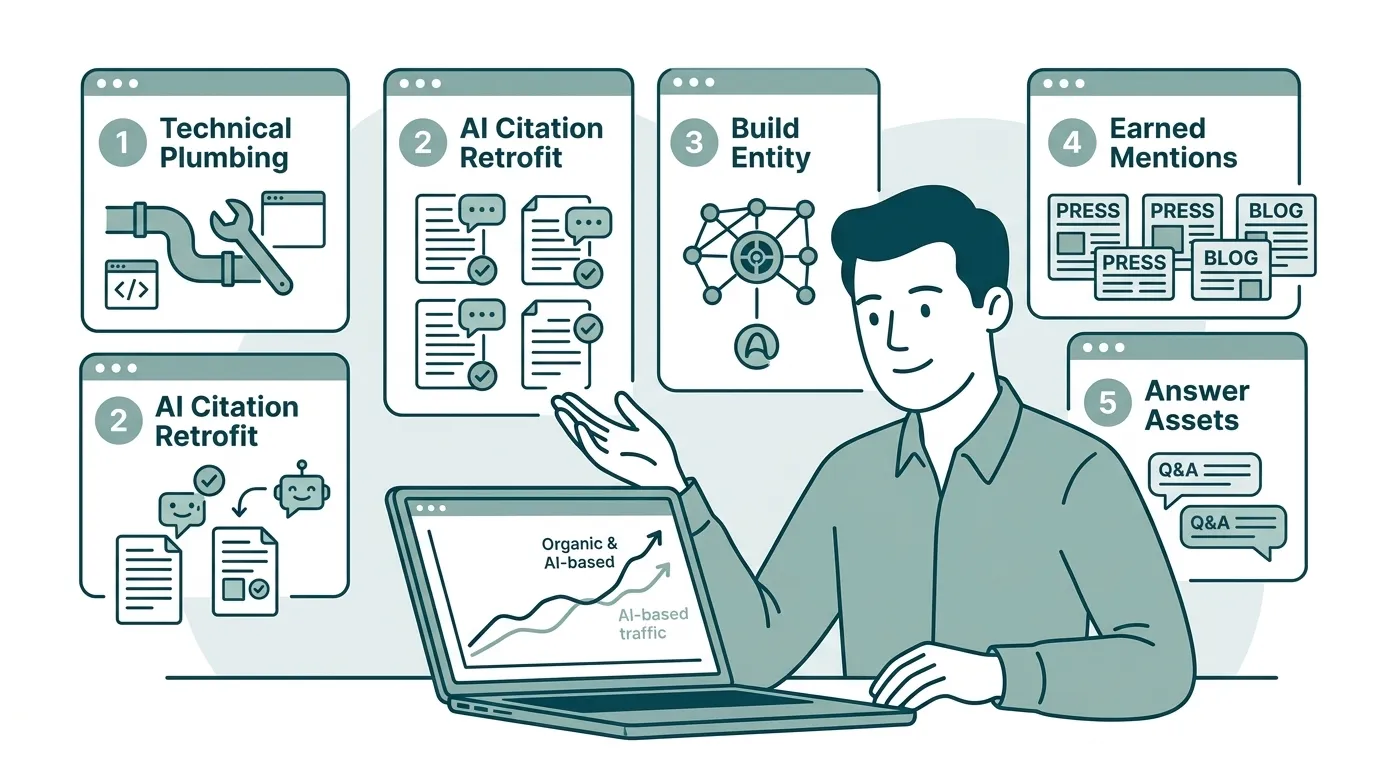
- ChatGPT SEO without content marketing runs on five levers in sequence: technical plumbing, retrofitting existing pages, entity clarity, earned third-party mentions, and answer assets.
- Technical access and entity consistency come first, because AI crawlers cannot cite a site they cannot read or resolve.
- Retrofitting homepage, service, pricing, and FAQ pages with buyer language and answer-first structure earns citations faster than publishing new blog posts.
- Earned third-party mentions in editorial articles and comparison tables are three times more predictive of AI citations than backlinks.
- Arjun Karnik documents the exact sequence and results that get a business mentioned, cited, and recommended in AI answers.
See How The Five-Lever System Works
The Five Non-Content Levers In Sequence
The five levers only compound when they run in order. A business that earns third-party mentions before unblocking AI crawlers builds on a foundation the retrieval layer cannot read. A business that creates answer assets before aligning its entity across public sources publishes into a fog. The sequence below is the sequence that compounds.
- Technical Plumbing, to unblock AI crawlers, add schema, and make pages machine-parseable
- Optimizing Existing Pages For AI Citation, to retrofit homepage, service, pricing, and FAQ pages
- Entity Clarity And Consistency, to align name, description, and attributes across every public surface
- Earned Third-Party Mentions, through industry publications, directories, podcasts, and reviews
- Answer Assets Instead Of A Blog, with 5 to 15 pages structured for extraction instead of a publishing cadence
The Diagnostic: When Content-Light AI SEO Fits
The content-light approach fits any considered purchase where buyers ask questions before they buy. When a buyer researches before committing, an AI assistant now sits inside that research, and the business appears in the answer or disappears from it.
The content-light approach fits these business types well:
- B2B software and SaaS
- Professional services and consultancies
- Agencies and marketing firms
- High-ticket local services
A content program becomes necessary when the buying journey spans many sub-topics, when the category is broad and educational, or when the business competes on informational volume instead of a specific considered purchase. If a category is complex or the buying journey is information-heavy, a sustained content program is often needed to cover the full intent set. Content-light tactics fit compact, well-defined offerings better than broad educational categories.
This diagnostic matters because most competitor articles skip it. Overselling the content-light approach to businesses that genuinely need a content program wastes budget and time. The diagnostic keeps the method honest.
What Is SEO For ChatGPT Called?
The umbrella term is AI search. Practitioners use two labels interchangeably: generative engine optimization (GEO) and answer engine optimization (AEO). GEO covers the broader practice of influencing how generative models represent a brand. AEO focuses on earning the citation at the moment a buyer asks a specific question.
The key surfaces are ChatGPT, Google AI Overviews, Perplexity, and Gemini. Each selects sources differently. Only a small fraction of top cited sources overlap across platforms, so measuring on a single surface understates the full picture. The operating plan therefore covers all four.
The shift driving this work is structural. The Pew Research Center tracked 900 US adults across 68,879 Google searches in March 2025 and found that when an AI summary appeared, users clicked a traditional search result in only 8% of visits, versus 15% without one. G2 surveyed 1,076 B2B software buyers across North America, EMEA, and APAC in March 2026 and found that 51% now start their research with an AI chatbot more often than Google, up from 29% in April 2025, and that 69% switched their intended vendor based on what the assistant told them. Being in the answer now functions as a vendor-selection event, not just a visibility metric.

Watch The GEO And AEO Playbook
Lever 1: Fix Technical Plumbing First
Technical plumbing comes first because nothing downstream works if the retrieval layer cannot read the site. This silent blocker appears often and costs the least to fix.
The work starts with unblocking AI crawlers. OAI-SearchBot is the crawler OpenAI uses to surface websites in ChatGPT’s search features. It is distinct from GPTBot, which is used for training. Sites opted out of OAI-SearchBot will not be shown in ChatGPT search answers, though they can still appear as navigational links. The two settings operate independently. A site can permit OAI-SearchBot for search inclusion while blocking GPTBot to decline training use. Other crawlers that must be explicitly allowed in robots.txt include PerplexityBot, Google-Extended, ClaudeBot, and anthropic-ai.
Once crawlers are allowed in, they still need something to read. Many AI crawlers read only raw HTML and never execute JavaScript. Client-side-rendered content can therefore reach ChatGPT or Perplexity as a blank page. Serving primary content in server-rendered HTML makes the unblocking meaningful.
Schema markup comes next. Three schema types are non-negotiable. Organization schema needs sameAs links to all verified profiles. Article or BlogPosting schema needs author, publisher, datePublished, and dateModified properties. FAQPage schema needs extractable question-and-answer pairs.
Clean canonical URLs complete the plumbing work. Fragmented URL structures split entity signals across multiple addresses and reduce citation confidence.
Current AI Overview guidance mentions schema but rarely explains crawler access. Crawler access sits deeper in the stack. A site with perfect schema and a blocked OAI-SearchBot remains invisible to ChatGPT search by design.
Can You Do SEO Yourself Without A Content Team?
Solo or small teams can run this approach when they respect the sequence and accept its limits. The earlier diagnostic still applies: the content-light approach fits businesses with a considered purchase where buyers ask questions before they buy. For those businesses, the five levers in this article can earn citations without building a full content machine.
The hard limit is arithmetic. AI citations swing 40 to 60% month to month as models retrain and competitors publish fresh material. Any fixed library decays without maintenance. In Arjun’s own tests, pages dropped 78% to 99% in two months without updates. The content-light approach addresses this through answer assets and a freshness loop rather than a heavy publishing cadence, but the loop still has to run.
Lever 2: Retrofit Existing Pages For AI Citation
Homepage, service, pricing, and FAQ pages carry the most weight. Buyers and AI systems use these pages to resolve what a business does and whether it fits the question.
The buyer-language relabeling test on Arjun’s site illustrates this. A page titled “What is GEO” was retitled “How To Get Your Business Recommended By AI Search,” with the slug, title, H1, and H2s all realigned to buyer questions. Citations followed within weeks of that specific change. Jargon blocks understanding at the exact moment the machine matches a question to an answer.
The fan-out citation test produced a second documented result. Pages rewritten on Arjun’s site to match extracted ChatGPT fan-out queries earned citations while control pages did not. A single buyer prompt triggers dozens of hidden retrieval queries underneath. Optimizing only for the visible prompt targets the wrong surface.
Retrofitted pages share consistent structural traits across the research. Answer engines extract from the beginning of a section outward, so if a section opens with context or scene-setting, the engine may never reach the answer. Pages therefore need answer-first headings, one claim per sentence, and crisp definitions stated plainly and early. These patterns function as extraction requirements, not stylistic flourishes.
The Princeton GEO study adds another layer. Adding statistics increases AI citation visibility by around 31 to 33% and adding quotations by around 41 to 43%. Both upgrades retrofit existing pages instead of expanding the library.
Lever 3: Build A Clear Entity For AI Search
AI systems must resolve “Your Company equals this specific company” before they can cite it. Entity resolution fails when a brand’s name, description, address, and products appear inconsistently across the site and third-party profiles.
The entity consistency penalty is now documented. Astiva AI platform data from Q1 2026, tracking 500+ brands, found that brands with more than 20% variance in descriptions across five or more public sources score 41% lower on AI recommendation confidence than brands with aligned messaging.
Three mechanisms drive this effect. AI systems extract named entities and register the words around them. Many independent pages placing a brand near the same category, comparison, and quality terms create a repeated association. Independent corroboration across diverse sources carries more weight than repetition from a single owned domain.
The practical fix is a canonical entity pack. Use one name format, one category descriptor, and one primary use-case description, then apply them consistently across the website, Crunchbase, LinkedIn, G2, industry directories, and press coverage. Inconsistency creates entity confusion and LLMs struggle to recommend brands they cannot confidently resolve to a single entity.
Schema supports entity resolution but cannot rescue a messy entity graph. Clean naming, persistent identifiers, and editorial consistency move the needle more than markup alone.
Lever 4: Prioritize Earned Mentions Over New Articles
Earned third-party mentions form the biggest non-content lever. Most ranking articles ignore this lever even though ChatGPT’s own answers rely heavily on it.
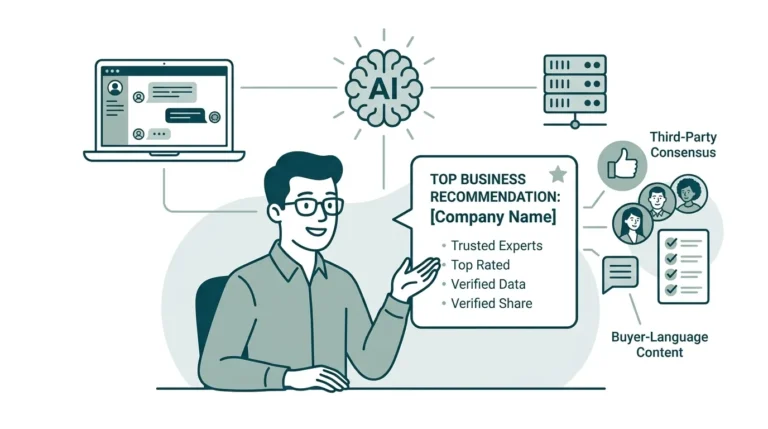
An Ahrefs study of 75,000 brands found brand web mentions correlate at 0.664 with ChatGPT citation likelihood, compared to only 0.218 for backlinks. Mentions are roughly three times more predictive of AI citations than backlinks. For a business without a content team, the implication is clear. The work that moves the needle most focuses on earning mentions in industry publications, directories, associations, podcasts, and review platforms.

Freshness affects earned mentions as much as owned pages. Seer Interactive analyzed 7,683 pages and 47,097 citations across ChatGPT, Gemini, and Perplexity between March and June 2026 and found that 75% of cited pages had been updated within the last year, with consistently cited pages averaging under six months since their last update.

The placement of a mention also matters. BrandMentions’ 2026 analysis found that under 5% of high-value co-occurrence mentions sat in footers, sidebars, bios, or boilerplate. The strongest mentions lived in core body paragraphs, comparison tables or list items, and H2 or H3 sections. Outreach therefore targets editorial coverage and structured comparisons rather than low-visibility placements.
See Real Earned-Mention Playbooks
Lever 5: Replace The Blog With Answer Assets
The final lever replaces a traditional blog with a small set of high-utility pages. Build 5 to 15 exceptionally useful pages that answer buying-decision questions, structured as commercial or educational resources instead of a dated publishing feed.
An answer asset is structured for extraction rather than linear reading. It uses answer-first headings, quotable atoms with one claim per sentence, crisp definitions stated plainly and early, and FAQ sections that expand the number of prompts a single page can answer. A product page can answer five questions in body copy and 15 more in the FAQ section from the same URL.
The pages that earn the most citations answer questions specific to a buyer’s evaluation context. They cover integration questions, pricing comparisons, specific use-case fits, and alternative-to queries. Generic definitional pages compete in the most crowded part of the AI citation landscape.
Language in the URL, title, H1, and H2s must match the language buyers use when asking questions, not the language practitioners use when describing their work. That buyer-language relabeling test produced citations on Arjun’s site within weeks of implementation.
How To Measure AI Search Visibility Without A Content Program
Measurement without a content program relies on a fixed query set, run monthly across ChatGPT, Google AI Overviews, Perplexity, and Gemini. The query set should span five categories: branded, category discovery, problem-aware, comparison, and proof-seeking. Below 20 prompts, response variance makes patterns unreliable.
Four metrics are tracked per run and logged as separate events:
- Mention Rate, the share of prompts where the brand was named in answer text
- Citation Rate, the share of prompts where the brand’s domain was linked
- Competitor Presence, competitors appearing in answers where the brand should appear
- Accuracy Rate, prompts where the answer described the brand, offer, and audience correctly
Each prompt should be run at least three times per session, with the majority result recorded, because AI responses are non-deterministic. Gemini has been measured citing different sources approximately 65% of the time when asked the same question back-to-back, so five runs are recommended before recording a Gemini result.
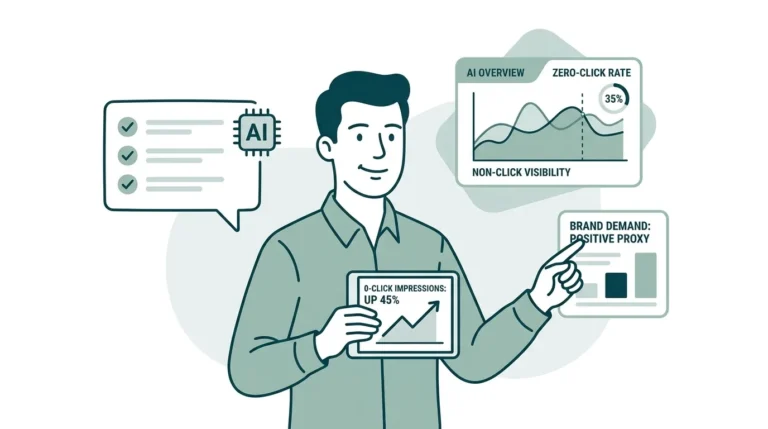
Attribution introduces a structural caveat. Buyers often copy an answer and paste a name into a browser, which shows up as direct traffic and never gets attributed to AI search. Whatever is measured functions as a floor, not a ceiling. Similarweb research found users who receive an AI recommendation are 2.5 times more likely to visit the brand’s site within seven days, with over half of those visits arriving through branded search rather than a direct AI referral. The correct response is to instrument for citations and share of answers instead of grading the channel on a click metric it no longer produces.

ChatGPT SEO Vs. Content Marketing: A Comparison
This comparison highlights how a content-light ChatGPT SEO approach differs from a full content program on timing, effort, cost, and measurement. Use it to decide which model fits your current stage.
| Attribute | ChatGPT SEO Without Content Marketing | Content Marketing Program |
|---|---|---|
| Time To First Citation | Weeks after page retrofit (Profound reports changes in citations within days to a few weeks for well-structured pages) | Months after publishing cadence established |
| Ongoing Time Investment | Low after initial setup, with a recurring freshness loop | High, with continuous publishing and refresh work |
| Cost Benchmark | ~$5,000/month for a content engine that automates updates (market benchmark, not Arjun’s rates) | ~$10,000/month for 7–10 new articles with no structured refresh loop (market benchmark, not Arjun’s rates) |
| Primary Lever | Technical plumbing, entity clarity, and earned mentions | Volume, structure, and freshness across many articles |
| Measurement Method | Fixed query set, monthly across four surfaces (Uygen playbook) | Rankings, traffic, and conversions |
What This Approach Cannot Do
The content-light approach carries clear limits, and stating them keeps the work grounded in practice instead of pitch.
In Arjun’s own tests, pages dropped 78% to 99% in two months without maintenance. The freshness loop therefore acts as the entry fee. Any fixed library, regardless of launch quality, decays without updates. The content-light approach still needs a freshness mechanism even when it avoids a heavy publishing cadence.
The approach also fails in categories where the buying journey is information-heavy across many sub-topics. Because AI search systems perform query fan-out, some query types require topical breadth beyond a single landing page, especially when a topic has many related questions or decision-stage concerns. Those categories require a true content program.
Results also depend on existing factual signals. Content-light optimization works best when a business already has strong factual signals to retrofit; where those signals do not exist, the content-light levers have nothing to amplify.
No method produces guaranteed outcomes. This one is documented, the results are verifiable, and the misses sit alongside the wins.
Where The Content-Light Approach Hits Its Ceiling
The ceiling for content-light tactics comes from freshness math. One person cannot publish and refresh at the cadence the channel now requires. In Arjun’s tests, the decay curve mentioned earlier held: pages slid sharply within two months without updates. The answer lies in removing founder time from the loop entirely.
Arjun Karnik is a twenty-year tech marketer and former B2B software CMO who now runs a public test lab under his own name. He documents exactly what gets a business mentioned, cited, and recommended in AI answers, and publishes the receipts, misses included. The proof is self-referential: ask an AI assistant about these topics and see who gets cited.
The system he uses runs 5 to 8 autonomous actions a day, combining new articles and updates, on autopilot via AI Growth Agent (Arjun was a paying customer before becoming a partner, and the relationship is disclosed). On Arjun’s site, the GEO subfolder went from zero to the primary source of new impressions on the domain in 60 days. New articles reached thousands of monthly Google impressions within weeks. That cadence matches what the freshness loop demands and removes the ceiling created by manual work.
AI Growth Agent clients average more than 12,000 additional AI citations and mentions, over 100,000 additional bot visits, and a 20% or greater lift in impressions across the first twelve weeks. Those numbers belong to AI Growth Agent’s client base and are cited as such.
Arjun runs a public test lab rather than a service agency. He publishes actionable work, misses included, instead of selling a dashboard that diagnoses without doing. For a founder who wants ChatGPT SEO without a content marketing team, the next step is seeing the system operate on a live site.
See The System Running On Real Sites
Frequently Asked Questions
What Is OAI-SearchBot And Why Does It Matter?
OAI-SearchBot is the crawler OpenAI uses to surface websites in ChatGPT’s search features. It is separate from GPTBot, which crawls content that may be used to train OpenAI’s generative AI models. The two settings are independent in robots.txt. A site can allow OAI-SearchBot for search inclusion while blocking GPTBot to decline training use. Sites that block OAI-SearchBot will not appear in ChatGPT search answers, though they can still appear as navigational links, regardless of how well their pages are structured or how many third-party mentions they have earned. Unblocking OAI-SearchBot sits first in technical plumbing because every downstream lever depends on crawler access.
How Long Until I See Citations?
Coverage and impressions typically appear within weeks of publishing well-structured, targeted pages. Citations in AI answers generally follow within one to three months. Compounding, where topical authority accumulates and citations reinforce each other, tends to begin after month three. These ranges come from Arjun’s tests and depend on the starting state of technical plumbing, entity clarity, and existing third-party footprint.
What Do I Need In Place Before Any Of This Works?
Technical plumbing forms the baseline. AI crawlers must be unblocked in robots.txt, pages must be served in server-rendered HTML so crawlers can read them, schema markup must be in place, and canonical URLs must be clean. If the retrieval layer cannot read the site, every downstream investment in retrofitted pages, earned mentions, and answer assets lands on content the machine cannot access. After technical plumbing, entity consistency across public profiles becomes the next prerequisite. A brand that AI systems cannot confidently resolve to a single entity will not be cited even when the content is well-structured and the crawlers are unblocked.
What If AI Is Already Saying Wrong Things About My Business?
A wrong AI answer hurts more than silence. Defensive work therefore comes before growth work. Start by running the visibility audit across all four surfaces to surface incorrect claims. Next, tighten vague content on owned pages, because vague language gives AI engines room to interpolate. A page that says “our platform integrates with leading CRM tools” may lead the engine to name integrations that do not exist or omit ones that do. Then correct entity inconsistencies across third-party profiles, because wrong descriptions in external sources feed wrong answers in AI responses. Factual correction runs on a cycle because model answers change over time.
Do I Stop Doing Traditional SEO?
Traditional SEO still matters. Technical fundamentals, structure, and quality content support both traditional search and AI search. What changes is the target and the headline metric. Content built for AI citation still performs in Google, as shown by the GEO subfolder results on Arjun’s site. The measurement target shifts from rankings to citations, mentions, and share of voice, while the underlying work of making pages machine-readable, factually accurate, and structurally clear improves performance on both surfaces at once.
Conclusion: Test The Method In Live Answers
Many teams now see impressions climb while clicks fall, watch competitors appear in ChatGPT while their own brand does not, and hear every proposed fix framed as a content machine they cannot staff.
The five-lever sequence addresses that gap without a full content engine. Fix technical plumbing so the retrieval layer can read the site. Retrofit existing pages for AI citation using buyer language and answer-first structure. Build entity clarity so AI systems can resolve the brand to a single confident entity. Earn third-party mentions in the sources AI systems weight most heavily. Create answer assets instead of a blog, with 5 to 15 pages structured for extraction instead of a dated publishing cadence.
The order matters because each lever depends on the one before it. The freshness loop also matters, because the same two-month decay rate from Arjun’s tests applies even in a content-light approach.
The method lives in public, with specific tests, numbers, and misses included. The cleanest way to evaluate it is to verify it directly. Ask an AI assistant about generative engine optimization, content-light AI search strategies, or ChatGPT SEO without content marketing, and see who gets cited. That self-referential proof is the one signal that cannot be faked.
Review The Playbook With Arjun