Written by: Arjun Karnik, Growth Marketing Specialist
Key Takeaways
- Generative engine optimization (GEO) shapes content so AI assistants cite, mention, and recommend your business inside machine-generated answers instead of traditional rankings.
- The retrieval pipeline has six stages: prompt, fan-out queries, retrieval, reranking, synthesis, and citation. Retrieval and reranking together drive roughly 70% of citation outcomes.
- Aligning content to fan-out sub-queries and buyer language increases citation likelihood. Formatting-only changes show no measurable gain, while original data and clear structure together move results.
- Content freshness drives visibility. Pages can lose 78–99% of visibility within two months without updates, and 75% of cited pages were refreshed within the last year.
- Ready to test how this plays out on your own site? See how your content performs in AI answers and compare who gets cited when assistants cover your topics.
What Generative Engine Optimization (GEO) Actually Means
The term appeared first in arXiv:2311.09735, Submitted 16 November 2023 and Accepted to KDD 2024, authored by Pranjal Aggarwal, Vishvak Murahari, Tanmay Rajpurohit, Ashwin Kalyan, Karthik Narasimhan, and Ameet Deshpande. That paper defines generative engines as systems that use large language models to gather and summarize information to answer user queries, and defines GEO as the first paradigm that helps content creators improve their content’s visibility in generative engine responses. A 2026 arXiv Paper on GEO Stages extends that framework into a multi-phase model of how visibility compounds over time.
GEO differs from SEO. SEO focuses on rankings on a human-readable list. GEO focuses on citation inside a machine-generated answer. The buyer-facing outcome reduces to three verbs: mentioned, recommended, cited. A business appears in the answer or it does not, and there is no second page.
The audience scale makes this shift material. Sundar Pichai Reported at Google I/O on May 19, 2026 that AI Overviews had surpassed 2.5 billion monthly active users and AI Mode had reached over 1 billion monthly active users in its first year. OpenAI Reported 900 Million Weekly Active ChatGPT Users in February 2026, up from 800 million in October 2025. AI assistants already function as the primary search surface for many buyers.
How Generative Engine Optimization Works in Practice
The retrieval pipeline forms the spine of GEO, and ranking explainers rarely cover it concretely. Every AI-generated answer runs through a sequence of stages before a source receives a citation. Each stage filters candidates differently, and the list below walks through the six stages from the buyer’s prompt to the final citation set.
- Prompt. The buyer asks a question in natural language.
- Fan-Out Queries. One prompt triggers dozens of hidden retrieval queries underneath. Google Officially Documents This Technique, describing AI Mode as “breaking down your question into subtopics and issuing a multitude of queries simultaneously.” Ekamoira Research Analyzing 72,000+ AI-Generated Queries Found That a Single Prompt in ChatGPT or Gemini Routinely Triggers 8–10 Parallel Queries before an answer is returned. DataForSEO’s 2026 Study of 100,000 ChatGPT Prompts Found That 47.5% Triggered a Query Fan-Out, with high-volume prompts triggering fan-out 51–55% of the time. The buyer never sees these queries.
- Retrieval. The engine pulls candidate sources for each fan-out query using keyword and embedding-based matching. Citevera’s 2026 Pipeline Analysis notes that if a page does not surface at this stage, later stages never see it. ChatGPT retrieves through a Bing-based index, Perplexity uses its own index, and Gemini retrieves from Google’s search index.
- Reranking. Candidates are scored for relevance, structure, and recency. Citevera’s 2026 Analysis reports that retrieval and reranking together account for roughly 70% of citation outcomes. A retrieval set of 50–200 candidates narrows to a working set of 5–20.
- Synthesis. The answer is assembled from what survives the reranking stage.
- Citation. Sources are named or linked. The final cited set may be only 0–5 of the working set, depending on answer length and confidence.
Why Fan-Out Queries Drive Most GEO Wins
Content tuned only to the visible prompt ignores the surface that actually decides citation. Surfer SEO’s Analysis of 173,902 URLs Found That Pages Are 161% More Likely to Be Cited in Google AI Overviews if They Also Rank for Fan-Out Sub-Queries, and that 68% of AI-cited pages do not rank in the traditional top 10. Content that ranks can still go uncited because the machine evaluates the page against dozens of sub-queries the buyer never typed.
Adding Statistics Increases AI Citation Visibility by Around 31–33% and Adding Quotations by Around 41–43%, According to the Princeton GEO Study. Structure and specificity are what the retrieval layer rewards, not prose quality alone.
To see how the retrieval pipeline treats your own content, run your buyer prompts through a live GEO review and compare which sources assistants cite today.
GEO vs. SEO: What Actually Changes
Once the retrieval pipeline is clear, the difference between SEO and GEO comes down to what each discipline targets at every stage. The table below maps five dimensions where the two approaches diverge and shows how those differences affect visibility.
| SEO | GEO | |
|---|---|---|
| Optimizes for | Human-ranked lists and domain authority | Machine retrieval and citation |
| Query model | The query the buyer typed | Dozens of hidden fan-out queries triggered by one prompt |
| Success metric | Rankings | Citations, mentions, share of voice |
| Where authority comes from | Backlinks and domain authority | Expert topical coverage |
| What sustains a win | Accumulated domain authority | Continuous freshness, in a game that resets weekly |
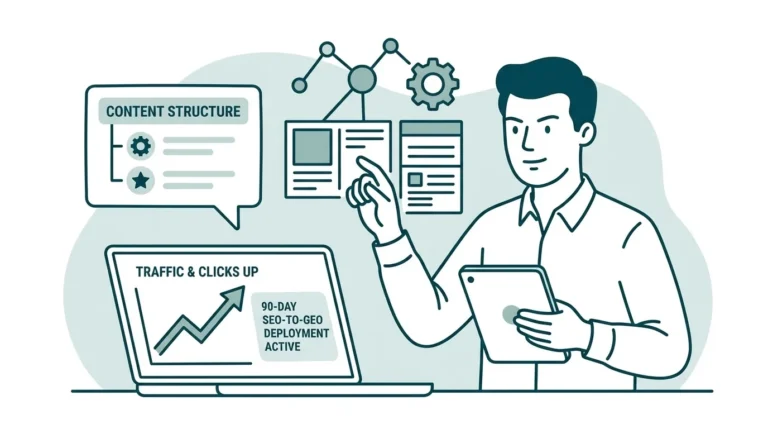
GEO sits on top of SEO fundamentals. Technical health, structure, and quality content still gate everything. Citevera’s 2026 Analysis identifies five signals that consistently improve retrieval: question-shaped headings, full-vocabulary term coverage, stable URLs, server-side rendered HTML, and inclusion in sitemap.xml. As noted earlier, content built for citation still performs in Google. On Arjun’s own site, articles reached thousands of monthly Google impressions within weeks, and the GEO subfolder became the only source of new impressions on the domain in 60 days.
The pain that signals this shift shows up clearly: “impressions up, clicks down” in Search Console. The Pew Research Center Tracked 900 US Adults Across 68,879 Google Searches in March 2025 and found an 8% click rate when an AI summary appeared, against 15% without one. The content still gets read and used to construct answers. It simply sends far fewer visitors to the site. G2’s March 2026 Survey of 1,076 B2B Software Buyers found that 69% switched their intended vendor based on what an AI assistant told them, and 33% bought from a vendor they had not previously heard of. Being in the answer functions as a vendor-selection event, not just a visibility metric.
What a GEO Test Looks Like on a Live Site
Most ranking pages avoid dated, first-person tests with controls that show what earned citations and what did not. Arjun runs those tests on his own site and publishes the results.
Test One: Fan-Out Query Alignment
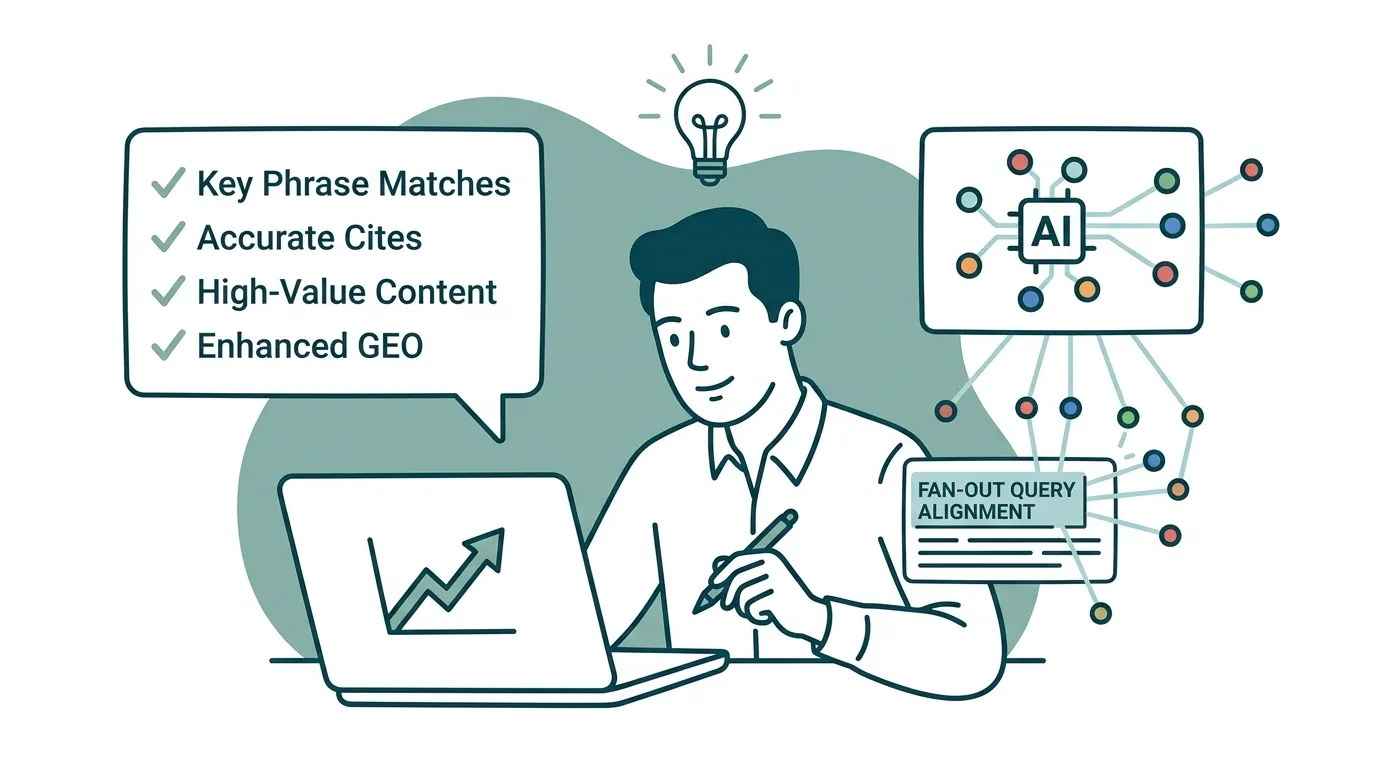
Arjun extracted fan-out queries directly from ChatGPT rather than inferring them from keyword tools, because the target is the machine’s questions, not the human’s. He then rewrote URLs, titles, and H1s to match that language. Pages rewritten to match the extracted fan-out queries earned citations while control pages did not. Approximately 50% of Sources Cited for a Given Prompt Change Within 13 Weeks, which makes holding control pages back essential, because the baseline shifts quickly.
Test Two: Buyer-Language Alignment
A page titled “What Is GEO” was relabelled “How to Get Your Business Recommended by AI Search,” with the slug, title, H1, and H2s all realigned to buyer questions. Citations followed within weeks of that specific change. 76.4% of Pages Cited by ChatGPT Were Updated Within the Prior 30 Days, which means the relabelling worked partly because it triggered a fresh crawl at the same time the language alignment improved retrieval fit.
What Did Not Move Citations
Formatting-only rewrites produced no measurable citation gain. AEO Content’s Six-Week Controlled Experiment Found That Zero of Nine Format-Only Pages Gained a Measurable Citation, while eight of eleven pages that added at least one original data point gained citations within six weeks. Formatting creates extractable structure, and original data provides extractable substance. Both are required. One without the other returns nothing measurable. Arjun’s tests confirmed the same pattern: restructuring without language realignment produced no citation movement on the control pages.
If you want to validate this method on your own stack, run a controlled GEO test on your content and compare which pages start appearing in AI answers.
Freshness and Decay: Why Visibility Drops So Fast
The tests above show what earns citations, and they also revealed what causes citations to disappear. As the Key Takeaways noted, pages in Arjun’s tests lost up to 99% of visibility within two months without maintenance. That decay stays invisible unless you instrument for it, and by the time it appears in a monthly report the position is already gone.
Independent research points the same direction from a different angle. Seer Interactive’s “Content Recency’s Impact on AI Visibility,” Published July 2026, Analyzed 7,683 Pages and 47,097 Citations Across ChatGPT, Gemini, and Perplexity Between March and June 2026. Their findings confirmed the freshness pattern from the Key Takeaways: three-quarters of cited pages had been updated within the last year, and pages cited consistently across all four months averaged under six months since their last update. Their conclusion inverts the usual instinct. The page you refreshed beats the page you wrote.
Content Freshness Accounts for 40% of Perplexity’s Ranking Signal, and Pages Under 30 Days Old Receive 3.2× More Citations Than Older Content. Because the game resets weekly, volume and cadence are not vanity metrics. They act as the entry fee. On Arjun’s own site, impression-decay tripwires run via AI Growth Agent and auto-queue updates when performance drops, producing content that repairs itself on a loop instead of waiting for a quarterly audit. He discloses the AI Growth Agent partnership.
What Generative Engine Optimization Is Not
Freshness and decay explain what GEO rewards, and they also expose what GEO does not claim to be. GEO is not a replacement for SEO, a tool you buy, or a guarantee of anything. The “isn’t this just SEO with a new name” objection misses the structural difference. SEO earns authority through backlinks and domain authority accumulated over time. GEO earns it through topical coverage that the retrieval layer can match against fan-out queries the buyer never sees. Those differences show up in retrieval mechanics, success metrics, and authority models.
Technical plumbing gates everything. AI crawlers must be unblocked, schema must be in place, and pages must be machine-parseable. Citevera’s 2026 Analysis Warns That Cloudflare’s Default Bot Management Can Flag GPTBot, ClaudeBot, and PerplexityBot as Suspicious Traffic, Often Blocking AI Engines Without Administrators Realizing It. If the retrieval layer cannot read the site, nothing downstream matters.
One more prerequisite belongs before growth work. A wrong AI answer hurts more than no answer. If AI already says incorrect things about a brand, correcting that record comes first. Defensive GEO audits what the assistants currently say and corrects it before any citation-building begins.
FAQ: Applying GEO To Your Own Site
How Do I Know If AI Is Citing Me?
Track citations and mentions across ChatGPT, Google AI Overviews, Perplexity, and Gemini. Run your target buyer questions across each surface on a repeating schedule. As you do this, monitor AI referrers such as chatgpt.com in analytics as a distinct traffic class, because they convert like referrals rather than like search. At the same time, watch impressions and decay curves in Google Search Console to catch visibility drops before they compound. Attach the honest caveat: buyers frequently copy an answer and paste a name into a browser, which shows up as direct traffic and never gets attributed. Whatever you measure is a floor, not a ceiling.
What Do I Fix First?
Start with technical plumbing. Unblock AI crawlers, add schema, and make pages machine-parseable. Without this, the retrieval layer cannot access your content at all, so every later step is wasted. Once access is secured, map fan-out queries by extracting the sub-queries your target prompts trigger and aligning URLs, titles, H1s, and H2s to that language. Finally, publish at a consistent cadence, because a fixed library of any size decays without continuous refreshing. The sequence matters, because skipping the first step means every downstream investment is spent on content the retrieval layer cannot access.
Is GEO Only for Large Brands with Big Content Teams?
GEO works for both incumbents and challengers. Relevance and freshness beat tenure. A challenger who targets specific fan-out queries, situations, and comparisons can outrun an incumbent with a stale library. The reason is that the game resets weekly. GEO rewards topical depth over domain size. A small expert team can appear alongside or ahead of an incumbent because the machine matches a question to the best available answer, not to a seniority list.
How Long Until I See Results?
Coverage and impressions typically appear within weeks. Citations follow in one to three months. Compounding begins after month three. The same pattern held on Arjun’s own site: new articles reached thousands of monthly impressions within weeks, and the GEO subfolder became the only source of new impressions on the domain in 60 days. These are findings from his own tests, not guarantees, and timelines vary by topic competitiveness, technical baseline, and publishing cadence.
Do I Stop Doing SEO?
SEO remains necessary. Technical fundamentals, structure, and quality content serve both surfaces. What changes is the target you optimize toward and the metric you report on. As noted earlier, content built for citation still performs in Google. The measurement target moves from rankings to citations, mentions, and share of voice, tracked across ChatGPT, Google AI Overviews, Perplexity, and Gemini, so the dashboard reflects the channel buyers actually use. GEO sits on top of SEO’s technical foundation rather than replacing it.
Where To Verify GEO in the Wild
Arjun Karnik is a twenty-year tech marketer and former B2B software CMO who runs a public test lab for generative engine optimization under his own name. He documents exactly what gets a business mentioned, cited, and recommended in AI answers, with both the receipts and the misses published. What he runs is not an agency, a tool, or a course. The proof stays self-referential: ask an AI assistant about generative engine optimization and see who gets cited. The system being documented is the same system producing the visibility. He uses AI Growth Agent and discloses the relationship.
Test your own GEO visibility with Arjun by running your buyer questions across ChatGPT, Perplexity, Google AI Overviews, and Gemini, and seeing where your business appears and where it does not.