Written by: Arjun Karnik, Growth Marketing Specialist
Key Takeaways
- The scissors pattern appears when impressions rise while clicks fall because AI surfaces use your content to answer queries without sending visitors.
- Five primary causes drive this pattern: AI Overviews, low-ranking keywords inflating impressions, a shift toward informational queries, weak titles and meta descriptions, and ranking volatility.
- Each cause uses a different Google Search Console filter and a targeted fix, from restructuring content for AI citations to rewriting titles that match buyer intent.
- The channel still works, but the metric used to grade it has changed. Citation share and share of answer now matter more than raw clicks.
- Not sure which branch is yours? See how the test lab diagnoses it in a live demo.
Start With The Five Causes Of The Scissors Pattern
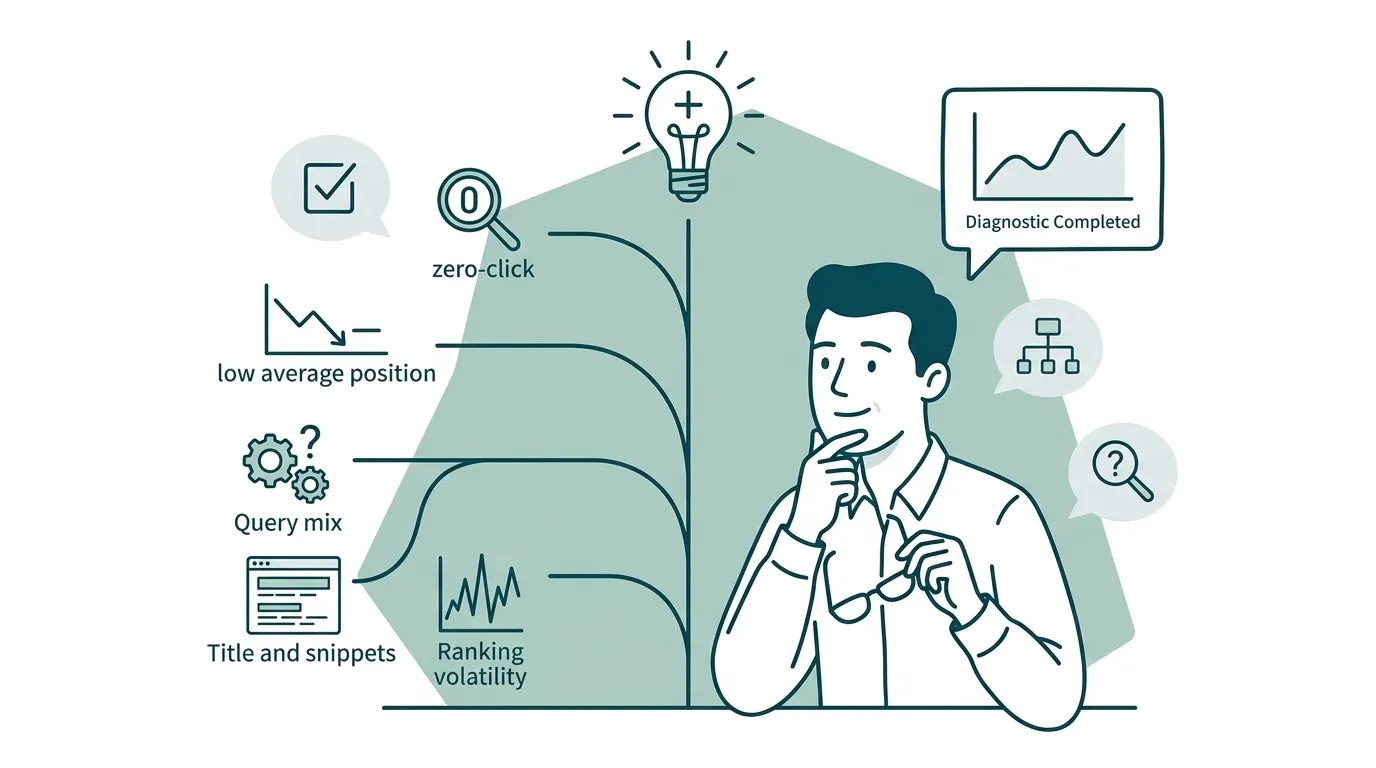
Each cause below has a different fix. Scan the list, then run the decision tree that follows to find yours.

- AI Overviews and zero-click surfaces answer the query before anyone reaches your link.
- Wider keyword reach at low average position inflates impressions without earning clicks.
- A query-mix shift toward informational terms pulls in low-intent searches.
- Weak titles and meta descriptions fail to earn the click at positions where clicks are available.
- Ranking volatility moves pages in and out of click-earning positions.
The rest of this article is a decision tree. Run the filter for each branch, confirm or rule it out, then apply the matching fix.
See how the test lab walks through this decision tree in a live account.
Use This Decision Tree When Impressions Rise And Clicks Fall
The table below is your diagnostic map. Each row pairs a cause with the exact Google Search Console filter that confirms or rules it out, plus the fix to apply when it does. Move through the branches in order, then read the section for the branch that matches your data.
| Diagnostic Branch | GSC Filter To Run | Fix |
|---|---|---|
| AI Overviews | Compare CTR on AIO queries vs. non-AIO queries at same position | Restructure content to earn the citation inside the summary |
| Average Position | Filter to positions 8–20, compare impression share vs. prior period | Report impressions in positions 1–10 only |
| Query Mix | Sort Queries by impressions, check for new low-CTR question queries | Separate branded from non-branded, segment by intent |
| Titles & Snippets | Filter to 500+ impressions, position ≤10, CTR >30% below benchmark | Rewrite titles to match exact intent |
| Ranking Volatility | Compare average position across two 28-day windows | Wait for volatility to settle, repair technical failures |
AI Overviews: The Zero-Click Branch
One-Sentence Answer: AI Overviews answer the query on the results page, and most users never scroll past them to click.
The proof comes from user behavior data. The Pew Research Center tracked 900 US adults across 68,879 Google searches in March 2025 and found an 8% click rate when an AI summary appeared versus 15% without one, roughly half the clicks gone. Links cited inside the summary were clicked only 1% of the time. AI Overviews now appear in approximately 48% of Google search results as of 2026. Similarweb clickstream data shows the zero-click rate for Google searches reached 68.01% in January through April 2026, up from 60.45% in 2024, with only 276 out of every 1,000 searches resulting in a click to the open web.

GSC Filter: Open Performance, go to the Queries tab, and compare CTR on queries where you know an AI Overview appears against comparable queries at the same average position where no AI Overview fires. A CTR gap of 40% or more at the same position is the AIO signal.
Fix: Restructure content to earn the citation inside the summary. Seer Interactive’s 2026 analysis of 53 brands, 5.47 million queries, and 2.43 billion impressions found that being cited inside an AI Overview delivered 120% more organic clicks per impression than not being cited, even though cited pages still underperformed no-AIO queries by 38%. Being in the summary beats being absent from it. Answer-first formatting, a direct claim in the opening sentence, and clean heading structure are the structural requirements.

Average Position: When Low Rankings Inflate Impressions
One-Sentence Answer: New impressions from keywords ranking in positions 8–20 inflate your totals and return almost nothing in clicks.
This cause rarely appears in forum threads. Google’s AI Mode uses query fan-out, decomposing a single prompt into subtopics and issuing multiple sub-searches, so your pages can surface against queries you never targeted at positions that earn no clicks. For example, holding 1,000 impressions at position 5 with roughly 5% CTR yields 50 clicks. Adding 4,000 impressions at position 38 raises impressions 400% while clicks stay at 50, and average position moves from 5 to about 31.
How To Filter By Query In Google Search Console
GSC Filter: Open Performance, click Add Filter, select Position, and set the range to 8–20. Compare the impression share from that band now versus the prior 28-day period. If the band grew materially, fan-out is your cause.
Fix: Stop reporting raw impressions as a visibility metric. Report impressions in positions 1–10 only. That single change makes your trend line meaningful again and separates real visibility gains from tail inflation.
Query Mix: When Informational Searches Drag Down CTR
One-Sentence Answer: Your site gained many new low-CTR informational queries, and their impressions drag down your blended CTR without adding proportional clicks.
Seer Interactive’s 2026 study found that informational queries trigger an AI Overview 36% of the time versus 5% for transactional queries, a roughly 7x gap in AIO exposure. A site that gains informational question-format queries gains impressions at the intent type most likely to resolve without a click.
GSC Filter: Open the Queries table, sort by impressions descending, and scan the new entries in the top 50. If question-format queries such as “what,” “how,” “why,” and “is” drive the impression growth and show CTR below 1%, query-mix shift is your cause.
Fix: Separate branded from non-branded queries using the filter “Queries not containing [your brand name].” Then segment by intent. Decide deliberately whether to build out informational queries for AI citation or deprioritize them in favor of commercial and navigational terms where clicks still flow.
Titles And Snippets: The High-Impression, Low-CTR Branch
One-Sentence Answer: Pages ranking where clicks are available fail to earn them because the title and meta description do not match the searcher’s exact intent.
Ahrefs’ July 2026 CTR benchmark study, based on anonymized Google Search Console data from 422,421 real websites, found that a healthy whole-site organic CTR typically falls between 1% and 2%. Pages at position 5 should earn roughly 5–7% CTR. A page at position 4 with a CTR well below the site’s own expected CTR curve for that position, such as 1.5% versus an expected ~6.5%, likely has a snippet problem rather than a ranking problem.
GSC Filter: Filter to pages with 500 or more impressions, average position 10 or better, and CTR more than 30% below the position benchmark. Those are your rewrite targets. (This same filter is referenced in the FAQ below.)
Fix: Rewrite titles to match exact intent in buyer language. In Arjun’s own test lab, a page titled “What is GEO” was relabelled “How to Get Your Business Recommended by AI Search.” The slug, title, H1, and H2s were all realigned to buyer questions. Citations followed within weeks of that specific change on his own site. The principle stays simple: jargon blocks both the machine and the human at the moment they match a question to an answer. Most sites see measurable CTR movement within 2–6 weeks of publishing a title rewrite, with high-authority pages reindexed faster.
See how the test lab rewrites titles for both clicks and citations — book a demo.
Ranking Volatility: When The Pattern Is Just Noise
One-Sentence Answer: Pages moving in and out of click-earning positions produce noisy data that looks like a trend but is not one.
GSC Filter: Compare average position across two 28-day windows for your core queries. Swings of more than three positions on queries that previously held steady indicate volatility rather than a structural shift.
Fix: Wait for the volatility to settle before making changes. Rewriting titles or restructuring content during a volatile period means you measure the ranking change, not the content change. Repair any independently verified technical failures such as accidental noindex directives, broken redirects, or server errors immediately, even during a rollout.
After Diagnosis: Shift The Metric From Clicks To Citations
Once you have identified your branch and applied the fix, the next step is to change how you measure success. The channel is not broken, but the metric you have been using to grade it no longer captures what it produces.
The measurement system that reflects where buyers actually are tracks citations and share of answer across ChatGPT, Google AI Overviews, Perplexity, and Gemini, plus AI referrers such as chatgpt.com in analytics, plus impression and decay curves in Search Console. G2 surveyed 1,076 B2B software buyers and decision-makers across North America, EMEA, and APAC in March 2026 and found that 69% switched their intended vendor based on what an AI assistant told them, and 85% view a vendor more favorably when an assistant mentions it. Being cited is a vendor-selection event, not a vanity metric.

Attach one honest caveat. Buyers frequently copy an answer and paste a name into a browser, which shows up as direct or branded traffic and never gets attributed. Whatever you measure is a floor, not a ceiling.

Arjun Karnik is a twenty-year tech marketer and former B2B software CMO who runs a public test lab for generative engine optimization under his own name, documenting exactly what gets a business mentioned, cited, and recommended in AI answers and publishing the receipts, misses included. He uses AI Growth Agent and discloses the relationship; he was a paying customer before becoming a partner. The 5 to 8 autonomous actions a day run via AI Growth Agent, not on something he built. On his own site, new articles reached thousands of monthly Google impressions within weeks, and the GEO subfolder became the only source of new impressions on the domain in 60 days. The Semrush AI Visibility Index did not report a 40 to 60% month-over-month change in AI citations; that roughly 50% monthly citation volatility figure comes from a separate Similarweb study, while Semrush’s own data reported an average change in prompt coverage of around 120% across the top 100 domains. That volatility makes freshness and cadence table stakes in this channel.
If you decide to bring in outside help, the options narrow quickly. Five alternatives exist for solving this problem, and each fails in a different way. Doing it yourself fails the volume and freshness math. Traditional SEO agencies optimize for lists buyers no longer read. Human content agencies produce unstructured, unrefreshed content at roughly $10,000 a month for 7 to 10 articles with no refresh loop. Cheap one-shot AI content gets buried by freshness bias. New GEO tools report without executing. The test lab is different because it is self-verifying: ask AI search about these topics and see who gets cited.
What Not To Conclude
Before you act on your diagnosis, make sure you are not drawing one of these three common but incorrect conclusions:
- Assume The Channel Behavior, Not A Site Failure. Impressions up, clicks down reflects channel behavior. The content is being read and used in the answer layer.
- Keep Investing In SEO Fundamentals. Technical fundamentals, structure, and quality content serve both traditional search and AI search. As noted earlier, Arjun’s own site saw new articles reach thousands of monthly impressions within weeks.
- Grade The Channel On Citation Metrics. Seer Interactive’s 2026 study found that 75% of cited pages had been updated within the last year, with consistently cited pages averaging under six months since their last update. Citation share now matters more than raw clicks.
Frequently Asked Questions
Why Do I Have A Lot Of Impressions But No Clicks?
Five causes produce this pattern: AI Overviews answering the query before anyone clicks, new keywords ranking in positions 8–20 that earn almost no clicks, a shift toward informational queries with low click intent, weak titles and meta descriptions failing to earn the click at positions where clicks exist, and ranking volatility moving pages in and out of click-earning positions. Each cause has a different fix. The diagnostic sequence in this article identifies which one is yours using filters you can run in Google Search Console today.
How Do I Check Whether My Impressions Are Coming From Low-Ranking Keywords?
Open Google Search Console Performance, click Add Filter, select Position, and set the range to 8–20. Compare the impression share from that band against the prior 28-day period. If a large share of your impression growth sits in that band, fan-out queries at low positions are inflating your totals. The fix is to stop reporting raw impressions as a visibility metric and report impressions in positions 1–10 only, which makes the trend line meaningful again. (See the Average Position section above for the full diagnostic.)
What Is A Good Clicks-Per-Impression Rate?
There is no single universal benchmark. CTR varies by position, query intent, device, and whether an AI Overview is present. As a working reference: position 1 earns roughly 25–30% CTR on queries without an AI Overview, position 5 earns roughly 5–7%, and positions 8–10 earn roughly 2–3%. When an AI Overview fires, position-1 CTR can fall by 58% or more on informational queries. The most useful benchmark is your own site’s CTR curve by position. Compare a page against what your site averages at that position, not against an industry table.
Is This AI Overviews Or My Titles?
Run both filters. AI Overviews suppress clicks across an entire query type regardless of how strong your title is. Weak titles suppress clicks on specific pages at positions where clicks are available. If your CTR gap appears on informational queries at positions 1–5 and matches the pattern of AI Overview-heavy SERPs, it is the AIO branch. If your CTR gap appears on pages ranking in positions 3–10 with high impressions and CTR more than 30% below the position benchmark, it is the titles branch. Both can be true simultaneously on different pages.
Should I Stop Doing SEO?
Continue doing SEO. Technical fundamentals, structured content, and freshness serve both traditional search and AI search simultaneously. Content built for citation still performs in Google. The change sits in what you optimize toward, such as citations, mentions, and share of voice, and what you report on. The scissors pattern signals that the metric you have been using to grade the channel no longer captures what the channel produces.
How Do I Measure This If Clicks Are Disappearing?
Track citation share across ChatGPT, Google AI Overviews, Perplexity, and Gemini. Monitor AI referrers such as chatgpt.com as a distinct traffic segment in analytics, because traffic arriving from those sources converts like a referral rather than like cold search traffic. Watch impression and decay curves in Search Console. Attach the honest caveat that buyers frequently copy an answer and paste a name into a browser, which shows up as direct or branded traffic. Whatever you measure is a floor. The correct response is to instrument for citations and share of answers rather than to keep grading a channel on the metric it no longer produces.
Conclusion: Run The Diagnostic, Then Fix The Right Thing
Impressions up, clicks down is not one problem. It is five, and each has a different fix. The diagnostic sequence is:
- Check whether AI Overviews are suppressing CTR on your informational queries by comparing CTR at the same position with and without AIO presence.
- Check whether new impressions are coming from positions 8–20 by filtering your position band and comparing impression share to the prior period.
- Check whether your query mix shifted toward informational terms by sorting the Queries table by impressions and scanning for new question-format entries.
- Check whether titles and snippets are underperforming by filtering to pages with 500+ impressions, position 10 or better, and CTR more than 30% below the position benchmark.
- Check whether ranking volatility is producing noisy data by comparing average position across two 28-day windows on your core queries.
Find your branch. Apply the fix for that branch. Then shift the metric from clicks to citations, because that metric reflects the channel buyers actually use.
Ready to turn citations into pipeline? See the test lab in a live demo.