Written by: Arjun Karnik, Growth Marketing Specialist
Key Takeaways
- ChatGPT now acts as both an SEO production tool and a citation surface that brands must target, with AI summaries already cutting traditional search clicks by nearly half.
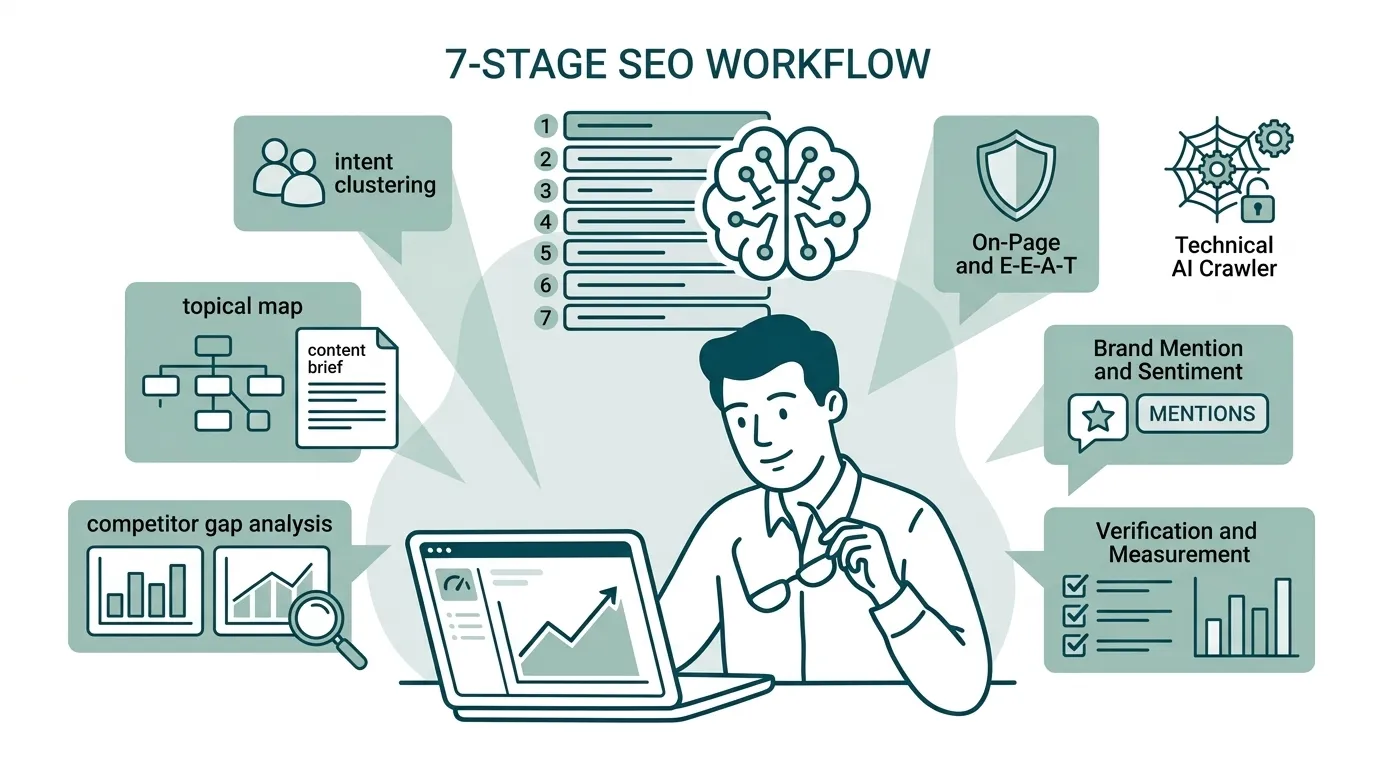
- A seven-stage workflow connects both frames: intent clustering, topical mapping, competitor gap analysis, on-page E-E-A-T work, technical crawler access, off-site brand mentions, and verification at every stage.
- Technical access for AI crawlers is the most under-served yet highest-impact stage, covering robots.txt rules for OAI-SearchBot, ChatGPT-User, and GPTBot plus server-side rendering and sub-500 ms TTFB.
- Structural optimization alone, including answer-first headings, FAQ blocks, and FAQPage schema, has lifted AI citation rates by 17.3% across six generative engines.
- Arjun Karnik’s AI Growth Agent system automates this workflow at 5–8 actions per day; see the AI Growth Agent system applied to your site.
Stage 1: Intent Clustering
Group queries by intent before writing any copy. A prompt that produces a table with columns for intent type, user problem, and page type prevents mismatched content from the start. The exact prompt to run:
“Here are my top 20 queries: [paste list]. Organize them into a table with four columns: query, intent type (informational / commercial / transactional / navigational), core user problem, and recommended page type. Flag any queries where the intent is ambiguous.”
Assign each cluster to a page type before any drafting begins, because a cluster without a destination page is a content gap you have already found. Cross-check the table against Search Console queries for the same URLs to confirm the clusters match real search demand. Any cluster that does not map to an existing page type becomes a new production item.
Today's Action: Run the prompt on your top 20 queries and reconcile the output against Search Console.
See how intent clustering runs automatically across your query set.
Stage 2: Topical Map And Content Briefs
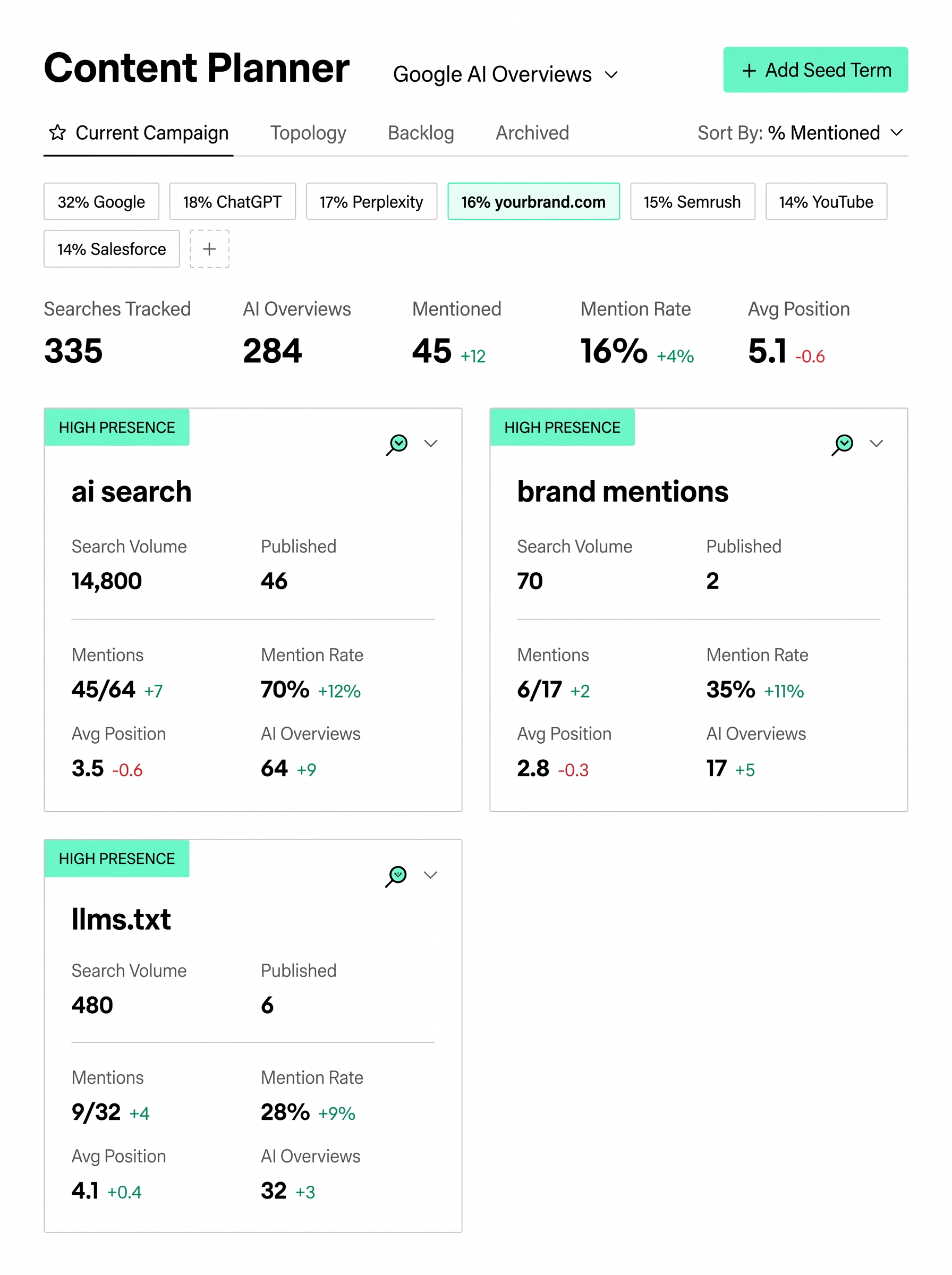
Once queries are clustered by intent, the next step is to organize them into a pillar-and-cluster map and generate briefs using fan-out query extraction. A single buyer prompt triggers dozens of hidden retrieval queries underneath. Focusing only on the visible prompt ignores the surface that AI systems actually use. The exact prompt:
“Act as a content strategist. For the buyer prompt '[your prompt]', list every sub-question a buyer might need answered before committing. Output a table with columns: sub-question, intent type, recommended page type, and whether an existing URL on [your domain] covers it. Flag gaps.”
Turn each brief into a production queue item. In Arjun Karnik's own test on his site, pages rewritten to match extracted ChatGPT fan-out queries earned citations while control pages did not. To verify it worked, confirm every brief maps to a mapped fan-out question before any writing begins.
Today's Action: Extract fan-out queries for one buyer prompt and map them to existing URLs.
Stage 3: Competitor Gap Analysis
With briefs mapped, the next question is what the existing results fail to cover. That gap is where new content earns citations. The framing missing from most ranking competitor articles is asking ChatGPT what your page can provide that the existing results do not. The exact prompt:
“Here are the top three results for '[your head term]': [paste URLs or summaries]. What questions does a buyer still have after reading these pages? What angles, data points, or perspectives are missing? Output a prioritized list of gaps, each with a one-sentence rationale.”
Convert each gap into a section-level brief. AI answer engines cite pages that provide unique, verifiable insight beyond common knowledge, and information gain is a primary differentiator between high-absorption and low-absorption citations. To verify it worked, confirm each gap maps to a real buyer question before assigning it to a writer or production queue.

Today's Action: Run the prompt against the top three results for your head term.
Stage 4: On-Page And E-E-A-T Work
Fix metadata, extractable blocks, and schema so AI models can lift clean structured sections. The March 2026 study cited earlier found that structural optimization alone produces a 17.3% improvement in AI citation rates, and the same lift holds across six generative engines. The exact prompt:
“Review this page content: [paste]. Output: (1) a revised meta title and description under 160 characters each, (2) a direct-answer opening paragraph under 60 words, (3) three FAQ pairs as standalone Q&A blocks, (4) a FAQPage JSON-LD schema block, and (5) an Article JSON-LD schema block with author, datePublished, and dateModified fields.”
Ship the metadata and schema to the page. To verify it worked, run the schema through Google's Rich Results Test and confirm each page opens with a direct answer visible in the raw HTML, not injected by JavaScript after load. JSON-LD structured data injected via Google Tag Manager appears to work in validation tools because those tools render JavaScript, while raw HTML crawlers see no schema at all.

Today's Action: Add FAQPage schema to your five highest-traffic pages.
Stage 5: Technical Access For AI Crawlers
Make the site readable to the retrieval layer so every other stage can work. This remains the most under-served section on the SERP and often has the most direct impact on visibility. The exact prompt:
“Generate a technical access checklist for AI crawler visibility. Include: robots.txt entries for GPTBot, OAI-SearchBot, and ChatGPT-User; an llms.txt file structure at root; server-side rendering requirements; and TTFB targets. Output as a numbered checklist with a pass/fail test for each item.”
The three OpenAI crawler tokens serve distinct purposes. OAI-SearchBot crawls the web to surface pages in ChatGPT search results with no training use, GPTBot crawls content that may be used in training generative AI models, and ChatGPT-User visits pages when a user asks ChatGPT a question. GPTBot and OAI-SearchBot serve different functions: blocking GPTBot leaves ChatGPT search results intact, while blocking OAI-SearchBot removes the site from ChatGPT's search answers. The robots.txt configuration that preserves ChatGPT search visibility while opting out of training is:
User-agent: OAI-SearchBot/Allow: /User-agent: ChatGPT-User/Allow: /User-agent: GPTBot/Disallow: /(if opting out of training)
Match rules on the product token, not the full user-agent string. Version numbers change and a rule keyed to GPTBot/1.4 stops matching once OpenAI ships a new version. Each OpenAI agent needs its own User-agent line rather than a comma-separated list.
On TTFB, GenReady classifies TTFB into three bands: under 500ms is fast for AI crawler indexing, 500–1,000ms is acceptable, and over 1,000ms carries a real risk of timeout. For real-time retrieval crawlers, if a server takes longer than approximately 500 milliseconds to respond, the AI system selects a faster source and the user never notices the absence. On rendering, many AI crawlers do not execute client-side JavaScript. Content rendered only through React, Vue, or Angular may therefore be invisible to them, which means critical content must be present in the initial HTML response.
On llms.txt, publish the file at root and confirm it serves as plain text rather than an HTML shell. Google states it does not use llms.txt, and no major AI provider has confirmed inference-time use of the file. Many AI development tools, agentic systems, and coding agents do read it, however, and the implementation cost is trivial, roughly a one-evening exercise. Publish it as a curated index of 10–30 high-value pages with descriptions written for the machine, not the human.
To verify it worked, fetch your own /robots.txt and confirm the three OpenAI tokens appear as intended with no catch-all User-agent: * / Disallow: / above them. Check server logs for 403 or 429 responses to AI crawler user agents. Those response codes indicate the server or CDN is blocking bots even when robots.txt allows them.
Today's Action: Fetch your own /robots.txt and confirm GPTBot, OAI-SearchBot, and ChatGPT-User appear as intended.
Stage 6: Off-Site Brand Mentions And Sentiment
Build the third-party record the assistant reads before it recommends a brand. Generative engines show a systematic bias toward earned media, meaning third-party authoritative sources, over brand-owned and social content. The exact prompt:
“I need to build third-party brand mentions for [brand] in the category [category]. For each of the following platforms — Reddit, G2, Trustpilot, YouTube — give me: (1) the specific subreddits or communities where buyers discuss this category, (2) the review request cadence that produces the most recent reviews, and (3) one specific action I can take this week. Output as a brief per platform.”
G2, TrustRadius, and Capterra are heavily indexed by AI engines and frequently cited for comparative buyer questions, and the volume and recency of reviews on these platforms directly influence whether AI engines recommend a brand. Assign one owner per platform and a review-request cadence. To verify it worked, run a clean-session prompt asking an AI assistant who the best options are in your category and check whether the brand name appears in the answer.
Today's Action: Request reviews from your five most recent customers with a direct link to your G2 or Trustpilot profile.
See how the off-site mention workflow runs without a manual review-request cadence.
Stage 7: Verification And Measurement
Baseline citations and recheck after each change so you can see what moved. The exact prompt:
“I want to track AI citation performance for [brand] in [category]. Give me: (1) a list of 10 prompts to run monthly across ChatGPT, Perplexity, and Google AI Overviews to check whether [brand] is cited, (2) a Search Console analysis checklist covering impressions trends, click divergence, and decay signals, and (3) a log template with columns for date, platform, prompt, cited (Y/N), and position in answer. Output as a numbered checklist.”
Google launched dedicated Search Console generative AI performance reports on June 3, 2026, providing impressions data for AI Overviews and AI Mode. These reports rolled out to all websites worldwide on August 31, 2026. AI Overview traffic now appears inside Search Console Performance reporting. Traditional and AI metrics share the same data layer, with a dedicated view added on top.
In Arjun Karnik's tests on his own site, pages dropped 78% to 99% in two months without maintenance. That decay remains invisible unless the site is instrumented for it. AI Growth Agent clients average more than 12,000 additional AI citations and mentions and a 20% or greater lift in impressions across the first twelve weeks. Log the baseline before any change and set a recheck date 30 days out.

Today's Action: Record your current citation count across ChatGPT, Perplexity, and Google AI Overviews using a clean browser session for each platform.
ChatGPT As A Tool Vs. GEO As A Discipline
The seven stages above describe what to do. What sustains the results is a separate question, and it comes down to the difference between using ChatGPT as a tool and treating GEO as a discipline. ChatGPT as a tool accelerates every stage of the workflow above. GEO as a discipline sustains the results after the tool produces them. ChatGPT alone breaks down at two points: it does not publish or refresh content at machine cadence, and it does not monitor citation decay. A system that publishes and refreshes at cadence converts tool output into compounding visibility.

The table below shows where the two frames diverge and why the tool alone stalls at the two points that matter most.
| Attribute | ChatGPT As A Tool | GEO As A Discipline |
|---|---|---|
| What It Optimizes For | Producing structured output faster | Citation inside AI-generated responses from systems such as Google AI Overviews and ChatGPT |
| Query Model | The prompt the user types | Dozens of hidden fan-out queries triggered by one buyer prompt |
| Success Metric | Output quality per session | Citations, mentions, and share of voice across ChatGPT, Perplexity, Google AI Overviews, and Gemini |
| What Sustains A Win | Static output after generation | Continuous freshness, with pages under 30 days old receiving 3.2× more citations than older content |
For a deeper look at the full 8-job playbook and how to show up in ChatGPT answers specifically, the linked pieces cover ground this article references rather than restates. The walkthrough below runs the entire seven-stage workflow end to end.
Watch the full workflow walkthrough or book a demo to see it applied to your site.
Who Runs This Workflow
The workflow above is not theoretical. It is the same process documented publicly on Arjun Karnik's test lab. Karnik is a twenty-year tech marketer and former B2B software CMO who runs a public test lab under his own name, documenting exactly what gets a business mentioned, cited, and recommended in AI answers, with the receipts, misses included. He runs a public test lab under his own name rather than operating as an agency, tool vendor, or course creator. The test lab is the proof: ask an AI assistant about generative engine optimization and see who gets cited.
His system runs via AI Growth Agent, a partnership he discloses, at 5 to 8 autonomous actions a day combining new articles with updates to existing ones. On his own site, new articles reached thousands of monthly Google impressions within weeks. The GEO subfolder went from zero to the only source of new impressions on the entire domain in 60 days. The fan-out rewrite test described in Stage 2 is the clearest example of this. Relabelling a jargon page to buyer language produced citations within weeks.
The method is self-verifying. Ask an AI assistant about these topics and see who gets cited. No guarantees of any outcome are made, and the ~$5,000 and ~$10,000 monthly figures referenced in market comparisons are category benchmarks, not his rates.
Book a demo to see the ChatGPT SEO workflow running on a live site.
Frequently Asked Questions
{ “@context”: “https://schema.org”, “@type”: “FAQPage”, “mainEntity”: [ { “@type”: “Question”, “name”: “Can ChatGPT do SEO optimization on its own?”, “acceptedAnswer”: { “@type”: “Answer”, “text”: “ChatGPT produces structured output such as intent tables, content briefs, schema blocks, and gap analyses, but it does not publish, refresh, monitor, or verify. Every stage of the workflow requires a human or an automated system to take the output and ship it. ChatGPT acts as the production accelerator, while the discipline of publishing, refreshing at cadence, and tracking citations converts that output into compounding visibility.” } }, { “@type”: “Question”, “name”: “Is SEO dead with AI in 2026?”, “acceptedAnswer”: { “@type”: “Answer”, “text”: “The target moved from rankings to citations, but the underlying disciplines of technical accessibility, structured content, topical authority, and freshness still serve both surfaces. Content built for AI citation continues to earn Google impressions, and the GEO subfolder results described earlier, with thousands of monthly impressions within weeks, are the proof point. Success metrics now include share of answer and citation count alongside rank position.” } }, { “@type”: “Question”, “name”: “How do you get your brand mentioned in ChatGPT?”, “acceptedAnswer”: { “@type”: “Answer”, “text”: “Three conditions must hold at the same time. The site must be technically accessible to AI crawlers, with robots.txt permitting OAI-SearchBot and ChatGPT-User, pages rendering in server-side HTML, and TTFB under 500ms. Content must be structured for extraction with answer-first headings, one claim per section, FAQ blocks with FAQPage schema, and language aligned to the fan-out queries a buyer’s prompt actually triggers. The brand also needs a third-party record through reviews, Reddit mentions, and earned media, because AI engines cross-reference owned content against third-party sources before citing a brand.” } }, { “@type”: “Question”, “name”: “What are the most common SEO mistakes in 2026?”, “acceptedAnswer”: { “@type”: “Answer”, “text”: “Four mistakes account for most of the gap between sites that earn citations and sites that do not. Publishing without structure leaves AI retrieval systems unable to extract clean answers even when the content is accurate. Blocking AI crawlers accidentally, usually through a catch-all robots.txt disallow or an overly aggressive WAF rule, removes the site from ChatGPT search answers entirely. Having no refresh loop means content decays silently, and the 78–99% two-month decay documented earlier is the clearest argument for a refresh loop. Measuring only traditional rankings while ignoring citation share leaves the dashboard saying everything is fine while the buyer journey moves to a surface that is not being tracked.” } }, { “@type”: “Question”, “name”: “How long does it take to see results from a ChatGPT SEO workflow?”, “acceptedAnswer”: { “@type”: “Answer”, “text”: “Technical fixes such as unblocking AI crawlers and enabling server-side rendering show results within days to about a week, because these changes take effect as soon as the next crawl cycle runs. Structural and schema changes typically produce citation improvements within two to six weeks. Fan-out query alignment and buyer-language relabelling have produced citations within weeks in Arjun Karnik’s own tests. Third-party coverage through reviews, Reddit mentions, and earned media takes three to nine months to accumulate enough signal to move citations consistently, and compounding across all stages typically begins after month three.” } } ] }
Can ChatGPT Do SEO Optimization On Its Own?
ChatGPT produces structured output such as intent tables, content briefs, schema blocks, and gap analyses, but it does not publish, refresh, monitor, or verify. Every stage of the workflow requires a human or an automated system to take the output and ship it. ChatGPT acts as the production accelerator, while the discipline of publishing, refreshing at cadence, and tracking citations converts that output into compounding visibility.
Is SEO Dead With AI In 2026?
The target moved from rankings to citations, but the underlying disciplines of technical accessibility, structured content, topical authority, and freshness still serve both surfaces. Content built for AI citation continues to earn Google impressions. The GEO subfolder results described earlier, with thousands of monthly impressions within weeks, are the proof point here. Success metrics now include share of answer and citation count alongside rank position, and the measurement dashboard needs to reflect both.
How Do You Get Your Brand Mentioned In ChatGPT?
Three conditions must hold at the same time. First, the site must be technically accessible to AI crawlers, with robots.txt permitting OAI-SearchBot and ChatGPT-User, pages rendering in server-side HTML, and TTFB under 500ms. Second, content must be structured for extraction with answer-first headings, one claim per section, FAQ blocks with FAQPage schema, and language aligned to the fan-out queries a buyer's prompt actually triggers rather than the visible keyword. Third, the brand needs a third-party record through reviews on G2 or Trustpilot, mentions in Reddit threads, and earned media in industry publications, because AI engines cross-reference owned content against third-party sources before citing a brand.
What Are The Most Common SEO Mistakes In 2026?
Four mistakes account for most of the gap between sites that earn citations and sites that do not. Publishing without structure, with prose blocks that lack headings, FAQ sections, and schema, means AI retrieval systems cannot extract clean answers even when the content is accurate. Blocking AI crawlers accidentally, usually through a catch-all robots.txt disallow or an overly aggressive WAF rule, removes the site from ChatGPT search answers entirely. Having no refresh loop means content decays silently, and the 78–99% two-month decay documented earlier is the clearest argument for a refresh loop. Measuring only traditional rankings while ignoring citation share leaves the dashboard saying everything is fine while the actual buyer journey has moved to a surface that is not being tracked.
How Long Does It Take To See Results From A ChatGPT SEO Workflow?
Technical fixes such as unblocking AI crawlers and enabling server-side rendering show results within days to about a week, because these technical changes take effect as soon as the next crawl cycle runs. Structural and schema changes typically produce citation improvements within two to six weeks. Fan-out query alignment and buyer-language relabelling have produced citations within weeks in Arjun Karnik's own tests. Third-party coverage through reviews, Reddit mentions, and earned media takes three to nine months to accumulate enough signal to move citations consistently. Compounding across all stages typically begins after month three, when the freshness loop becomes the primary driver of sustained visibility rather than the initial structural work.