Written by: Arjun Karnik, Growth Marketing Specialist
Key Takeaways
- AI search visibility follows a strict sequence: confirm crawler access, audit current AI answers, map fan-out queries, and publish structured buyer-language pages.
- Impressions without clicks often mean AI assistants are consuming the content; missing citations usually cause the gap, not weak content.
- Technical barriers such as robots.txt blocks, WAF rules, or JavaScript-only rendering silently disqualify 73% of sites from AI crawler access before content strategy matters.
- Pages must be refreshed continuously. Cited pages average under six months since last update, and unmaintained pages can lose 78–99% visibility within two months.
See How This Sequence Gets Your Business Recommended By AI Search
How To Get Recommended By AI For SEO
- Verify AI crawlers can reach the site.
- Audit what AI currently says about the business.
- Map the fan-out queries behind buyer prompts.
- Align content to buyer language.
- Publish structured pages at machine cadence.
- Run the freshness loop.
- Measure citations and share of answer.
Step 1: Verify AI Crawler Access Before Anything Else
Three crawlers gate AI search visibility: GPTBot, OAI-SearchBot, and PerplexityBot. Each performs a different job. GPTBot handles potential training data. OAI-SearchBot indexes content for ChatGPT search answers, and publishers must ensure they are not blocking it for site content to appear in ChatGPT summaries and snippets. PerplexityBot indexes content for Perplexity’s real-time retrieval. Blocking any one of them silently disqualifies the site from that surface, regardless of content quality.
The check runs in two places. First, inspect robots.txt for explicit disallow rules targeting these user-agents. Second, check CDN-level and WAF-level configurations, because many security setups block entire categories of non-browser bots and silently override robots.txt. OtterlyAI’s analysis of over one million AI citations found that 73% of audited sites have technical barriers, such as robots.txt blocks or JavaScript-only rendering, that prevent AI crawler access. That pattern is the most common silent disqualifier in the channel.
Robots.txt and WAF rules are only the first gate. Even a site that passes them can still be invisible if its content never reaches the crawler as HTML. JavaScript rendering forms a separate gate. Across more than 500 million GPTBot fetches, Vercel and MERJ found no evidence of JavaScript execution and concluded that none of the major AI crawlers currently render JavaScript. Content delivered only client-side remains invisible. A documented case shows ChatGPT abandoning a pricing table that loaded via JavaScript and citing a third-party site for the numbers instead. If the retrieval layer cannot read the site, nothing downstream matters. Fix this first.
Step 2: Audit What AI Currently Says About Your Business
Start by establishing a baseline before publishing a single new page. Run the business name and its core category questions through ChatGPT, Google AI Overviews, Perplexity, and Gemini. Record where the business is mentioned, where it is cited, where competitors appear instead, and where the answers are wrong.
A wrong AI answer hurts more than no answer. If an assistant tells buyers the business serves a different market, charges different prices, or does not exist in a category it actually leads, that becomes the first priority. Treat this as defensive GEO and run it before any growth work.
This baseline also acts as the control group. Every result from Steps 3 through 7 is measured against it. Without that baseline, there is no way to know whether a content change produced a citation or whether the citation already existed. AirOps’ 2026 State of AI Search research found that only 30% of brands stay visible across back-to-back AI answers. A single snapshot is not enough, so the baseline needs multiple runs per engine to be reliable.
Step 3: Map the Fan-Out Queries Behind Buyer Prompts
A single buyer prompt does not produce a single lookup. It triggers a set of hidden retrieval queries underneath, and the answer is assembled from what comes back. Google AI Mode averages 10.7 sub-queries per prompt, ChatGPT generates 2 to 4, and Perplexity uses a single query 70.5% of the time. Optimizing for the visible prompt while ignoring the fan-out targets the wrong surface. That is why content that ranks can still go uncited.
The extraction method shapes the results. Fan-out queries differ from People Also Ask questions. 85sixty found that 95% of fan-out phrases show zero monthly search volume, yet they gate generative visibility. Keyword tools do not surface them because they have no volume to report.
Three documented extraction methods exist. For Google, the Gemini API with grounding enabled returns the exact sub-queries in the web Search Queries field, which is the most accurate route for Google’s surfaces. For ChatGPT, you can inspect fan-out sub-queries directly in browser developer tools. Open DevTools, go to the Network tab, filter by the conversation ID, and search the JSON response for the word “queries”. The third method requires no tools. Ask ChatGPT or Perplexity directly what sub-questions an AI search engine would research before answering the target query. Run the same prompt five times and keep the themes that recur across three or more runs.
That extraction method produced measurable results on Arjun Karnik’s own site. Extracting fan-out queries from ChatGPT and rewriting URLs, titles, and H1s to match them produced citations on the rewritten pages while control pages stayed uncited. The target is the machine’s questions, not the human’s.
Step 4: Align Content To Buyer Language
Buyer language alignment improves citation odds at the exact moment the machine matches a question to an answer. A page titled in practitioner vocabulary competes poorly against a page titled in the words a buyer would actually type into an assistant.
The fix is mostly relabelling. A page on Arjun Karnik’s own site titled “What is GEO” became “How to Get Your Business Recommended by AI Search”, with the slug, title, H1, and H2s all realigned to buyer questions. Citations followed within weeks of that specific change. The content underneath changed very little, but the language on the surface changed completely.
An Ahrefs study of 1.4 million prompts measured the cosine similarity between page title and query. Cited pages scored 0.602; uncited pages scored 0.484. That makes semantic title match the strongest measured factor in citation. Pages with a clean, descriptive URL slug had an 89.78% ChatGPT citation rate versus 81.11% for pages without one. These gaps show the machine can match a question to an answer directly when labels are clear.
The alignment applies to every structural element: slug, title tag, H1, and H2s. Each one sends a signal the retrieval layer reads before it reads the body. When those signals misfire, the body does not matter.
Step 5: Publish Structured Pages At Machine Cadence
Structure forms the baseline requirement for AI visibility. Because the retrieval layer extracts claims rather than narratives, every structural element has to carry the answer directly. Put query language in URLs, titles, H1s, and H2s. Apply schema everywhere. Use answer-first formatting so the claim can be lifted as one or two sentences without surrounding context. Google AI Overview’s synthesis layer lifts sentences rather than paragraphs, and the clearest predictor of citation is whether the query’s answer can be lifted as one or two contiguous sentences without losing meaning.
On Arjun Karnik’s own site, pages rewritten to match extracted fan-out queries earned citations while control pages did not. New articles reached thousands of monthly Google impressions within weeks. The GEO subfolder went from zero to the only source of new impressions on the entire domain in 60 days. The engine running this is AI Growth Agent, where Arjun is a partner and discloses the relationship, producing 5 to 8 autonomous actions per day and combining new articles with updates to existing ones.
AI Growth Agent clients average more than 12,000 additional AI citations and mentions, over 100,000 additional bot visits, and a 20% or greater lift in impressions across the first twelve weeks. Those are AI Growth Agent’s numbers from their clients, cited as theirs.
Cadence determines coverage across the fan-out space. A Surfer SEO study of 400,000+ searches found pages ranking for fan-out queries are 161% more likely to be cited in Google AI Overviews. Coverage across the full fan-out question space requires volume. One person cannot publish and refresh at the cadence the channel requires.
Watch How Structured Publishing Earns AI Citations
Step 6: Run the Freshness Loop
Freshness keeps citations from decaying. In Arjun Karnik’s tests on his own site, pages dropped 78% to 99% in two months without maintenance. That decay stays invisible unless the site is instrumented for it, and by the time it appears in a monthly report the position is already gone.
Independent research points the same direction. Seer Interactive analyzed 47,097 AI citations across 7,683 pages in ChatGPT, Gemini, and Perplexity between March and June 2026 and found that 75% of cited pages had been updated within the last year, with consistently cited pages averaging under six months since their last update. Their conclusion inverts the usual instinct. The page refreshed beats the page written.

Quattr’s analysis of the AI citation decay cycle found platform-specific citation half-lives of roughly 3.4 weeks for ChatGPT, 4.3 to 4.8 weeks for Google AI surfaces, and 5.7 to 5.8 weeks for Perplexity. AirOps’ 2026 State of AI Search research found that pages not updated for more than three months are over 3x more likely to lose AI citations compared with recently refreshed pages.
The freshness loop in Arjun’s system uses impression-decay tripwires wired to Search Console signals that automatically queue content updates when performance drops, run via AI Growth Agent. The content repairs itself rather than waiting for a quarterly audit. Freshness becomes the hardest thing for a competitor to sustain and the easiest thing for an incumbent to neglect, which makes it a natural place for a challenger to win.

Step 7: Measure Citations and Share of Answer
Measurement shifts from rankings to citations, mentions, and share of voice. Track citation presence across ChatGPT, Google AI Overviews, Perplexity, and Gemini. Segment AI referrers such as chatgpt.com in analytics as a distinct traffic class, because it converts like a referral rather than like search. Monitor impressions and decay curves in Google Search Console.
The Semrush AI Visibility Study found that AI citations change 40 to 60% month over month. A single measurement is a snapshot, not a position. Run the same prompts repeatedly across engines and track the trend, not the individual answer.

One honest caveat applies to every measurement. Buyers frequently copy an answer and paste a name into a browser, which lands in analytics as direct or branded traffic and never gets attributed to the AI answer that caused it. Whatever is measured is a floor, not a ceiling. The practical response is to instrument for citations and share of answer rather than grading the channel on the click metric it no longer reliably produces.

A competitive share of citation for B2B brands in 2026 sits between 5% and 15% aggregate across major AI engines, with 20% or above signaling category leadership. Treat that range as the benchmark.
SEO vs GEO vs AEO: What Changes and What Stays the Same
The People Also Ask set for this topic, including “Is SEO still worth it in 2026?”, “Is SEO no longer relevant?”, and “What is better than SEO?”, reveals genuine confusion about whether AI search replaces traditional SEO. AI search changes the surface and the success metric. The table below shows that the three disciplines share the same technical foundation but diverge on one thing: what you optimize for and what you measure.

| Dimension | SEO | GEO | AEO |
|---|---|---|---|
| Optimizes for | Human-ranked lists and domain authority | Machine retrieval and citation | Direct answer extraction |
| Query model | The query the buyer typed | Dozens of hidden fan-out queries per prompt | The single question asked |
| Success metric | Rankings | Citations, mentions, share of voice | Answer inclusion |
| What sustains a win | Accumulated domain authority | Continuous freshness, with cited pages averaging under six months since last update | Structured, extractable claims |
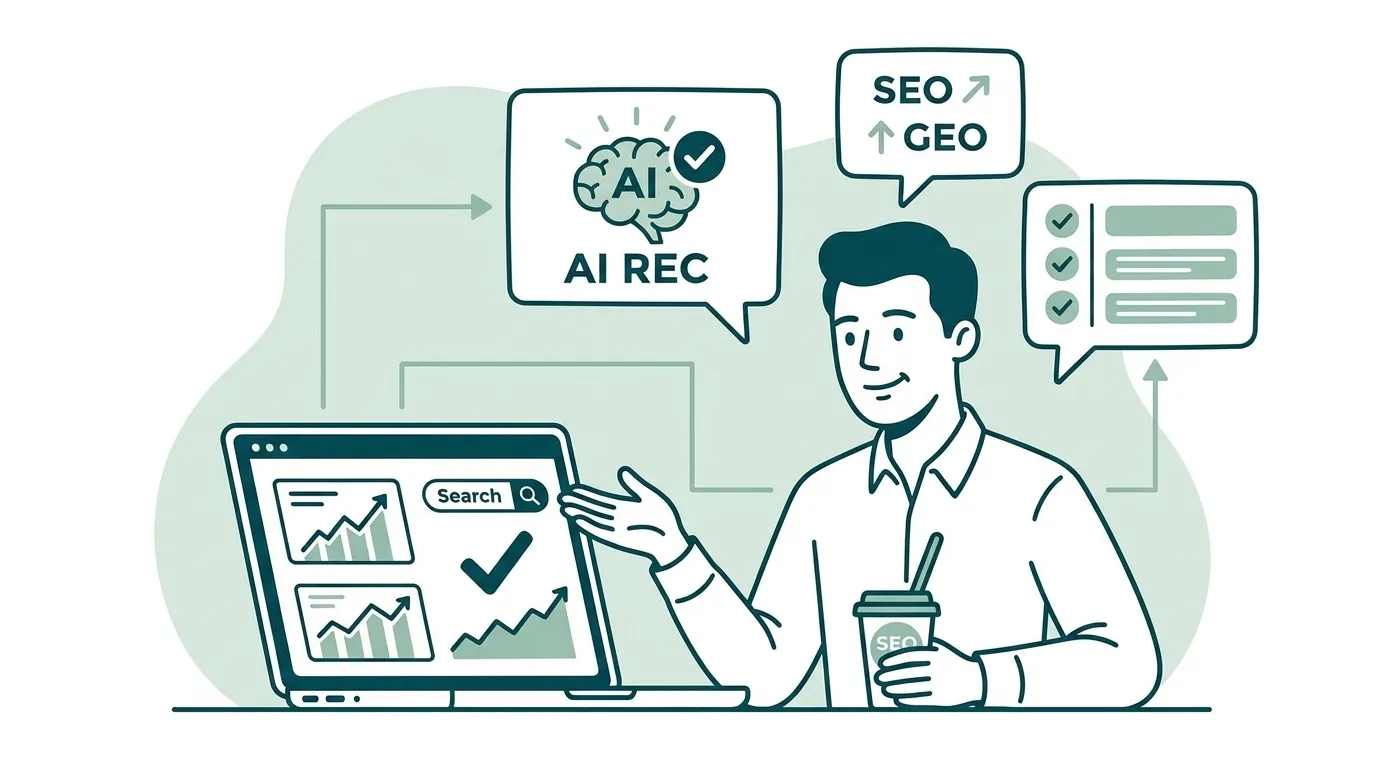
Technical fundamentals, structure, and quality content serve both SEO and GEO. On Arjun Karnik’s own site, articles built for AI citation reached thousands of monthly Google impressions within weeks, and the GEO subfolder became the only source of new impressions on the domain. The target changes. The underlying discipline of publishing relevant, structured, fresh, specific content stays the same.
Frequently Asked Questions
The questions below are the ones buyers and marketers ask most often once they understand the sequence.
Is SEO Still Worth It In 2026?
Yes, and the two disciplines reinforce each other rather than compete. Traditional SEO builds the technical foundation, including crawlable pages, structured data, and topical authority, that GEO depends on. Content built for AI citation still performs in Google organic results. The success metric changes, because rankings measure one surface while citations and share of answer measure the surface where most B2B buyers now start their research. Running both measurement systems simultaneously gives a complete picture of organic visibility.
How Long Until I See a Citation?
Coverage and impressions typically appear within weeks of publishing structured, buyer-language-aligned content. Citations in AI answers usually follow within one to three months for moderate-competition queries. Compounding, where topical authority accumulates and citations become self-reinforcing, tends to begin after month three. The relabelling test described in Step 4 is the clearest example of how fast this can move. No outcome is guaranteed, and timelines vary by category, competition, and how much technical plumbing needs repair first.
What Do I Need In Place Before Any Of This Works?
Three things must be true before content strategy matters. First, AI crawlers such as GPTBot, OAI-SearchBot, and PerplexityBot must be allowed in robots.txt and not blocked at the CDN or WAF level. Second, pages must be server-rendered because AI crawlers do not execute JavaScript. Third, schema markup must be present so the retrieval layer can parse what each section contains without inferring it from layout. When any of these three are missing, content investment produces no citation return. Fix the plumbing first.
Do I Stop Doing SEO?
SEO remains part of the system. The technical work, content structure, and topical authority that SEO builds are the same inputs GEO rewards. The optimization target and the reporting metric change. A business that abandons SEO loses the organic ranking signals that feed AI retrieval, because most AI surfaces still pull heavily from indexed, ranked content. The practical shift is to add citation tracking and share-of-answer measurement alongside rank tracking and to align content structure and language to buyer questions rather than keyword density.
How Do I Measure This If Clicks Are Disappearing?
Measure what the channel currently produces. Track citation presence across ChatGPT, Google AI Overviews, Perplexity, and Gemini using repeated prompt runs. Segment chatgpt.com and equivalent AI referrers in analytics as a distinct traffic class. Monitor branded search volume in Google Search Console as a proxy for AI-driven awareness, because buyers who read an AI answer that names a business often search the brand name directly before visiting. Impressions in Search Console show content consumption even when clicks do not follow. Every one of these metrics understates real impact because of the copy-paste-to-browser behavior that lands as direct traffic, so treat the measured number as a floor.
Can I Do This Myself?
The sequence is documented and executable. The failure mode for doing it yourself comes from arithmetic rather than discipline. The channel requires continuous publishing plus continuous refreshing across a mapped fan-out question space. The 78% to 99% two-month decay mentioned earlier is the default outcome without maintenance. Sustaining that refresh cadence alongside new content production is a full-time function. In a business with zero to three marketers, there is rarely someone available to own it without dropping other work. The sequence works, and the constraint is volume and freshness math.
The Sequence and the Test-and-Learn Approach
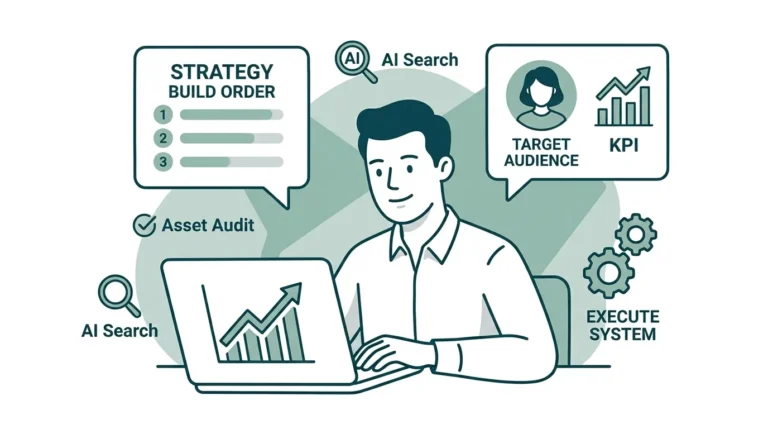
The seven steps run in order because each one is a prerequisite for the next. Crawler access comes first because nothing downstream works without it. The AI audit comes second because a wrong existing answer causes more damage than a missing one. Fan-out mapping comes third because it determines what gets written and in what language. Buyer-language alignment comes fourth because the machine matches questions to labels before it reads body copy. Structured publishing at machine cadence comes fifth because coverage across the full fan-out space requires volume. The freshness loop comes sixth because decay is the default state without active maintenance. Measurement comes seventh because it closes the feedback loop and feeds wins back into production.
The seven steps above work as a system, but they demand a cadence most teams cannot staff. That is the gap Arjun Karnik’s test lab was built to close, a public, self-verifying lab for generative engine optimization where the misses are published alongside the wins. Arjun is a twenty-year tech marketer and former B2B software CMO who runs this lab under his own name, documenting exactly what gets a business mentioned, cited, and recommended in AI answers and publishing the receipts.
The alternatives each miss part of the sequence. Doing it yourself fails the arithmetic, and the alternatives each miss part of the sequence. Traditional SEO agencies still optimize for rankings, human content agencies produce articles the machine cannot parse, and cheap AI content lacks the structure and maintenance the channel requires. New GEO tools diagnose without doing the work. Arjun’s differentiator is that the method is self-verifying and the misses are published alongside the wins. He uses AI Growth Agent and discloses the relationship.
Get Your AI Visibility Baseline and See the Full Sequence In Action