Written by: Arjun Karnik, Growth Marketing Specialist
Key Takeaways
- Generative engine optimization for Perplexity centers on citation engineering. You earn mentions by combining technical access, structured content, and third-party authority.
- Perplexity operates as an answer engine with its own crawler (PerplexityBot), retrieval pipeline, and multi-model stack that favors live web content and real-time freshness signals.
- Technical requirements form the foundation. Allow PerplexityBot in robots.txt, remove noindex tags, verify canonicals, and keep pages live-fetchable without login walls or firewall blocks.
- Content structure drives citation rates. Answer-first passages, buyer-language headings, dated statistics with named sources, and self-contained paragraphs consistently beat traditional prose formats.
- Arjun Karnik runs a public test lab that shows what gets businesses mentioned and cited in AI answers. See the results and book a demo to apply these frameworks to your business.
How Perplexity Works As An Answer Engine
Perplexity is an answer engine built on retrieval-augmented generation (RAG). It retrieves live web passages first. The LLM then writes an answer only from that retrieved evidence, and citations attach claims back to specific URLs. If a page is not in the retrieved pool, Perplexity cannot cite it.
Perplexity’s Multi-Model Stack
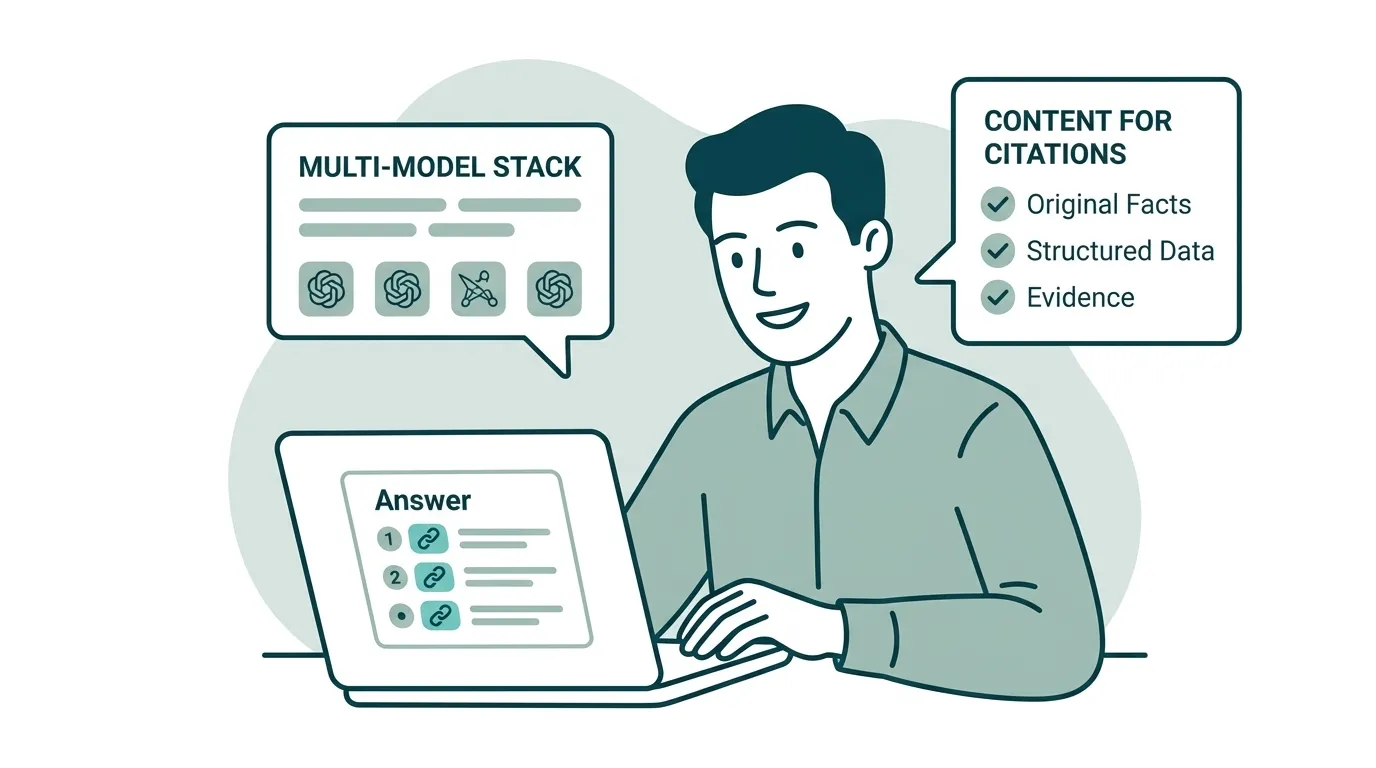
Perplexity uses a multi-model architecture. Its help center lists ten advanced search models available on Pro and Max plans as of September 4, 2026: Sonar 2 (Perplexity), GPT-5.6 Terra and GPT-5.6 Sol (OpenAI), Gemini 3.7 Flash (Google), Claude Sonnet 5 and Claude Opus 5 (Anthropic), Kimi K3 (Moonshot AI), GLM 5.3 (Z.ai), Grok 4.6 (xAI), and Nemotron 3 Ultra (NVIDIA). Perplexity’s help center notes that models can change and the in-product model selector is the source of truth for each account.
How Perplexity Differs From A Simple Wrapper
Perplexity’s help center states that it integrates external models with its own search, citations, tools, prompts, safety systems, and usage limits, so a model in Perplexity can behave differently from the same model in the provider’s standalone product. Perplexity runs its own index, its own crawler (PerplexityBot), and its own retrieval pipeline. Perplexity’s help center also confirms that it operates independently of ChatGPT, with a distinct account and subscription structure.
Claude’s Role Inside Perplexity
Claude sits in the model mix as one option among several. Claude Sonnet 5 and Claude Opus 5 are available on Pro and Max plans as of September 4, 2026. Perplexity’s Deep Research workflow runs on Anthropic’s Claude Opus model (specifically Claude Opus 4.5, according to third-party analyses). Claude supports research-heavy workflows, while Perplexity’s own Sonar models remain the default.
Perplexity As An Engine, Not A Single Model
Perplexity functions as an answer engine that routes queries to multiple LLMs. Its proprietary Sonar family is built on open models like Llama 3.3 70B and fine-tuned for real-time search synthesis.
Perplexity’s Retrieval And Citation Pipeline
Perplexity’s answer pipeline runs five stages: query understanding with intent parsing and query expansion, hybrid retrieval using BM25 plus dense vectors on a live index, cross-encoder reranking of roughly 10 candidates, constrained generation from retrieved chunks, and citation mapping. Its help center simplifies this into three steps: understanding the question, searching the internet for information from authoritative sources, and summarizing the most relevant insights into a coherent answer with numbered citations.
Arjun Karnik runs a public test lab that documents what gets a business mentioned, cited, and recommended in AI answers. The lab publishes the full record, including misses. He is a twenty-year tech marketer and former B2B software CMO.
PerplexityBot And Technical Plumbing
How Perplexity Follows Robots.txt
Perplexity’s help center documents its robots.txt behavior in a dedicated article. The practical requirement is straightforward. Allow PerplexityBot in robots.txt and keep pages live-fetchable. Blocking PerplexityBot removes a site from what Perplexity can cite. Before anything else, confirm that the retrieval layer can actually reach your pages. The checklist below covers the access requirements that determine whether Perplexity can cite you at all.
Technical Access Checklist
- Allow PerplexityBot and Perplexity-User in robots.txt, because blocking either removes the site from what Perplexity can cite.
- Verify canonical tags resolve correctly, since a broken canonical can point the crawler away from the page you want cited.
- Remove noindex from pages intended for citation, because a noindex tag makes the page invisible to retrieval.
- Check Cloudflare and WAF rules against Perplexity’s published IP ranges so security filters do not silently block the crawler.
- Ensure JavaScript rendering does not hide key content from the crawler, especially primary answers and statistics.
- Remove login walls from content intended for citation so Perplexity-User can fetch the page in real time.
The primary sources for Perplexity’s crawler and source-label behavior are: Perplexity Help Center, “How Does Perplexity Work?”, Perplexity Help Center, “Understanding Source Labels”, and Perplexity help center, “How Does Perplexity Follow Robots.txt?”
Those technical requirements are necessary but not sufficient. On Arjun’s own site, the GEO subfolder went from zero to the only source of new impressions on the domain in 60 days. The system runs 5 to 8 autonomous actions a day, including new articles and updates, via AI Growth Agent (Arjun is a partner and discloses the relationship). The results show what becomes possible once access, content, and authority work together.
Content Structure For Perplexity Citations
Perplexity’s retrieval and scoring occur at both document and sub-document levels, segmenting pages into self-contained spans that can be individually retrieved and ranked. Content structured in answer-first, self-contained passages is more likely to be extracted and cited.
Because Perplexity retrieves and ranks individual passages, the tactics that move citation rates are structural rather than stylistic. The list below covers the formatting choices that consistently improve extraction.
- Lead with the answer, then support it with context and detail.
- Use question headings in buyer language that match how people actually search.
- Keep passages self-contained, with one claim per paragraph.
- State crisp definitions plainly and early in the section.
- Include dated statistics with named sources near the relevant claim.
- Use tables and comparisons instead of long prose blocks when possible.
A 2026 arXiv paper by Junwei Yu, Mufeng Yang, Yepeng Ding, and Hiroyuki Sato tested structural optimization across six mainstream generative engines. It found consistent citation rate improvements of 17.3% and subjective quality improvements of 18.5%.
Freshness is not a minor signal. Content updated within the last 30 days earns an 82% citation rate versus 37% for older content, and freshness accounts for roughly 40% of Perplexity’s ranking signal. Seer Interactive’s analysis of 47,097 AI citations across 7,683 pages in ChatGPT, Gemini, and Perplexity between March and June 2026 reinforces the pattern. Seventy-five percent of cited pages had been updated within the last year, and consistently cited pages averaged under six months since their last update.
Original Facts And Evidence For GEO
The arXiv paper “Think Before Writing: Feature-Level Multi-Objective Optimization For Generative Citation Visibility” (arXiv:2604.19113, submitted April 21, 2026) by Zikang Liu and Peilan Xu found that citation behavior is more strongly influenced by document-level content properties than by isolated lexical edits.
According to the Princeton GEO study (Aggarwal et al., ACM KDD 2024), adding statistics increased AI citation visibility by about 33% and adding quotations by about 43% on the study’s position-adjusted word count metric (baseline score 19.5; statistics addition 25.9; quotation addition 27.8). The practical tactics for evidence-rich content are:
- Publish first-party data and benchmarks that others can cite.
- Include surveys with clear sample sizes and dates.
- Quote experts with explicit attribution.
- Attribute every claim to a named source.
Building Third-Party Authority For Perplexity
Perplexity evaluates domains on authorship and demonstrated expertise. Its source-label system marks some citations with a shield icon and classifies domains at the whole-website level into Government, Academic, or Trusted. The source review process checks whether a site corrects its mistakes, identifies authors, and separates news from advertising or opinion.
Reddit appears in 62% of bottom-of-funnel LLM responses across approximately 1,000 commercial-intent prompts and 57,095 citations collected between January 29 and February 4, 2026, which makes forum participation a concrete authority-building lever. The authority-building tactics that apply directly to Perplexity are:
- Run digital PR to earn independent mentions on Trusted domains.
- Secure coverage in industry publications your buyers already read.
- Participate in forums Perplexity cites, including Reddit.
- Appear on podcasts that publish transcripts and show notes.
- Maintain consistent author bylines with real credentials.
How To Measure Perplexity Visibility
Generative search behaves stochastically, so a single answer does not represent a ranking position. The arXiv paper “Don’t Measure Once: Measuring Visibility In AI Search (GEO)” (arXiv:2604.07585, submitted April 8, 2026) by Julius Schulte, Malte Bleeker, and Philipp Kaufmann concludes that generative-search visibility should be characterized as a distribution rather than a single-point outcome, and that repeated measurements are necessary.
The measurement method that accounts for stochastic output:
- Fixed Prompt Set: Run the same 10–20 buyer questions monthly.
- Mention Rate: Percentage of prompts where the brand is named.
- Citation Rate: Percentage of prompts where the brand’s content is cited with a link.
- Citation Share: Brand citations as a percentage of all citations in the answer.
- Claim Accuracy: Whether Perplexity describes the brand correctly.
- Competitor Share: Which competitors appear instead.
Olivier Martinez’s 2026 survey “Optimizing Visibility In Generative Engines” (arXiv:2607.14035) reviewed 45 GEO studies and found substantial run-to-run variability in outputs. The finding supports a measurement-first approach before claiming citation lift. Report confidence intervals or variability rather than one-off screenshots.
Arjun’s tests are published in public, with specific tests, numbers, and misses included. The method is self-verifying, because you can ask an AI assistant about these topics and see who gets cited. See how the measurement framework applies to your business.
Perplexity GEO Checklist
The measurement framework above only works when the underlying foundations are in place. Technical requirements come first. Content structure and authority-building only compound if the retrieval layer can read the site.
Technical
- Allow PerplexityBot and Perplexity-User in robots.txt.
- Verify canonical tags and remove noindex from citation-target pages.
- Check Cloudflare and WAF rules against Perplexity’s published IP ranges.
- Ensure JavaScript rendering does not hide content.
- Remove login walls from content intended for citation.
Content
- Structure pages in answer-first, self-contained passages.
- Use question headings in buyer language.
- Align slugs, titles, and H1s to fan-out queries.
- Include dated statistics with named primary sources.
- Add schema markup.
Authority
- Build third-party mentions on Trusted domains.
- Maintain consistent author bylines with credentials.
- Participate in forums Perplexity cites, including Reddit.
Measurement
- Run a fixed prompt set monthly.
- Track mention rate, citation rate, citation share, and claim accuracy.
- Report variability instead of single-run snapshots.
Perplexity Vs. ChatGPT And Google AI Overviews For GEO
Perplexity retrieves from the web on every query and attaches numbered inline citations to nearly every claim. ChatGPT answers from its trained model first and only runs a web search when it judges the question needs current information. Google AI Overviews sits on top of Google’s existing search index.
Only about 11% of domains cited by ChatGPT are also cited by Perplexity for comparable query sets. Optimizing for one engine does not guarantee visibility in the others. The structural differences that matter for GEO practitioners are:
- Perplexity weights content freshness far more aggressively than Google. Recently updated pages can outrank stronger domains in Perplexity retrieval.
- Google AI Overviews visibility remains connected to traditional ranking strength, while Perplexity visibility depends more on retrieval behavior and source quality.
- Because Perplexity and Google AI Overviews retrieve and rank independently, the same query routinely returns a different set of cited brands on each engine, so a single blended “AI visibility” number misleads.
As the Seer Interactive data cited earlier shows, freshness is not optional. The same pattern holds across engines.
Conclusion: An Evidence-Based, Test-And-Learn Approach
Generative engine optimization for Perplexity is citation engineering. The goal is not to rank but to be cited. Perplexity has no ranking position; it surfaces citations and mentions. Winning requires treating Perplexity as a documented retrieval system. That means allowing PerplexityBot, structuring content in answer-first passages, and aligning to fan-out queries. It also means publishing dated evidence, building third-party authority, and measuring citations as a distribution rather than a single result.
Arjun Karnik’s public test lab publishes the full record, including the misses, of what gets businesses cited in AI answers. He is a twenty-year tech marketer and former B2B software CMO. The method is self-verifying, because you can ask an AI assistant about these topics and see who gets cited.
Get your Perplexity citation audit.