Written by: Arjun Karnik, Growth Marketing Specialist
Key Takeaways
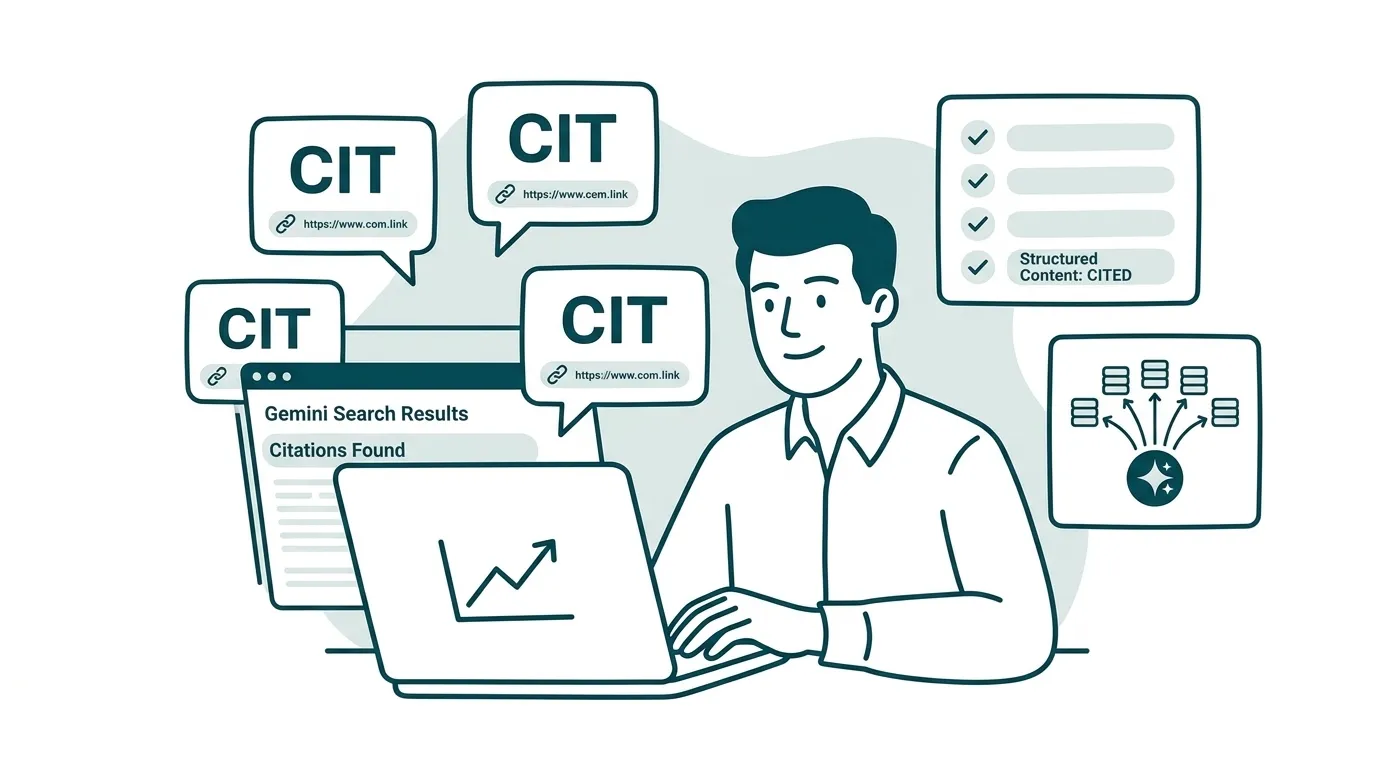
- Generative engine optimization for Gemini means structuring content so Google’s Gemini models retrieve and cite it inside AI-generated answers through live retrieval-augmented generation grounded in Google’s search index.
- Traditional SEO is the entry fee: pages must rank in Google Search and be crawlable, renderable, and eligible for snippets before Gemini can cite them.
- Extract fan-out queries directly from Gemini, then align slug, title, H1, and H2s to that language so each section becomes independently extractable and quotable.
- Apply answer-first formatting, one-claim-per-sentence passages, and Article, FAQPage, and Organization schema to increase the likelihood of citation by roughly 2.7×.
- Arjun Karnik’s public test lab documents this method with receipts, showing how consistent fan-out alignment and freshness maintenance drive measurable Gemini citations.
See How Arjun’s GEO System Works In Practice
How Gemini’s Dual Paths Drive Live Citations
Gemini’s dual-path model shapes how your content gets used. The foundational training data layer contains everything the model learned before its knowledge cutoff. It answers general, stable questions from this layer without running a live search. The live RAG layer behaves differently. For factual, current, or local queries, Google’s Gemini Enterprise Agent Platform documentation defines grounding as connecting model output to verifiable sources, specifically through Google’s own search engine rather than a separate index built for AI.
Each path drives a different content strategy. Training-data citations reward consistent, repeated, entity-clear coverage over time. That is the kind of topical authority that accumulates across dozens of structured pages. Live RAG citations reward pages that rank in Google, are machine-parseable, carry schema markup, and stay fresh. Google’s Gemini API grounding documentation describes a five-stage grounding workflow. The prompt reaches the model with Google Search available. Gemini analyzes whether searching could improve the answer. It creates one or more search queries if needed, processes the retrieved results, and returns a response with inline citation annotations.
The live path is the one a business can influence this quarter. Training data is fixed until the next model update. The grounding layer updates as fast as Google’s crawler indexes new content, which ties GEO directly to your existing search footprint.
Why Traditional SEO Is The Entry Fee For Gemini Citations
Most businesses carry an outdated mental model. They treat traditional SEO and GEO as alternatives, as if work on Gemini replaces work on search. Google’s Search Central guide “Optimizing your website for generative AI features on Google Search,” published May 15, 2026, states plainly: “Our generative AI features on Google Search are rooted in our core Search ranking and quality systems.” Google runs one index. Gemini’s live citations come from Google’s ranking systems, so ranking acts as the prerequisite for GEO.
Google’s guide also confirms that pages must be indexed and eligible to display a snippet. They must be crawlable, renderable, and not blocked by robots.txt or noindex, or Gemini cannot retrieve and cite them in AI features. Google rank is a dominant lever for Gemini citations, and pages that do not rank on roughly page one of Google for the fan-out queries behind a prompt are unlikely to be in the candidate pool, though some cited pages fall outside the top 10.
Content built for citation still performs in Google. On Arjun’s own site, new articles reached thousands of monthly Google impressions within weeks of publication. The GEO subfolder went from zero to the only source of new impressions on the domain in 60 days, measured in Google Search Console.
How Gemini Breaks Prompts Into Fan-Out Queries
One buyer prompt usually triggers a cluster of background searches. Google’s AI optimization guide describes query fan-out as the model issuing concurrent related sub-queries derived from the original prompt. For the example query “how to fix a lawn full of weeds,” the system may simultaneously query “best herbicides,” “remove weeds without chemicals,” and “prevent weeds in lawn.” The answer is assembled from what comes back across all of them.
Independent SEO research has documented AI Mode splitting a single query into roughly eight to twelve background searches before answering. A page can rank number one for the head keyword and receive zero citations in the synthesized answer if it loses on the surrounding sub-queries.
The operational move is to extract fan-out queries directly from the assistant rather than inferring them from keyword tools. The target is the machine’s questions, not the human’s visible prompt. Once extracted, align slug, title, H1, and H2s to that language. Seer Interactive pulled the fan-out queries Gemini generated for the same 100 prompts twice daily for a week and logged 11,029 unique sub-queries. Only 8 appeared in every run, and 99% had no monthly search volume in a keyword tool. Keyword tools miss this surface.
In a documented test on Arjun’s own site, pages rewritten to match extracted fan-out queries earned citations while control pages did not. Alignment to fan-out query language was the isolated variable.
How To Structure Content For Gemini Extraction
Gemini’s synthesis layer extracts passages, not whole pages. For a passage to be retrieved, it should open with a direct answer to the question that section addresses, make sense extracted from surrounding context with no back-references such as “as noted above,” and cover one clear topic within its section.
The structural requirements are:
- Answer-first headings phrased as buyer questions, so each section is independently extractable
- Quotable atoms with one claim per sentence, so a model can lift a single line cleanly
- Article, FAQPage, and Organization schema on every page, because schema markup delivers the 2.7× citation lift noted earlier
- Answer-first formatting in the first 40 to 60 words of each section, because Google’s AI scans pages from the top down looking for the most immediately accessible answer
The buyer-language alignment example from Arjun’s own test lab shows this in practice. A page titled “What is GEO” was relabelled “How to Get Your Business Recommended by AI Search.” The slug, title, H1, and H2s were all realigned to buyer questions. Citations followed within weeks of that specific change. Jargon blocks extraction at the exact moment the machine matches a question to an answer.
How To Optimize A Page For Gemini
The following actions are Gemini-specific and ordered by dependency.
- Confirm pages are indexed and eligible to show a snippet. They must be crawlable, renderable, and not blocked by robots.txt or noindex.
- Extract fan-out queries directly from the assistant and align slug, title, H1, and H2s to that language.
- Lead each section with a direct answer in the first sentence.
- Add Article, FAQPage, and Organization schema to every page.
- Keep the Google Business Profile complete, consistent, and actively maintained. This profile feeds Gemini’s local grounding path as a primary input.
- Refresh priority pages on a loop rather than publishing once. Content freshness is a significant AI ranking signal. Very recent content earns more citations, but the peak citation rate comes from pages aged 30–89 days, which achieve 32.8% compared with 25.3% for content under 30 days old. Much of the freshness advantage comes from updating older URLs rather than publishing new ones.
- Measure citations separately from clicks, because the zero-click path means analytics only capture a portion of the impact.
According to the Princeton GEO study (Aggarwal et al., ACM SIGKDD 2024), adding statistics increases AI citation visibility by roughly 37–41% (Position-Adjusted Word Count) and adding quotations by roughly 28% (Subjective Impression). Both are structural choices you can make in the draft, not stylistic flourishes added later.
See The Gemini Optimization Checklist Applied To Real Pages
How GEO For Gemini Differs From GEO For ChatGPT
Gemini and ChatGPT pull from different retrieval substrates, so the same page can win in Gemini and lose in ChatGPT. The table below shows where the tactical levers diverge.
How Google Business Profile And Local Signals Shape Gemini
Local signals sit at the center of Gemini’s recommendations for nearby services. Google’s Gemini Enterprise Agent Platform documentation lists Grounding with Google Maps as a distinct grounding type from Grounding with Google Search. For any query with a local dimension, Gemini can ground its answer in Google’s place data rather than in web pages. A business’s Google Business Profile feeds Gemini’s recommendations as a primary signal.
Scope’s Gemini local search guide describes Gemini’s four-step local process. The system detects location, pulls real-time Google Maps and GBP data, integrates Google Search for supplementary results, and synthesizes a recommendation that typically names two to four businesses with specific reasoning. GBP changes appear in Gemini within hours, faster than on any other AI platform.
Gemini can read the text of reviews for specifics like “great with vintage frames,” allowing the model to match a business to qualitative details in a prompt. Ten reviews mentioning a specific service outperform fifty generic “great service” reviews for Gemini extraction. Google Business Profile data has minimal influence on Gemini for category-level queries without a geographic component. For those, website content and third-party coverage matter more. The GBP investment specifically targets Gemini in a way that ChatGPT-focused work cannot replicate.
How To Measure Gemini Citations
The measurement stack has three layers that build on each other. First, track share of answer across ChatGPT, Google AI Overviews, Perplexity, and Gemini. Run a repeatable prompt set weekly and record whether the brand appears, how it is described, and which sources are cited. Second, segment AI referrers such as chatgpt.com as a distinct traffic class in analytics, because Searchless’s zero-click AI search benchmark found Google AI Mode sessions showed a 93% zero-click rate. Most users who see a Gemini-powered answer never click through. Third, monitor impression and decay curves in Google Search Console to see how visibility changes over time.
Buyers frequently copy an answer and paste a name into a browser, which shows up as direct traffic and never gets attributed. Whatever you measure understates the real impact. The practical response is to instrument for citations and share of answers rather than grading the channel only on click-based metrics.
In Arjun’s own tests, pages dropped 78% to 99% in two months without maintenance. Seer Interactive analyzed 47,097 AI citations across 7,683 pages in ChatGPT, Gemini, and Perplexity between March and June 2026, and found that 75% of cited pages had been updated within the last year, with pages cited consistently across all four months averaging under six months since their last update. The page you refreshed beats the page you wrote.
The cadence reference on Arjun’s own site is 5 to 8 autonomous actions a day via AI Growth Agent, mixing new articles with updates. That cadence keeps the library from decaying in place and sustains Gemini visibility.
Frequently Asked Questions About Gemini GEO
What Is Generative Engine Optimization For Gemini?
Generative engine optimization for Gemini is the practice of structuring, publishing, and refreshing content so that Gemini’s live retrieval layer, grounded in Google’s search index, retrieves and cites it inside AI-generated answers. GEO extends SEO with a synthesis layer that rewards fan-out query alignment, schema markup, and continuous freshness.
Do Gemini And ChatGPT Require Different Tactics?
Gemini and ChatGPT respond to different levers. Gemini’s live citations come from Google’s ranking systems, so Google ranking acts as the prerequisite and the Google Business Profile feeds local queries directly. ChatGPT’s browsing mode correlates with Bing’s top results and weights directory and review platform coverage more heavily. The same crawlable, answer-first, schema-marked structure serves both, but distribution tactics diverge by engine.
Does Schema Markup Help With Gemini Citations?
Schema markup materially improves Gemini visibility. Pages with Article, FAQPage, Organization, and relevant schema markup are substantially more likely to be cited by Gemini than pages without structured data. Schema gives Gemini’s retrieval layer machine-readable facts to extract and attach to specific spans of generated text. It functions as a structural requirement rather than a cosmetic enhancement.
How Long Until Citations Appear?
Structural and on-page changes such as heading alignment, clean passages, and schema can show movement in Gemini citations within days of a Google recrawl. Lifting underlying Google rank takes longer and usually spans months. The 60-day GEO subfolder result mentioned earlier is the clearest example of this timescale. Plan for quick structural wins and slower ranking gains in parallel.
Does AI-Generated Content Get Penalized?
Google evaluates quality, structure, and freshness rather than the production method. Relevant, structured, fresh, specific content performs well regardless of whether a human or an AI drafted it. Scaled content that is thin, unstructured, or unrefreshed is what gets penalized, and that risk applies equally to human-written and AI-produced work.
Should I Stop Doing Traditional SEO?
Traditional SEO remains essential. Technical fundamentals, structure, and quality content serve both traditional search and Gemini’s live retrieval layer. What changes is the target you optimize toward and the metric you report on. Content built for citation still performs in Google, and Google ranking provides the access point for Gemini citations.
What Technical Plumbing Must Be Fixed First?
Fix crawl and structure before chasing citations. Unblock AI crawlers, add schema, and make pages machine-parseable. If the retrieval layer cannot read the site, nothing downstream matters. Confirm Googlebot is not blocked in robots.txt. Note that blocking Google-Extended controls whether content trains Gemini models, and it does not affect inclusion in Google Search or Gemini’s grounded results, which are served by Googlebot.
How Do I Verify This Method Works?
Verification starts with the answers buyers already see. Ask an AI assistant about the topics you have optimized for and see who gets cited. Arjun’s test lab is self-verifying in exactly this way, because the same system being documented produces the visibility. Run a repeatable prompt set weekly, record citation rate and share of voice, and compare against a baseline established before any changes. Specific, dated, first-person, verifiable content is what the retrieval layer rewards.
Conclusion: Act Before Gemini’s Answers Harden
The dual-path model frames every tactical choice. Foundational training data moves slowly and sits outside your control this quarter. Live RAG from Google’s index moves quickly and responds directly to what you publish, structure, and refresh. The Google index dependency means Google ranking functions as the prerequisite for GEO. Fan-out query extraction sits at the operational center of the method, because the visible prompt differs from the surface Gemini retrieves against.
At Google I/O in May 2026, Sundar Pichai put AI Overviews at over 2.5 billion monthly active users and AI Mode at over 1 billion monthly active users within its first year. The Pew Research Center tracked 900 US adults across 68,879 Google searches in March 2025 and found that when an AI summary appeared, users clicked a traditional search result in 8% of visits, against 15% when no summary appeared. AI answers already shape how buyers research and choose.
Early citations become tomorrow’s record. Answers gain incumbency, and the cost of entry rises as settled answers harden. This pattern mirrors the early SEO window, where decoding a new layer produced outsized returns, followed by a long period of paying to catch up. AI Growth Agent clients average more than 12,000 additional AI citations and mentions, over 100,000 additional bot visits, and a 20% or greater lift in impressions across the first twelve weeks.
Arjun Karnik’s public test lab provides a verifiable version of this method, with specific tests, real numbers, and misses published in public. The system runs via AI Growth Agent, and that relationship is disclosed. Ask an AI assistant about these topics and see who gets cited. The receipts are the proof.
See The Gemini GEO Playbook For Your Site