Written by: Arjun Karnik, Growth Marketing Specialist
Key Takeaways
- Generative engine optimization tools track brand mentions, citation share, prompt coverage, competitor visibility, sentiment, and content gaps across AI platforms like ChatGPT, Google AI Overviews, Perplexity, and Gemini.
- Most GEO tools focus on diagnosis and do not handle content fixes, publishing updates, or freshness loops that actually earn citations.
- Technical prerequisites come first: AI crawlers must be unblocked in robots.txt, schema markup added, and pages made machine-parseable before any tool can deliver results.
- Share of answer now matters more than rank position, with 5–15% aggregate citation share representing competitive performance for B2B brands in 2026.
- See how citation measurement and execution work together in a live walkthrough.
Why The Category Exists: The Click Is Going Away
AI summaries reduce clicks, and B2B buyers now start their research with assistants. When analytics show “impressions up, clicks down,” that pattern reflects a structural shift rather than a reporting glitch.

A Pew Research Center study analyzing 68,879 Google searches from 900 U.S. adults in March 2025 found that when an AI summary appeared, users clicked a traditional result in 8% of visits versus 15% when no summary appeared. SparkToro and Similarweb’s clickstream analysis found that 68.01% of U.S. Google searches ended without a click in the first four months of 2026.

AI chatbots now drive over 40% of B2B product-discovery interactions. As of March 2026, 51% of B2B software buyers start their research in an AI chatbot more often than Google, up from 29% in April 2025. Perplexity itself accounts for only about 7.3% of measurable B2B AI referrals. Being in the answer functions as a vendor-selection event, not just a visibility metric.

Seer Interactive analyzed 7,683 pages and 47,097 citations across ChatGPT, Gemini, and Perplexity between March and June 2026 and found that 75% of cited pages had been updated within the last year. The page you refresh outperforms the page you only wrote once.

Generative Engine Optimization Tools Compared: What Each Type Measures And What It Misses
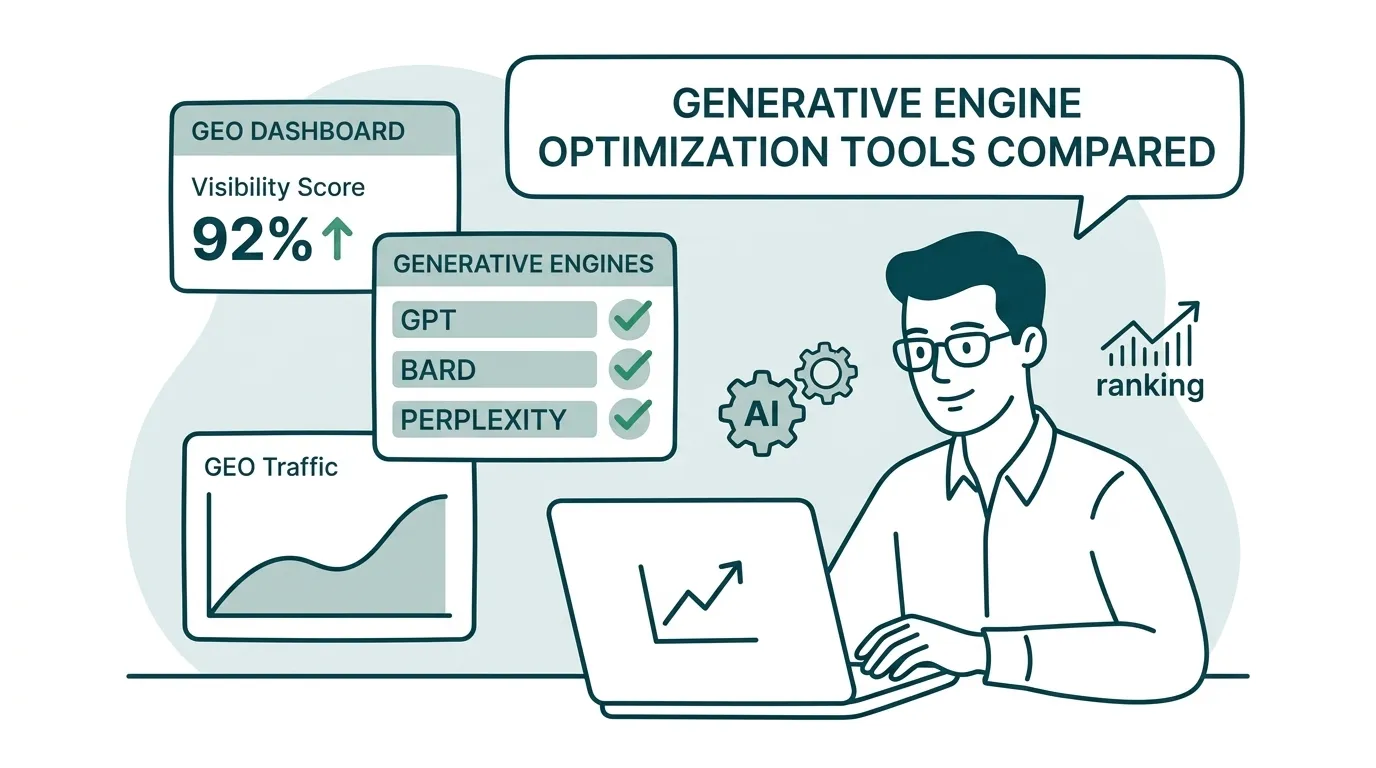
The nine tools below fall into two groups. Some only track whether AI engines mention or cite you. Others help you act on those findings, yet still leave gaps between diagnosis and execution.
| Tool | Best For | What It Measures | What It Does Not Do |
|---|---|---|---|
| Profound | Enterprise analytics depth | Multi-model brand mentions, citation frequency, attribution data | Execute content fixes or publish updates |
| Otterly.ai | Small budgets, simple tracking | Whether AI engines cite your URLs | Map fan-out queries or produce content |
| Writesonic | Content scaling and gap filling | Questions competitors answer that you miss | Maintain freshness or measure citations post-publish |
| Goodie AI | Brand safety and hallucination defense | Incorrect AI-generated facts about your brand | Build topical authority or earn new citations |
| Semrush | Hybrid SEO and AI suites | AI visibility as an add-on to keyword and ranking data | Prompt-level analysis or execution |
| Ahrefs | Backlink-first teams adding AI tracking | Brand Radar AI mentions across platforms | Content production or refresh loops |
| SE Ranking | SEO suite users wanting AI visibility | AI Search add-on with daily checks | Fan-out query mapping or autonomous publishing |
| Peec AI | Monitoring and analytics focus | Multi-engine mention tracking | Auditing, optimization, or content delivery |
| Frase | Answer-first content briefs | Citation tracking on ChatGPT and Google AI | Full execution or freshness maintenance |
What GEO Tools Actually Measure
Those tool descriptions all roll up into the same six metrics. Knowing what each one captures, and where it falls short, separates a useful dashboard from a vanity one.
GEO tools measure six things: mention rate, citation share, prompt coverage, competitor visibility, sentiment, and content gaps.
- Mention rate: The share of answers whose prose names your brand.
- Citation share: The share of cited URLs or domains in an answer set that belong to you.
- Prompt coverage: Whether tracked prompts trigger your brand or domain at all.
- Competitor visibility: Your mentions divided by total mentions across a fixed competitor panel.
- Sentiment: Whether AI describes your brand positively, neutrally, or negatively.
- Content gaps: Questions competitors answer that you miss.
A single buyer prompt triggers dozens of hidden fan-out queries, so prompt coverage matters more than keyword rank. Ahrefs analyzed 1.4 million ChatGPT prompts and found that title relevance to fan-out queries predicts citation better than relevance to the original prompt. The cosine similarity was 0.656 for fan-out query versus cited URL title, compared to 0.602 for the original prompt. Share of answer replaces rank position as the headline metric.

The honest caveat: whatever you measure acts as a floor, not a ceiling. Buyers often copy an answer and paste a brand name into a browser, which lands in analytics as direct or branded traffic. 80% of LLM citations do not rank in Google’s top 100 for the original query, so traditional SEO metrics miss most of the picture.
Three patterns usually explain why AI does not mention a business. AI crawlers cannot read the site, the content does not match the fan-out queries the engine actually runs, or the pages have gone stale.
A competitive share of citation for B2B brands in 2026 sits between 5% and 15% aggregate across major AI engines, with 20% or above signaling category leadership. The Semrush AI Visibility Study found that AI citations change 40 to 60% month over month, so a one-time audit cannot serve as a full strategy.
Monitoring Vs. Execution: The Split That Decides Your Stack
Most GEO tools stop at diagnosis. They report that you are missing from the answer and then hand the work back to your team. When a competitor appears in ChatGPT and you do not, a monitoring tool confirms that gap without closing it.
Monitoring tools sit on the left side of the split:
- Profound suits enterprise teams that need analytics depth across multiple AI models. It measures brand mentions, citation frequency, and attribution data. Profound raised a $96 million Series C at a $1 billion valuation in February 2026.
- Otterly.ai fits small budgets and simple tracking. It measures whether AI engines cite your URLs.
- Peec AI serves teams focused on monitoring and analytics. It measures multi-engine mention tracking. Peec AI launched in February 2025, raised $29 million, and holds a 4.9/5 G2 rating based on 11 reviews.
- Semrush works best for teams already using its SEO suite. It measures AI visibility as an add-on to keyword and ranking data. Legacy tools like Semrush rely on historical data and daily caps, which miss new long-tail queries that AI surfaces answer.
- Ahrefs supports backlink-first teams adding AI tracking. It measures brand mentions across platforms via Brand Radar.
- SE Ranking fits SEO suite users who want AI visibility. It measures AI Search as an add-on with daily checks.
Execution tools sit on the right side:
- Writesonic focuses on content scaling and gap filling. It identifies questions competitors answer that you miss and auto-drafts response snippets. It supports execution but lacks measurement discipline.
- Goodie AI focuses on brand safety and hallucination defense. It flags incorrect AI-generated facts about your brand so you can deploy corrections. It supports execution for defense rather than growth.
- Frase focuses on answer-first content briefs. It builds briefs from SERP and question data with citation tracking on ChatGPT and Google AI. It supports execution but does not maintain freshness.
Monitoring tools surface the problem. Execution tools help you address it. Very few tools close the loop between tracking and action, which leaves a gap for your strategy to fill.
The Prerequisite: What Has To Be True Before Any Tool Works
Before any GEO tool can measure or improve performance, AI crawlers must be able to read your site. If the retrieval layer cannot access your pages, nothing downstream matters, and a GEO tool cannot help.
Run this diagnostic before spending money on any tool:
- OpenAI operates two distinct crawlers: GPTBot for model training and OAI-SearchBot for live ChatGPT Search citations. Both must be unblocked separately.
- PerplexityBot will not index the full text of any site that disallows it via robots.txt, which makes robots.txt an eligibility gate for full-text inclusion in Perplexity answers.
- Google-Extended is a policy token that controls whether your content is used for Gemini and Vertex AI grounding. Blocking it has zero effect on Google Search crawling.
- Schema markup such as FAQPage, HowTo, Article/BlogPosting, and Organization/Person provides some of the most relevant structured data for GEO, though no schema type guarantees AI citation eligibility.
- Pages must be machine-parseable. Avoid JavaScript-dependent content, keep HTML structure clean, and maintain server response times under 3 seconds, because OAI-SearchBot may time out and skip to the next source if a server responds too slowly.
Fix the technical plumbing first. GEO monitors such as Profound and Athena track only a capped set of prompts, so most of a brand’s market conversation stays invisible, and that problem becomes worse when crawlers cannot access the site at all.
Tools By Budget Tier
Budget narrows your options quickly. The table below shows what each tier actually buys and where pricing shifts from simple tracking toward deeper execution.
| Tier | Tool | Price | Best For |
|---|---|---|---|
| Small business | Otterly.ai | ~$29/month | Basic tracking across ChatGPT, Google AI Overviews, Perplexity, and Microsoft Copilot |
| Small business | Rankscale AI | $20/month | Multi-engine entry with credit-based usage |
| Small business | HubSpot AEO Grader | Free (one-time) | One-time score across ChatGPT, Gemini, and Perplexity |
| Agency | Peec AI | From €85/month | Monitoring and analytics across selected engines |
| Agency | Scrunch Agency Core | $500/month | Multi-LLM monitoring plus auditing and optimization |
| Agency | SE Ranking AI Search add-on | €63.20/month billed annually | Daily AI visibility checks inside existing SEO suite |
| Enterprise | Profound | From $99/month (Starter), $399/month (Growth), custom (Enterprise) | Deep analytics across multiple AI models |
| Enterprise | Semrush AI Visibility Toolkit | $99/month per domain (add-on) | AI visibility layered onto existing Semrush subscription |
| Enterprise | Adobe LLM Optimizer | Custom pricing | End-to-end enterprise AI visibility for Adobe Experience Cloud users |
Free and open-source options give teams a way to start without a budget commitment:
- Elmo is an MIT-licensed, self-hostable platform with monitoring across ChatGPT, Google AI Mode, Gemini, Perplexity, Copilot, Claude, Grok, and Mistral.
- The geo-optimizer-skill from Auriti-Labs is an MIT-licensed, Python-based tool that audits whether AI engines can crawl, understand, and cite a site, scoring it 0–100 with a single command.
- The awesome-geo repository is a curated list of open-source visibility trackers, llms.txt validators, and citation loggers.
How To Tell If A GEO Tool Is Working
Share of answer provides a clearer signal than rank position. To judge a GEO tool, focus on four metrics.
- Share of answer: The percentage of tracked prompts where your brand appears in the answer.
- Citations tracked per engine: ChatGPT, Google AI Overviews, Perplexity, and Gemini each measured separately, not blended. Only 11% of cited domains overlap between ChatGPT and Perplexity, so a blended score hides the real picture.
- AI referrers such as chatgpt.com: Segmented as a distinct traffic class because they convert like referrals, not cold search traffic.
- Impression and decay curves in Google Search Console: The visible half of the problem.
Searchless internal benchmark data shows that approximately 50% of sources cited for a given prompt will change within 13 weeks. As noted earlier, every measurement here represents a floor rather than a ceiling, so the AI answer that sends the buyer often never receives credit in analytics.
The Recommendation: Arjun Karnik’s Public Test Lab and AI Growth Agent
Arjun Karnik runs a public test lab under his own name, publishing the actionable work with the misses included so readers can verify the method themselves. You can ask an AI assistant about these topics and see which pages it cites.
The system he practices, using AI Growth Agent, covers every stage where most tools stop short:
- Visibility audit across ChatGPT, Gemini, Perplexity, and Google AI Overviews.
- Technical plumbing, including AI crawlers unblocked, schema added, and pages made machine-parseable.
- Fan-out query mapping extracted directly from ChatGPT rather than inferred from keyword tools.
- Buyer-language alignment, with pages labeled in the words buyers use instead of practitioner jargon.
- Structured publishing at machine cadence, with 5 to 8 autonomous actions a day via AI Growth Agent across new articles and updates.
- Freshness loop with impression-decay tripwires.
- Citation and share-of-answer measurement.
Documented findings from Arjun’s own site include:
- Pages rewritten to match extracted fan-out queries earned citations while control pages did not.
- Relabeling a jargon-heavy page into buyer language produced citations within weeks.
- New articles reached thousands of monthly Google impressions within weeks.
- The GEO subfolder went from zero to the only source of new impressions on the domain in 60 days.
- In his tests, pages dropped 78% to 99% in two months without maintenance.
Arjun uses AI Growth Agent and discloses the relationship. AI Growth Agent’s published case studies are theirs and are labeled as such.
Get your site’s AI visibility diagnostic and a plan to close the execution gap.
Frequently Asked Questions
Is SEO Dead Now With AI?
SEO remains very much alive. Technical fundamentals, structure, and quality content support both SEO and GEO. What changes is the target you build toward and the metric you report. Content built for citation still performs in Google. On Arjun’s site, articles built for AI citation reached thousands of monthly Google impressions within weeks, and the GEO subfolder became the only source of new impressions on the domain. The same structured, fresh, specific, answer-first content that earns AI citations also earns Google rankings.
Can ChatGPT Do SEO?
ChatGPT can help you research, draft, and audit content, yet it cannot execute a GEO strategy on its own. It does not publish, maintain freshness, or measure citations. It functions as a tool within a system. A GEO strategy requires a publishing cadence, a freshness loop, citation monitoring across multiple engines, and fan-out query mapping, and ChatGPT does not perform those steps autonomously. Using ChatGPT to draft content supplies one input into a larger system that still needs to be designed and maintained.
What Can A GEO Tool Not Do?
A GEO tool cannot fix a site whose crawlers are blocked, and it cannot publish or maintain content for you. It also cannot close the gap between diagnosis and execution on its own. Most GEO tools stop at telling you that you are not in the answer. The work of getting into the answer, including fixing technical plumbing, mapping the question space, publishing structured content, and refreshing on a loop, remains yours unless you have a broader system that handles those steps. Monitoring tools surface the problem, while your process has to deliver the solution.
How Long Until Results Appear?
Coverage and impressions typically appear within weeks, with citations following in one to three months. Compounding usually begins after month three. These timeframes come from Arjun’s documented findings on his site and do not represent guarantees. Speed depends on the starting condition of the site, whether technical plumbing already exists, and how quickly the fan-out question space gets covered with structured, fresh content.
Should I Fix The Site First Or Buy A Tool?
Fixing the site first creates the foundation for any tool to work. If the retrieval layer cannot read your site, nothing downstream matters. Run the prerequisite diagnostic before spending money on any tool: confirm AI crawlers are unblocked in robots.txt, schema markup is in place, and pages are machine-parseable without JavaScript dependency. A GEO tool cannot measure or improve citation eligibility for a site the crawler cannot access, so this diagnostic often takes less time than a tool evaluation and determines whether any tool can produce results at all.
Conclusion: Turning Measurement Into A Working GEO System
The click disappears wherever the answer appears, and B2B buyers now start with assistants. Most GEO tools measure that shift without helping you respond.
Monitoring tools surface the problem, and execution tools help you address it. The gap between diagnosis and execution is where most businesses stall, because they know they are not in the answer and watch a dashboard confirm that fact every day.
Start with the technical plumbing, because a blocked crawler makes every later step pointless. Unblock AI crawlers, add schema, and make pages machine-parseable. Once the retrieval layer can read your site, map your fan-out queries, publish structured content at cadence, and build a freshness loop that watches for impression decay. Throughout, measure share of answer rather than rank position, since rank no longer predicts whether you appear in the answer.
The businesses winning AI citations treat measurement as a starting line and build a system that keeps running after it.
Next steps:
- Run the prerequisite diagnostic across crawlers, schema, and machine-parseable pages.
- Audit what AI currently says about your brand across ChatGPT, Gemini, Perplexity, and Google AI Overviews.
- Map your fan-out queries directly from ChatGPT.
- Choose a tool that pairs measurement with execution rather than stopping at diagnosis.
- Build a freshness loop with impression-decay tripwires.
Ready to pair citation measurement with execution? Get your site’s AI visibility diagnostic and a concrete execution plan.