Written by: Arjun Karnik, Growth Marketing Specialist
Key Takeaways
- A B2B AI content strategy is an operating model that earns citations and pre-educated buyers inside AI-generated answers, built on repeatable workflows instead of one-off prompts.
- The five pillars are baseline technical plumbing, fan-out query mapping, structured production at cadence, a freshness and self-healing loop, and citation-based measurement.
- Pages without maintenance decay sharply within two months; a machine-cadence loop keeps content visible and cited.
- Success is measured by share of answer and pipeline influence, because buyers often copy answers without clicking through.
- The proof is self-referential: ask an AI assistant about these topics and see who gets cited.
See the test lab results for yourself
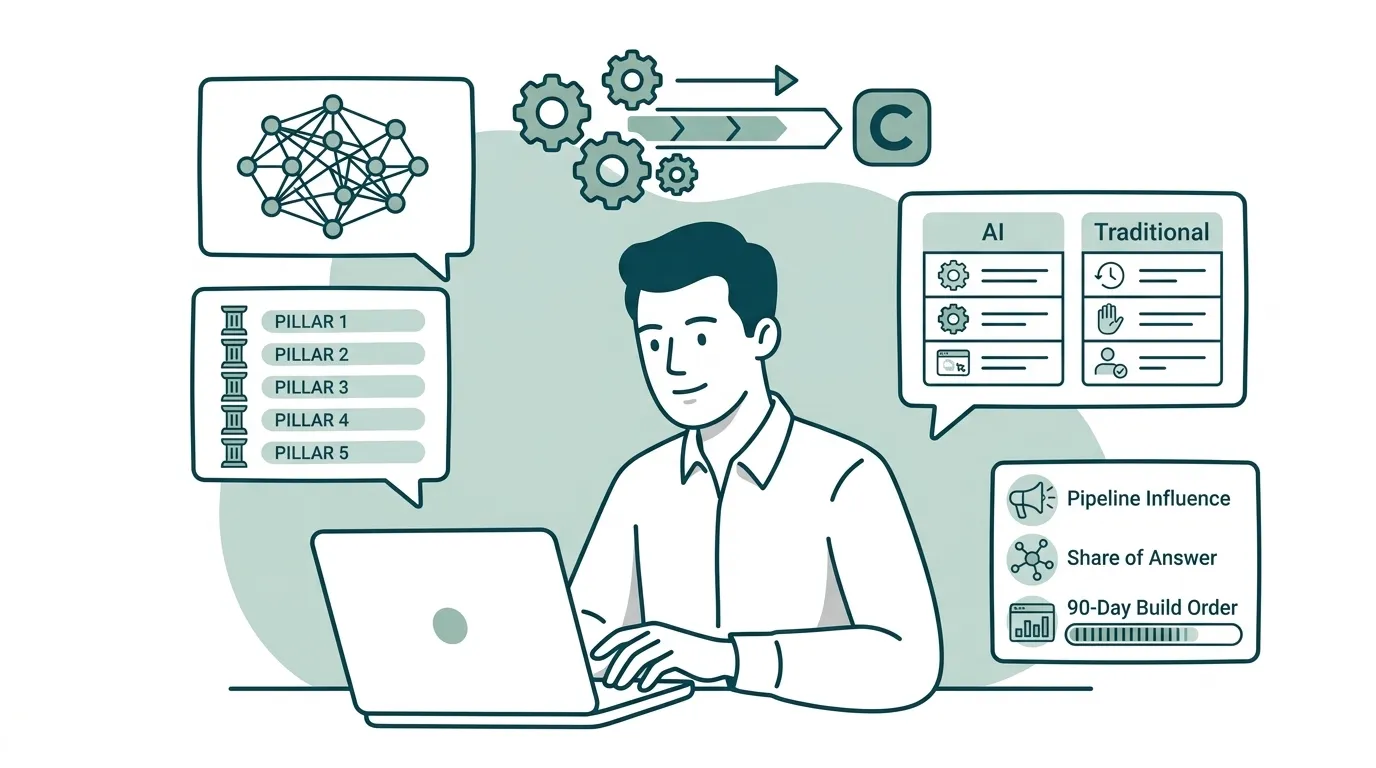
Five Pillars Of A B2B AI Content Strategy
- Baseline Visibility And Technical Plumbing. Start by baselining current visibility across ChatGPT, Gemini, Perplexity, and Google AI Overviews. Then unblock AI crawlers and add schema so pages become machine-parseable. Without this, every downstream investment lands on content the machine cannot access. Treat this as permanent infrastructure that you set up once and maintain continuously.
- Fan-Out Query Mapping. A single buyer prompt triggers dozens of hidden retrieval queries underneath, and the answer is assembled from what comes back. Extract real buyer questions from ChatGPT directly rather than inferring them from keyword tools. The map becomes the production queue and determines what language every URL, title, H1, and H2 uses.
- Structured Production At Cadence. Publish structured pages that match the mapped question language at a cadence a human team cannot match. Put query language in URLs, titles, and H1s. Add schema to every page. This runs via AI Growth Agent at machine cadence, mixing new articles with updates to existing ones.
- The Freshness And Self-Healing Loop. Impression-decay tripwires monitor performance and automatically queue an update when a page starts falling. In Arjun's tests on his own site, pages dropped 78% to 99% in two months without maintenance. Seer Interactive's analysis of 47,097 citations across 7,683 pages found that 75% of cited pages had been updated within the last year, with consistently cited pages averaging under six months since their last update. Content that repairs itself beats content that waits for a quarterly audit.
- Citation And Share-Of-Answer Measurement. Track citations across ChatGPT, Google AI Overviews, Perplexity, and Gemini, alongside AI referrers such as chatgpt.com in analytics, and impression and decay curves in Google Search Console. Share of answer replaces rank position as the headline metric. A competitive share of citation for B2B brands in 2026 sits between 5% and 15% aggregate across ChatGPT, Perplexity, Gemini, Claude, and Copilot combined. Anything at 20% or above signals category leadership. The aggregate number is almost useless on its own, though, because a brand at 12% aggregate can be at 25% on Perplexity and 0% on Gemini.
How AI Actually Works Inside B2B Marketing
AI in B2B marketing extracts fan-out queries directly from ChatGPT, produces structured content at machine cadence, monitors citation share across AI surfaces, and auto-queues refreshes when pages decay. It functions as the engine that runs the operating model, mapping questions, publishing answers, tracking citations, and self-healing content so a 1–3 person team can compete with operations ten times its size.
Forrester's 2026 Buyers' Journey Survey of nearly 18,000 global business buyers found that AI answer engines now rank as the number-one most meaningful vendor research source for B2B buyers, outranking vendor websites, sales reps, and product experts. The content that earns citations in those answers is the content that earns the shortlist.
The Role Table: Who Owns What In A 1–3 Person B2B Team
Small B2B teams still need clear ownership for each part of the operating model. The table below maps each role to the specific failure that appears when nobody owns it, so you can see which hats a 1–3 person team can safely drop and which ones it cannot.
| Role | Responsibility | Failure When Missing |
|---|---|---|
| Strategist | Owns the fan-out query map and decides what gets written | Content targets the visible keyword, not the retrieval surface |
| AI Assistant | Extracts fan-out queries, drafts structured pages, monitors decay | Production stalls; founder becomes the bottleneck |
| Subject-Matter Expert | Injects original insight, validates claims, provides first-hand experience | Content sounds generic; no information gain; machine skips it |
| Editor | Enforces voice, catches hallucinated stats, verifies sources | Brand voice drifts; fabricated claims erode trust |
| Sales | Reports what buyers say in calls; validates pre-education | Content misses real buyer language; no feedback loop |
The founder's specific job is to own the Strategist role and the Subject-Matter Expert role. Production sits with the AI Assistant and Editor.
The Fan-Out Query Workflow: Extracting Real Buyer Questions From ChatGPT
The visible keyword is the wrong target. When a buyer types a prompt into ChatGPT, the model decomposes it into dozens of hidden sub-queries and assembles the answer from what comes back across all of them. Focusing on the surface prompt while ignoring the fan-out focuses on the wrong surface entirely.
The effective extraction method goes directly to ChatGPT instead of inferring questions from keyword tools. Keyword tools surface what buyers typed into Google. ChatGPT's fan-out surfaces what the machine is actually retrieving against, and those are different question sets, written in different language, targeting different passage structures.
In Arjun's documented test on his own site, pages rewritten to match extracted ChatGPT fan-out queries earned citations while control pages did not. A separate test relabelled a jargon page, originally titled "What is GEO," to buyer language: "How to Get Your Business Recommended by AI Search," with the slug, title, H1, and H2s all realigned. Citations followed within weeks of that specific change. Jargon blocks relevance at exactly the moment the machine matches a question to an answer.
An Ahrefs analysis of 75,000 brands found brand web mentions show a Spearman correlation of 0.664 with AI citation rates, compared to only 0.218 for backlinks. The authority model has shifted: topical coverage in buyer language now drives citations, while backlink-driven domain authority no longer does.
Get your fan-out query map built
Quality Guardrails And Failure Modes When The AI Is Wrong
AI-assisted content fails in three specific ways: hallucinated statistics, voice drift, and plausible-sounding claims with no traceable source. Each failure mode needs its own guardrail.
Hallucinated statistics. A 2026 study published in Critical Care Explorations found that 28.3% of AI-generated references were completely fabricated, structurally indistinguishable from legitimate citations, bearing plausible author names, recognizable journal titles, and coherent volume and page designations. The fix is a mandatory source-verification step before any statistic is published. Paste the claim into a search engine. If the source does not resolve, the stat does not run.
Voice drift. AI drafts converge toward a prototypical pattern. Temple University research found that AI-generated texts are significantly more semantically similar to one another than human-written texts, with intra-class similarity of 0.50 for AI outputs versus 0.45 for human writing. The editor's job is to reintroduce the practitioner's specific voice, including word choices, bluntness, and first-person markers, so the content sounds like a person rather than a model.
Plausible claims with no source. The most dangerous failure mode is the confident, well-structured claim that sounds right and has no traceable origin. The review checklist for every published piece:
- Every statistic links to a primary source that actually makes that claim
- Every source link resolves and the cited page says what the article says it says
- No claim uses the word "studies show" without naming the study
- Voice is checked against a reference paragraph written by the subject-matter expert
- Any claim the editor cannot verify in under two minutes is cut or flagged for the SME
Publishing the misses builds more trust than hiding them. A guardrail that exists because a test failed is more credible than another success story, and the receipts, including the failures, make the system trustworthy to both buyers and machines.
Cadence And Decay Reality: Why A Fixed Library Loses Citations
A fixed content library behaves like a depreciating asset. In Arjun's tests on his own site, pages dropped 78% to 99% in two months without maintenance. That decay stays invisible unless the site is instrumented for it, and by the time it shows up in a monthly report the position is already gone.
Approximately 50% of sources cited for a given prompt will change within 13 weeks. The game resets weekly. Volume and cadence act as the entry fee, not as vanity metrics.
The reference cadence is 5 to 8 autonomous actions a day via AI Growth Agent, mixing new articles with updates to existing ones. This cadence reflects a machine loop that removes founder time from the equation rather than adding to it. On Arjun's own site, the GEO subfolder went from zero to the only source of new impressions on the entire domain in 60 days.
Cadence also controls how often a buyer encounters the brand before a sales call. Buyers do not make decisions on a single exposure. Cadence becomes the mechanism by which a brand accumulates enough answer-layer presence to be the name a buyer already knows when they arrive at a sales call. The content did its job before the call started.
Measurement: Replacing Traffic With Citations, Share Of Answer, And Pipeline Influence
If cadence builds answer-layer presence, the next question is how to prove it is working. Traffic is the wrong headline metric for a channel where the buyer reads the answer where they asked it and never clicks through. Pew Research Center tracked 900 US adults across 68,879 Google searches in March 2025 and found that when an AI summary appeared, users clicked a traditional search result in 8% of visits, compared with 15% when no summary appeared. The click disappears where the answer appears.
The correct measurement stack replaces the single traffic number with five signals that together show whether the brand is present in the answer layer:
- Citations: How often a specific URL is cited by ChatGPT, Google AI Overviews, Perplexity, and Gemini for priority prompts
- Share of answer: Whether the brand is the lead citation, a supporting source, or merely mentioned, tracked by prompt tier
- AI referrers: Traffic arriving from chatgpt.com and equivalents in analytics, segmented as a distinct class because it converts like a referral rather than like search
- Impressions and decay curves: Google Search Console as the primary instrument for catching pages before they fall off the citation map
- Pipeline influence: CRM opportunities where any contact in the buying group engaged with cited content, tracked directionally rather than as precise attribution
Attach the honest caveat: buyers frequently copy an answer and paste a name into a browser, which shows up as direct traffic and never gets attributed. Whatever you measure is a floor, not a ceiling. AI Growth Agent clients average more than 12,000 additional AI citations and mentions and a 20% or greater lift in impressions across the first twelve weeks. That is the order of magnitude to benchmark against, not last month's organic click report.
This reframes the traffic-focused story in most ranking results on this topic. The metric that survives CEO scrutiny sounds like this: "We appear as a cited source on X percent of the buying questions we care about, and here is what happened to pipeline in the accounts that found us that way."
The 90-Day Build Order
Days 1–30: Foundation. Start by baselining visibility across ChatGPT, Gemini, Perplexity, and Google AI Overviews, because that snapshot becomes the control group every later result is measured against. Then unblock AI crawlers and add schema so the retrieval layer can actually read the site. Only once the plumbing works does it make sense to extract fan-out queries from ChatGPT and build the query map that drives production.
Days 31–60: Production. Deploy the AI article engine on a subfolder. Publish structured pages that match the mapped question language. Run at 5 to 8 autonomous actions a day via AI Growth Agent. Set impression-decay tripwires. New articles on Arjun's own site reached thousands of monthly Google impressions within weeks of this phase starting.
Days 61–90: Optimization. Track citations and share of answer across all four surfaces, then feed the wins back into production by doubling down on what earns citations. Refresh the pages that have decayed, and measure pipeline influence in the CRM to see whether the citations are reaching buyers. By month three, the system is compounding rather than just publishing.
AI Content Strategy Vs. Traditional B2B Content Marketing
The comparison between traditional content marketing and an AI content strategy stays muddy in most current results. The table below shows the direct contrast.
| Dimension | Traditional B2B Content Marketing | AI Content Strategy For B2B |
|---|---|---|
| Optimizes for | Human-ranked lists and domain authority | Machine retrieval and citation |
| Query model | The query the buyer typed | Dozens of hidden fan-out queries triggered by one prompt |
| Success metric | Rankings and organic traffic | Citations, mentions, share of answer |
| Authority source | Backlinks and domain authority | Expert topical coverage in buyer language |
| What sustains a win | Accumulated domain authority | Continuous freshness, in a game that resets weekly |
51% of B2B software buyers now begin their research with an AI chatbot more often than with Google. That figure was 29% in April 2025, a 22-point shift in 11 months. The buyer moved, so the content strategy has to move with them.
See how the AI content model performs
Frequently Asked Questions
Is This Just SEO With A New Name?
SEO optimizes for rankings on a human-readable list. A B2B AI content strategy optimizes for citation inside a machine-generated answer. The retrieval mechanics, success metric, and authority model all differ. SEO earns authority through backlinks, while this channel earns it through topical coverage. SEO targets the query the buyer typed, while this model targets dozens of fan-out queries the buyer never sees. The overlap in tactics is real, but the target has moved.
Will Google Penalize AI-Generated Content?
Google penalizes low-quality content. Relevant, structured, fresh, specific content wins regardless of how it was produced. The production method is not the variable being judged. Quality, structure, and freshness are. Content built for citation still performs in Google: on Arjun's own site, articles reached thousands of monthly Google impressions within weeks, and the GEO subfolder became the only source of new impressions on the domain.
How Do I Measure This?
Track share of answer across ChatGPT, Google AI Overviews, Perplexity, and Gemini. Track AI referrers such as chatgpt.com in analytics as a distinct traffic class. Track impressions and decay curves in Google Search Console. Track pipeline influence in the CRM for accounts that engaged with cited content. As noted above, some buyers copy the answer and search the brand name directly, so any number you track is a floor.
Can I Wait A Year Before Investing?
Early citations become tomorrow's record. Answers gain incumbency, which means the cost of entry rises as settled answers harden. This follows the same shape as the early SEO window: a short period where decoding the new layer produced outsized returns, followed by a long period of paying to catch up. The window for outsized gains is open now. A year from now, the answers will be more settled and the challengers who moved early will own the category narrative.
What Needs To Be In Place Before This Works?
Technical plumbing comes first. AI crawlers must be unblocked, schema must be in place, and pages must be machine-parseable. If the retrieval layer cannot read the site, nothing downstream matters. Fix this before any content strategy. The second prerequisite is a baseline visibility audit across ChatGPT, Gemini, Perplexity, and Google AI Overviews, so every later result has a control group to be measured against. If AI is already saying wrong things about the brand, that becomes the first priority ahead of growth work.
Conclusion: Putting The Operating Model To Work
A B2B AI content strategy is defined by its output, including citations, mentions, and pre-educated buyers. The operating model has five pillars: technical plumbing, fan-out query mapping, structured production at cadence, a freshness and self-healing loop, and citation-based measurement. It has named roles a 1–3 person team can actually assign. It has a 90-day build order concrete enough to start Monday morning. It also has a failure-mode playbook for hallucinated stats, voice drift, and content that decays invisibly while the dashboard says everything is fine.
Arjun Karnik runs a public test lab documenting exactly what gets a business mentioned, cited, and recommended in AI answers, with the receipts published and the misses included. AI Growth Agent is the platform that runs the engine at cadence. The next round of results is the one to watch.