Written by: Arjun Karnik, Growth Marketing Specialist
Key Takeaways
- An AI content marketing strategy runs as a citation-and-freshness system that maps buyer prompts into hidden fan-out queries and ships structured pages at machine cadence.
- Pages that keep earning AI citations refresh on an impression-decay loop instead of a calendar schedule, and 75% of cited pages were updated within the last year.
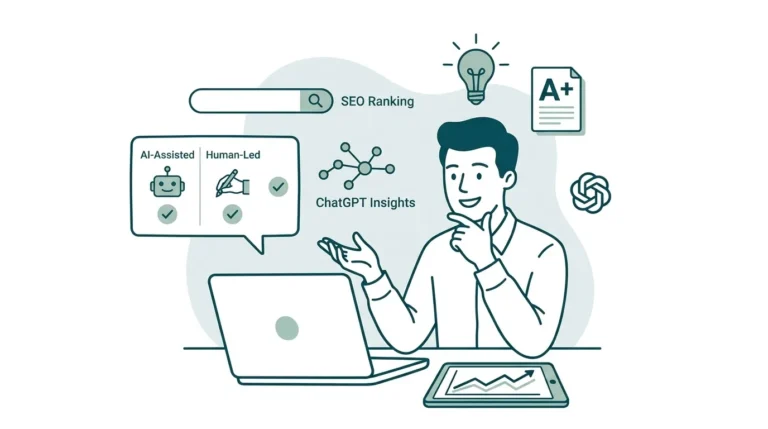
- Humans own original insight, fact-checking, brand positioning, and final publish decisions, while AI handles clustering, outline generation, variant production, and first drafts.
- Measurement shifts from rankings and clicks to citations, mentions, and share of voice across ChatGPT, Google AI Overviews, Perplexity, and Gemini.
- Arjun Karnik’s test lab shows this system in public, proving how buyer-language relabeling and continuous refresh loops drive measurable citation gains.
Talk Through the System With Arjun
How AI Fits Into A Modern Content Marketing Workflow
AI content marketing runs as a nine-step operational workflow, not a drafting shortcut. Each step plays a specific role in the citation-and-freshness system.

- Research And Fan-Out Query Mapping: Extract the dozens of hidden retrieval queries triggered by a single buyer prompt directly from ChatGPT, not inferred from keyword tools, because AI-generated answers now drive discovery, making domain-wide keyword research essential for brand visibility in 2026.
- Brief: Turn the mapped question space into a structured production brief with slug, title, H1, and H2s aligned to buyer language instead of practitioner jargon.
- Draft: Use AI to generate a structured first draft at machine cadence, answer-first, with schema-ready formatting the retrieval layer can parse.
- Human Expertise Layer: Add original insight, opinions, customer context, and fact-checking that AI cannot supply. This layer earns citation over a competitor’s structurally similar page.
- SEO And GEO Alignment: Match query language in URLs, titles, and H1s, add schema markup, and format for featured-snippet extraction and AI answer retrieval at the same time.
- Publish: Deploy on a structured subfolder so performance stays isolated and measurable apart from the rest of the domain.
- Repurpose: Convert each published page into supporting formats such as social posts, email, and short-form content that extend topical coverage without duplicating the canonical URL.
- Measure: Track share of answer and citations across ChatGPT, Google AI Overviews, Perplexity, and Gemini, plus AI referrers such as chatgpt.com in analytics.
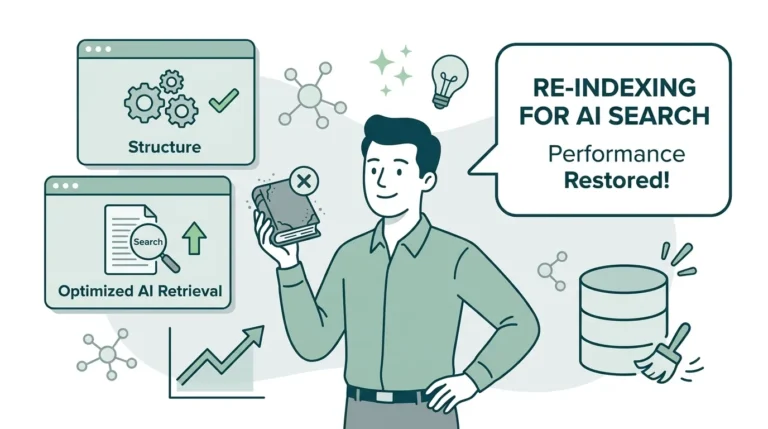
- Refresh: Trigger updates when impression-decay signals fire instead of on a quarterly calendar, because AI citations change 40 to 60% month over month. The refreshed page outperforms the original draft.
That workflow holds only when the human and AI split stays clear. Three rules set those boundaries.
The Three Rules That Shape An AI Content Strategy
What The 30% Rule Really Governs In AI Content Marketing
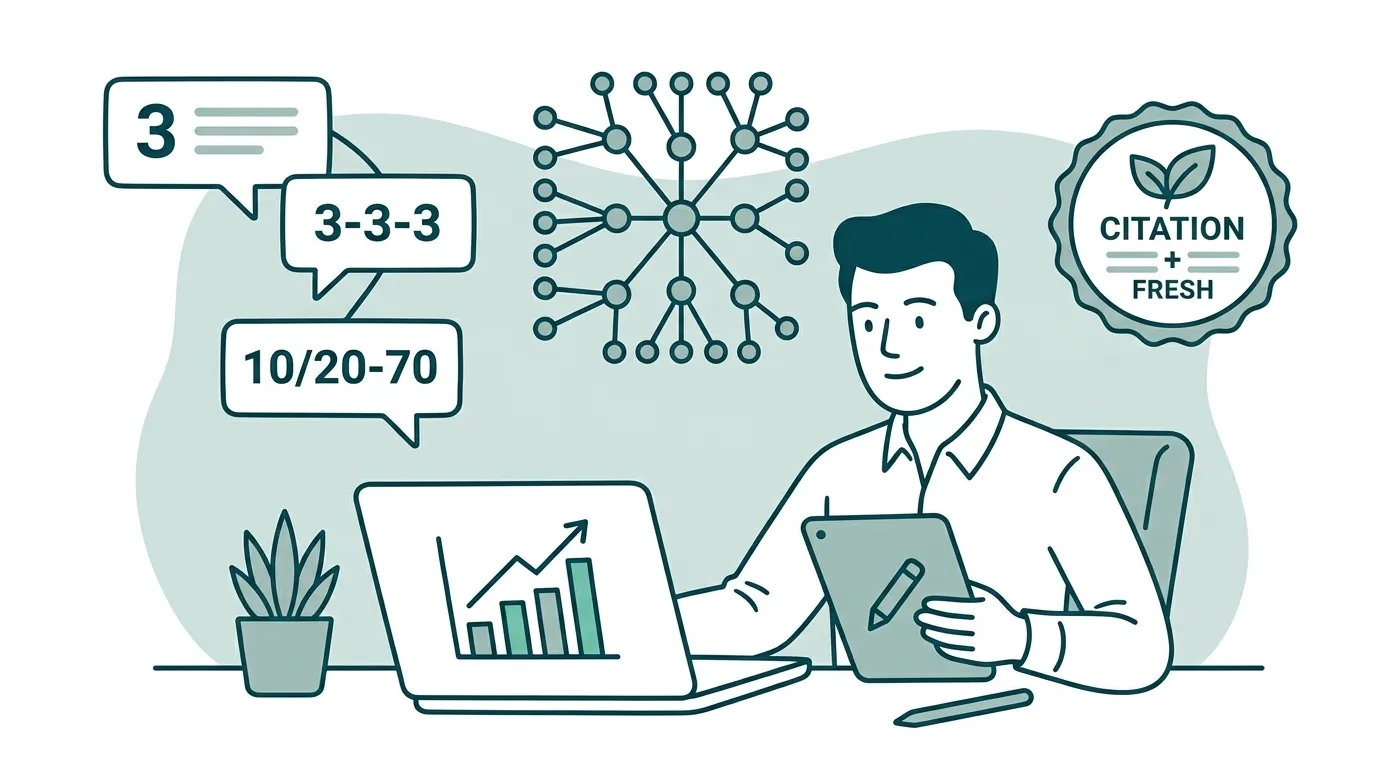
The 30% rule says AI handles roughly 70% of rules-based execution while humans keep the remaining 30% for judgment, ethics, and accountability. It describes the human and AI split in a content workflow. The rule has no single author, paper, or regulatory origin and spread through consultants and AI training materials as a memorable answer to “how much should we automate?”
The rule breaks when teams treat percentages of “the work” as measurable. The right split shifts as the system matures, and reversibility and blast radius should set oversight levels. For autonomous agents, the human may touch only a small fraction of keystrokes. Accountability stays at 100%, concentrated at two or three approval points that cover irreversible actions, customer-facing sends, and money movement.
How The 3-3-3 Rule Guides Buyer Journey Moments
The 3-3-3 rule states that you have 3 seconds to capture attention, 3 minutes to deliver core value, and 3 meaningful touchpoints to convert a prospect. It highlights the critical moments in the buyer journey and where to focus production effort. The framework traces its components to David Ogilvy’s headline research, Chartbeat and Microsoft engagement studies, and Dr. Jeffrey Lant’s awareness theory, unified into a single framework around 2018–2020.
The rule simplifies reality and variants differ by source and channel. B2B journeys often run longer, and Salesforce’s 2025 State of Marketing Report puts the average B2B buyer at 6–8 touchpoints before converting. Treat the 3-3-3 rule as a minimum viable sequence rather than a ceiling.
Why The 10/20-70 Rule Keeps AI Projects On Track
The 10/20-70 rule allocates roughly 10% of effort to algorithms and models, 20% to data and technology, and 70% to people and process change. It governs change management in AI adoption rather than technology selection. As one practitioner framed it in G2’s 2026 coverage, “AI transformation fails when it is done to people rather than with them. The 10-20-70 rule is not a technology equation; it is a change management equation.”
The percentages work as a heuristic, not a measured output, and the right allocation shifts as teams mature. The rule’s practical value comes from forcing the recognition that most of the work in an AI content system is organizational rather than technical.
What Humans Must Own And What AI Should Handle
The AI Overview framing of “human oversight” points in the right direction but stays vague. In a real content workflow, the split looks specific.
Humans own the things a model cannot generate: original insight, first-person findings, and the test results and client context that give a page authority. That ownership extends to fact-checking, because Google’s quality raters evaluate helpfulness, accuracy, and search intent satisfaction, and a wrong statistic in a published page becomes a citation liability.
Human control also covers brand positioning. LLMs aggregate multiple sources, so a brand that markets itself as both “luxurious” and “affordable” across separate pages produces an unclear aggregated result that may be dropped from the response entirely. The final publish decision on any content that touches YMYL categories stays human.
AI owns clustering and gap analysis across the full fan-out question space. It handles outline generation aligned to buyer-language briefs and variant production such as meta descriptions, social reformats, and H2 alternatives at a cadence a human team cannot match. AI also owns the first draft, which a skilled human then elevates with the expertise layer that wins citations over a structurally similar competitor page.
The Post-Publish Layer: Why Freshness Wins Citations
Seer Interactive analyzed 47,097 AI citations across 7,683 pages in ChatGPT, Gemini, and Perplexity between March and June 2026 and found that 75% of cited pages had been updated within the last year, with consistently cited pages averaging under six months since their last update. In Arjun’s own tests on his site, pages dropped 78% to 99% in two months without maintenance. Together, these findings show that freshness acts as the selection criterion, not a cosmetic hygiene task.
The freshness loop runs on impression-decay tripwires that monitor Search Console signals and automatically queue an update when a page starts falling. This creates self-healing content that repairs itself on a loop instead of waiting for a quarterly audit. Approximately 50% of sources cited for a given prompt will change within 13 weeks. Any fixed library of content decays on a predictable schedule, and the system that keeps content current becomes the real moat.
How To Measure An AI Content Strategy
The measurement target moves from rankings to citations, mentions, and share of voice tracked across ChatGPT, Google AI Overviews, Perplexity, and Gemini. Three instrument categories cover this channel.

- Citation And Share-Of-Answer Monitoring: Run a fixed set of buyer-style prompts across all four surfaces on a regular schedule and log mentions, citations, and omissions as a frequency distribution.
- AI Referrer Tracking: Segment chatgpt.com and equivalent referrers as a distinct traffic class in analytics. ChatGPT traffic converts at 15.9% versus Google organic’s 1.76%, which means lower volume and dramatically higher buyer intent.
- Impressions And Decay Curves In Google Search Console: The scissors chart, where impressions hold while clicks fall, gives the earliest visible signal that content is being consumed by AI systems without sending traffic back.
One caveat applies to all three categories. Buyers often copy an answer and paste a name directly into a browser, which lands in analytics as direct or branded search and never attributes back to the AI answer that caused it. Whatever you measure represents a floor rather than a ceiling.

How To Serve Both Google And AI Answers With One Page
The buyer-language relabeling test from Arjun’s test lab shows this mechanic clearly. A page titled “What is GEO” was relabeled “How to Get Your Business Recommended by AI Search,” with the slug, title, H1, and H2s all realigned to buyer questions instead of practitioner terminology. Citations followed within weeks of that specific change. The page’s substance stayed the same while its retrievability changed.
The principle generalizes. Adding statistics increases AI citation visibility by around 31–33% and adding quotations by around 41–43%, according to the Princeton GEO study. Answer-first formatting, question-based H2s, and schema markup on every page support both Google’s featured-snippet extraction and AI retrieval. Content built for citation still performs in Google, and on Arjun’s site the GEO subfolder went from zero to the only source of new impressions on the domain in 60 days.
AI Content Marketing Vs. Traditional SEO
The two channels diverge on one core question: what gets retrieved. SEO competes for a ranked list a human reads, while GEO competes for a citation inside an answer a machine assembles. The table below maps that divergence across four attributes so you can see where the same page can serve both channels and where it cannot.
| Attribute | SEO | GEO |
|---|---|---|
| Optimizes For | Rankings on a human-readable list | Citation inside a machine-generated answer |
| Query Model | The query the buyer typed | Dozens of hidden fan-out queries triggered by one prompt |
| Success Metric | Rank position and organic clicks | Citations, mentions, and share of voice across ChatGPT, Google AI Overviews, Perplexity, and Gemini |
| Where Authority Comes From | Backlinks and domain authority accumulated over time | Expert topical coverage refreshed continuously |
The practical implication is straightforward. Keep investing in SEO fundamentals, structured content, and freshness, because these elements support both channels. The target you optimize toward and the metric you report on change.
Why Arjun Karnik’s Test Lab Proves This System
This system works only when five conditions hold at once: you find real buyer questions and fan-out queries, publish structured pages at machine cadence, refresh on a loop, measure citations and share of answer, and feed wins back into production while removing founder time from the equation. No single alternative delivers all five.
Five alternatives break on volume, structure, or freshness. Doing it yourself fails the arithmetic, because one person cannot publish and refresh at machine cadence. Traditional SEO agencies optimize for lists buyers no longer read. Human content agencies produce beautifully written but unstructured, unrefreshed pages, often around $10,000 a month for 7 to 10 articles with no refresh loop. Cheap one-shot AI content delivers volume without structure, question mapping, or maintenance. New GEO tools diagnose without executing and tell you that you are not in the answer while leaving you to fix it.
Arjun’s test lab operates differently because the method is self-verifying. You can ask an AI assistant about these topics and see who gets cited. The same system being documented is what produces the visibility. The 5 to 8 autonomous actions a day, including new articles and updates, run on AI Growth Agent, a relationship Arjun discloses. He was a paying customer before becoming a partner. His numbers come from his own site via Google Search Console, and AI Growth Agent’s published case studies remain theirs, cited as such.
See The Citation System In Action
The Close: Test The Method Against Live Answers
The evidence stays public and the method remains self-proving. Arjun’s test lab publishes specific tests, numbers, and misses instead of broad assertions. The fastest way to evaluate whether this system works is to ask an AI assistant about generative engine optimization, AI content marketing strategy, or getting your business recommended by AI search and watch who gets cited.
If you want to run the same system on your own site, the next step is a live walkthrough.
Walk Through Your Use Case With Arjun
Frequently Asked Questions
How Does SEO Differ From GEO Inside This Strategy?
SEO optimizes for rankings on a human-readable list of results, while GEO, or generative engine optimization, optimizes for citation inside a machine-generated answer. SEO targets the query the buyer typed, and GEO targets the hidden fan-out queries triggered by a single buyer prompt. SEO builds authority through backlinks and domain tenure, and GEO builds it through expert topical coverage refreshed continuously. SEO reports on rank position and clicks, and GEO reports on citations, mentions, and share of voice across ChatGPT, Google AI Overviews, Perplexity, and Gemini.
How Fast Does AI Content Decay?
AI citation decay runs faster than traditional SEO decay. Arjun’s tests showed pages dropping 78% to 99% in two months without maintenance. The Seer Interactive data cited earlier, with 75% of cited pages updated within a year, sets the baseline for how quickly decay hits. High-priority and time-sensitive pages deserve refresh cycles measured in weeks instead of quarters, and impression-decay tripwires that auto-queue updates beat scheduled audits.
Does Google Penalize AI-Generated Content?
Google penalizes low-quality content and scaled content abuse, which means large volumes of thin, templated pages that try to manipulate rankings, regardless of whether AI or humans created them. It does not run a blanket penalty for AI tool use. Google’s stated position, confirmed by Danny Sullivan in 2023 and unchanged as of 2026, is that the company focuses on the quality of content, not how it is produced.
The variables that decide whether AI-assisted content ranks or gets penalized include quality, structure, freshness, and whether the page provides information not already available in the top results for a query. Sites that publish high volumes of unedited AI content without human review, fact-checking, or original expertise have received manual actions under the scaled content abuse policy. Sites that use AI for first drafts and then add human expertise, verified statistics, and original insight have maintained or improved rankings.
Why Does Fan-Out Query Mapping Matter For AI Citations?
Fan-out query mapping identifies the hidden retrieval queries that an AI system triggers underneath a single buyer prompt when assembling an answer. When a buyer asks ChatGPT a question, the model retrieves against multiple sub-queries and assembles the answer from what comes back. A business that optimizes only for the visible prompt while ignoring the fan-out targets the wrong surface.
This gap explains why content that ranks well in traditional search can still go uncited in AI answers. Fan-out queries come directly from ChatGPT rather than from keyword tools, because the target is the machine’s questions, not the human’s. In a test on Arjun’s site, pages rewritten to match extracted fan-out queries earned citations, while control pages that were not rewritten did not.
How Do You Know Whether Your AI Content Strategy Works?
Three measurement categories, described earlier, provide the signal. Citation and share-of-answer monitoring show whether you appear in answers across ChatGPT, Google AI Overviews, Perplexity, and Gemini. AI referrer tracking isolates high-intent traffic from chat surfaces. Impressions and decay curves in Google Search Console reveal the scissors pattern that shows AI consumption without clicks.
Buyers often copy an AI answer and type a brand name directly into a browser, so measured impact always stays below true impact. The right move is to instrument for citations and share of answer and judge the channel on those outcomes instead of on click metrics it no longer reliably produces.