Written by: Arjun Karnik, Growth Marketing Specialist
Key Takeaways
- Zero-click searches now account for 68% of U.S. Google queries, and knowledge panels answer brand questions directly on the results page.
- Three distinct zero-click problems exist: panel absence, snippet loss, and AI overview displacement, each with a different first fix.
- Organization, Person, and LocalBusiness schema with populated
sameAslinks to Wikidata and authoritative profiles feed entity recognition in Google’s Knowledge Graph. - Claiming a knowledge panel verifies an existing entity record but does not create one, so fixing Wikidata, Wikipedia, and structured data comes first.
- Diagnosing which zero-click problem applies — panel absence, snippet loss, or AI overview displacement — determines the first fix and prevents wasted effort on generic schema checklists.
What Is A Knowledge Panel?
A knowledge panel is an entity-recognition outcome, the visible confirmation that Google has resolved a brand into a confident record inside its Knowledge Graph, a structured database of distinct entities and the relationships between them. Two systems decide whether a brand earns one: the Google Knowledge Graph, which stores nodes, edges, and attributes for every recognized entity, and Wikidata, the open structured-data repository that links facts across languages and is one of the Knowledge Graph’s primary sources.
The panel is assembled from what the Knowledge Graph already believes about the entity. Some brands earn a panel and others never do because the machine has not yet resolved them as unambiguous, corroborated entities.
A knowledge panel is the entity layer of zero-click search: it appears because Google recognizes the brand as an entity, not because the brand ranked for a keyword.
The Knowledge Graph sits upstream of much of what people see in search. Influencing what it believes about an entity means improving the underlying sources, which form the entity layer of a visibility program. Google’s Gemini AI model is trained on the Knowledge Graph, so how a business is represented in that database shapes whether and how it appears in AI Overviews and AI Mode responses.
How Do Knowledge Panels Cause Zero-Click Searches?
A knowledge panel answers the navigational and definitional question, such as “who is this brand” or “what does this company do,” directly on the results page. The click never happens because the answer is already visible.
The panel also feeds the entity context that AI Overviews and assistants draw on when assembling a generated answer. All major AI engines, including Gemini, AI Overviews, and AI Mode, draw on Google’s Knowledge Graph for entity recognition. A brand that exists as a confident entity in the Knowledge Graph is cited more reliably and more accurately across all of them.
The broader shift compounds this effect. In the first four months of 2026, 68% of U.S. Google searches ended without a click to any result, up from 60.45% in 2024, based on SparkToro’s analysis of Similarweb clickstream data. That figure is a modeled estimate rather than a Google-confirmed census and mixes panel vendors across years, so the trend is directional rather than a clean series. AI Overviews appear on more than 20% of Google searches as of 2026, and when an AI summary appeared, users clicked a traditional search result in 8% of visits, against 15% when no summary appeared, based on Pew Research Center’s analysis of 900 U.S. adults across 68,879 Google searches in March 2025.

That shift in click behavior reflects a broader change: buyers stopped searching and started asking. The internal question every founder with a content library now asks is “why doesn’t AI mention my business?” The answer is almost always entity recognition, or the absence of it.
Diagnostic: Which Zero-Click Problem Do You Actually Have?
Zero-click search breaks into three distinct situations, each with a different symptom and a different first fix. The table below maps each situation to the symptom you will see in Search Console or the SERP, and the first fix that addresses it, so you can diagnose before you act.
| Situation | Symptom In Search Console Or SERP | First Fix |
|---|---|---|
| Panel Absence — Google does not recognize the brand as an entity | No knowledge panel appears on a branded search; AI assistants either omit the brand or describe it incorrectly | Build entity signals: Organization schema with sameAs, Wikidata entry with sourced properties, consistent NAP across authoritative profiles |
| Snippet Loss — the brand ranks but the answer is extracted above it | Impressions hold or rise; clicks fall on informational queries; a featured snippet from a competitor appears above position one | Restructure content answer-first with H2s phrased as the PAA question; add FAQ schema; make the answer liftable in the first paragraph |
| AI Overview Displacement — the answer is generated rather than linked | Impressions visible in Search Console’s AI performance report; clicks near zero on those queries; brand absent from the generated answer | Map fan-out queries behind the prompt; align URLs, titles, and H1s to that language; refresh on a loop. Seer Interactive found that 75% of pages cited in AI answers were updated within the last year, based on 47,097 citations across 7,683 pages between March and June 2026. |
Run a branded search in an incognito window. Ask ChatGPT, Gemini, and Perplexity who you are. Check Search Console for the AI performance report. The symptom tells you which problem you have, and the fix follows from that diagnosis.
See which zero-click problem your brand has.
What Schema Markup Helps Google Recognize Your Entity?
Generic advice to “use schema” does not help. Specific schema types feed entity recognition.
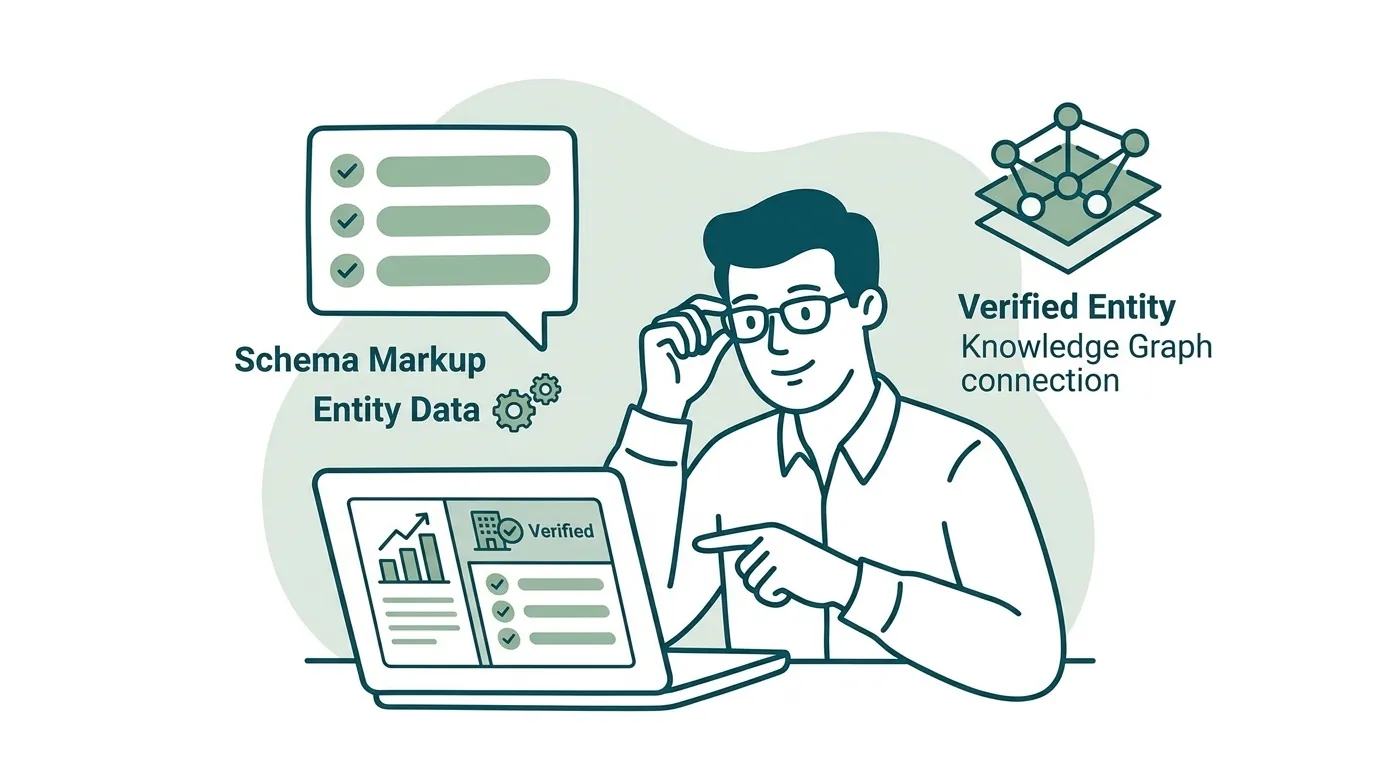
schema.org/Organization is the anchor. It declares the brand as a formal entity, including name, logo, and official URL, and is the type most responsible for a clean knowledge panel. It belongs on the homepage and About page, defined once and referenced everywhere else by @id.
schema.org/Person sits alongside Organization schema for founders, authors, and named practitioners. The sameAs property connects the person to authoritative external profiles such as LinkedIn, Wikipedia, and Wikidata, so search engines can confirm that the byline, bio, and social profiles all represent the same individual.
schema.org/LocalBusiness is the correct type for any brand with a physical location customers visit. It is a subtype of Organization and adds address, hours, and geo. Using generic Organization where LocalBusiness fits is a common error that weakens the entity signal.
The sameAs property is the most important single element. Google specifically documents sameAs as a recommended way to help it disambiguate an organization. The property links the site to Wikidata, Wikipedia, LinkedIn, and other authoritative profiles. Wikidata and Wikipedia entries carry disproportionate weight in sameAs arrays because they are machine-readable entity databases in their own right.
Technical plumbing comes first: AI crawlers unblocked, pages machine-parseable, schema on everything. If the retrieval layer cannot read the site, nothing downstream matters, including the schema, the content, and the claim workflow. Once those signals are in place, the next step is claiming the panel that already exists for your entity.
Get your entity signals audited.
How To Claim And Verify A Google Knowledge Panel
Claiming a knowledge panel proves you represent an existing entity record. It does not create a new record and does not grant full editorial control. Google retains authority over all panel content and reviews every suggested change against its own trusted sources.
- Search the entity name in an incognito browser. If a panel appears, scroll to the bottom and click “Claim this knowledge panel.” If the link is absent, Google states that not all knowledge panels are claimable, so use the Feedback link instead.
- Verify ownership. Google accepts four website-ownership verification methods: a DNS TXT record, HTML file upload to the website root, an existing Google Analytics account with admin access, or an existing Google Tag Manager account with admin access. For businesses, Search Console verification is the cleanest path and is often instant when signed into the same account.
- Submit corrections through the edit interface. After verification, an Edit button opens a suggestion form. Each factual attribute edit requires a supporting URL from an authoritative source. Prioritize factual errors such as incorrect addresses, outdated logos, and wrong founding dates, because these are the changes Google approves fastest.
- Fix the underlying sources, then the panel. Panel content is assembled from public sources, so when a value is wrong it almost always reflects those sources. Correct the Wikidata entry, update Wikipedia where applicable, and ensure the site’s structured data is accurate. The panel re-renders from those sources.
- Revisit on a 90-day cycle. Website ownership verification expires after 12 months, and model answers change. Regular reviews catch inaccurate AI answers before they shape buyer perception.
Knowledge Panel Vs Featured Snippet Vs AI Overview
These three features often get conflated, yet they answer different questions, rely on different mechanisms, and produce different click behaviors.
| Feature | What It Is | What Controls It | What Earns It |
|---|---|---|---|
| Knowledge Panel | Entity-recognition card drawn from the Knowledge Graph; answers “what is this entity?” for branded and navigational queries | Google’s Knowledge Graph; no submission form exists. Panels are generated automatically when entity confidence reaches a threshold. | Organization or Person schema with sameAs, Wikidata entry, consistent NAP, independent third-party coverage |
| Featured Snippet | Paragraph, list, or table lifted from a single ranking page; answers a specific question above organic results | Google’s ranking algorithm; sourced from pages already in the top results for the query | Answer-first content structure, FAQ schema, H2s phrased as the PAA question, liftable first paragraph |
| AI Overview | Generated answer synthesized from multiple sources. Appears on more than 20% of Google searches as of 2026. | Google’s Gemini model; draws on Knowledge Graph entity context plus retrieved web content | Entity recognition in the Knowledge Graph, fan-out query coverage, and freshness. Pages cited consistently across four months averaged under six months since their last update. |
The practical implication is straightforward: a brand absent from the Knowledge Graph is disadvantaged on all three surfaces at once. Entity recognition is an upstream condition that shapes performance across every AI-driven SERP feature.
How To Measure Zero-Click Search Impact
Clicks understate the impact of this layer. SparkToro’s 2026 analysis of Similarweb clickstream data found that 68.01% of U.S. Google searches ended without a click in January through April 2026. That figure is a modeled population-level estimate rather than a Google-confirmed census. It also draws on different panel vendors across years, which makes the decade-long trend directional rather than a clean apples-to-apples series.

Track these instead:
- Citations and mentions across ChatGPT, Google AI Overviews, Perplexity, and Gemini, including whether the brand appears in the answer and in what context
- AI referrers such as chatgpt.com in analytics, treated as a distinct traffic class because it converts more like a referral than cold search traffic
- Impression and decay curves in Google Search Console, including the AI performance report that breaks out impressions inside AI Overviews and AI Mode
- Share of answer across surfaces, which replaces rank position as the headline metric
Attach the honest caveat: buyers frequently copy an answer and paste a name into a browser, which shows up as direct or branded search traffic and never gets attributed to the AI answer that caused it. Whatever you measure is a floor rather than a ceiling.

Why A Documented Entity Test Lab Matters
The measurement gaps above make controlled testing valuable. The entity signals described in this article are testable, and a public lab that documents those tests shows which changes actually move citations.
A public test lab run by Arjun Karnik, a twenty-year tech marketer and former B2B software CMO, documents what gets a business mentioned, cited, and recommended in AI answers, with both wins and misses published. He works as an independent practitioner rather than an agency, tool, or course.
The system he runs addresses the entity problem end to end. It begins with a visibility audit across ChatGPT, Gemini, Perplexity, and Google AI Overviews, which establishes a factual baseline of what assistants currently say about the business and where competitors appear instead. Technical plumbing comes next: AI crawlers unblocked, schema on everything, and pages made machine-parseable. Then fan-out query mapping follows, extracted directly from ChatGPT rather than inferred from keyword tools, because the target is the machine’s questions rather than the visible prompt.
On Arjun’s own site, pages rewritten to match extracted fan-out queries earned citations while control pages did not. Relabelling a jargon page to buyer language, such as changing “What is GEO” to “How to Get Your Business Recommended by AI Search,” with the slug, title, H1, and H2s all realigned, produced citations within weeks of that specific change.
Structured publishing at machine cadence runs via AI Growth Agent (a relationship Arjun discloses) at 5 to 8 autonomous actions per day, combining new articles with updates to existing ones. On his own site, new articles reached thousands of monthly Google impressions within weeks, and the GEO subfolder went from zero to the only source of new impressions on the entire domain in 60 days.
The freshness loop uses impression-decay tripwires that auto-queue updates when performance drops. In Arjun’s own tests, pages dropped 78% to 99% in two months without maintenance, based on his measured decay curves rather than a general law about how the web behaves. Because that decay is continuous, the system also tracks citation and share-of-answer to confirm that updates are working, and audits what AI currently says about the brand so inaccurate answers can be corrected before they spread.

Every test, number, and miss is published in public, which makes the method self-verifying. Asking AI search about these topics shows which entities the systems now name.
Run the visibility audit on your own brand.
Conclusion: The Entity Layer Decides Who Gets Named
The knowledge panel represents the entity layer of zero-click search, and entity recognition decides whether the brand becomes the answer or remains invisible. Every AI-driven SERP feature, including knowledge panels, AI Overviews, and assistant citations, draws on the same upstream condition: whether Google and the major AI platforms have resolved the brand as a confident, corroborated entity.
The next-step checklist:
- Run the visibility audit across ChatGPT, Gemini, Perplexity, and Google AI Overviews
- Fix the technical plumbing, unblock AI crawlers, add schema, and make pages machine-parseable
- Map the fan-out questions behind buyer prompts, not just the visible keyword
- Align language to buyers, including slugs, titles, H1s, and H2s in the words buyers use
- Publish and refresh at cadence, because a fixed library decays
- Measure citations and share of answer instead of clicks
No guarantees attach to any of this work. What you gain is a documented, self-verifying system run by a practitioner who publishes the misses alongside the wins.
Frequently Asked Questions
Knowledge Panel Vs Google Business Profile
A Google Business Profile is a listing you manage directly, including hours, address, phone number, reviews, and photos, and it is designed for location-based searches. You create it, you update it, and it appears primarily when someone searches for your business in a local context.
A knowledge panel is an entity summary derived from Google’s Knowledge Graph. You do not edit it directly; you can only suggest changes after claiming it, and Google reviews every suggestion against its own trusted sources. A knowledge panel appears for branded and navigational searches and displays what Google believes about the entity based on corroborated signals from Wikidata, Wikipedia, structured data on your own site, and authoritative third-party references. A business can have both. The Google Business Profile supports local SEO, and the knowledge panel supports brand recognition. For local businesses, a complete and verified Google Business Profile is one of the most reliable routes to triggering a knowledge panel because it sends a direct signal to the Knowledge Graph about the entity’s existence and attributes.
Do I Need A Wikipedia Page To Get A Knowledge Panel?
No. Wikipedia is the highest-leverage single signal for Knowledge Graph inclusion, and for most entities with a Wikipedia article the knowledge panel’s description and key facts trace back to it. Wikipedia is not mandatory, though. Google now builds panels from Wikidata entries with well-sourced properties, a complete Google Business Profile, Organization schema with populated sameAs links, consistent NAP across authoritative directories, and independent press coverage, even without a Wikipedia article.
The practical sequence for most B2B SaaS businesses and professional services firms is straightforward. Create a Wikidata entry with at least ten well-sourced properties. Implement Organization schema with sameAs pointing to Wikidata, LinkedIn, and other verified profiles. Ensure NAP consistency across the web, and accumulate independent editorial mentions from authoritative sources. Wikipedia, if the entity meets its notability criteria, accelerates the process but does not act as the gate. Wikidata has lower notability requirements and is read directly by Google’s Knowledge Graph, which makes it the practical first target for most businesses seeking entity recognition.
How Long Does It Take For A Knowledge Panel To Appear After Building Entity Signals?
Google does not publish timeline guarantees, and no third party can responsibly quote precise figures. Industry observation and documented cases suggest that established brands with strong existing online presence may see a panel within one to three months of completing entity signals, while newer brands starting from minimal independent coverage typically wait six to twelve months. The key variables are entity confidence, meaning how consistently and completely the brand is described across corroborating sources, and notability, meaning whether independent, reliable sources cover the entity at all.
The work that produces a knowledge panel, including Organization schema with sameAs, a Wikidata entry, consistent cross-web presence, and independent coverage, also improves citation likelihood in AI Overviews, ChatGPT, Gemini, and Perplexity, whether or not a panel ever appears. The panel acts as a visible confirmation of entity recognition rather than the sole reason to do the work. Entity recognition in AI engines does not require a knowledge panel; it requires the same underlying signals the panel is built from.
Why Does My Content Rank But Still Not Get Cited In AI Answers?
Ranking and citation are different outcomes driven by different mechanisms. A page can rank well for a keyword without the entity being in the Knowledge Graph, and a page can be technically accessible without being structured for machine retrieval. Three gaps account for most citation failures.
First, fan-out queries. A single buyer prompt triggers dozens of hidden retrieval queries underneath, and content optimized for the visible keyword misses the retrieval surface entirely. The fix is mapping the full fan-out question space and aligning URLs, titles, and H1s to that language. Second, freshness. In Arjun Karnik’s own tests, pages dropped 78% to 99% in two months without updates, and the Seer Interactive freshness finding cited earlier, that most pages cited in AI answers were updated within the last year, applies here as well. A ranking page that has not been refreshed is losing citation ground continuously. Third, entity absence. If the brand is not recognized as an entity in the Knowledge Graph, AI systems have no confident record to draw on when assembling an answer, regardless of how well the content ranks.
How Should I Measure Whether GEO And Entity Work Are Effective?
Clicks under-report performance at this layer. The correct measurement targets are citations and share of answer across ChatGPT, Google AI Overviews, Perplexity, and Gemini; AI referrers such as chatgpt.com in analytics, segmented as a distinct traffic class; impression and decay curves in Google Search Console, including the AI performance report; and branded search volume, which captures buyers who copied an answer and typed the brand name directly into a browser.
The honest caveat applies to all of it. Because buyers frequently copy an answer and paste a name into a browser, a meaningful share of AI-driven demand lands in analytics as direct or branded search rather than as anything traceable to the AI answer that caused it. Whatever you measure is a floor rather than a ceiling. The practical response is to instrument for citations and share of answer instead of grading the channel on a click metric it no longer reliably produces. Share of answer across the four major surfaces, tracked on a consistent query set and measured at a regular cadence, reflects the channel buyers actually use.