Written by: Arjun Karnik, Growth Marketing Specialist
Key Takeaways
- Channel selection depends on business model, sales cycle, and time horizon rather than universal rankings.
- SEO and content marketing deliver compounding results but require six-to-twelve-month horizons and continuous investment.
- AI search and generative engine optimization is the fastest-growing channel, with citations replacing traditional clicks as the key metric.
- Email marketing delivers the highest ROI of any channel but requires an existing owned audience.
- Run a short diagnostic with your team before you add new channels so you avoid spreading budget too thin.
Run This Diagnostic Before You Read Any Channel Breakdown
Answer three qualifiers to narrow your starting channel pair before you dive into the details.
B2B Or B2C? B2B buying cycles run weeks to months with multiple approvers. B2C cycles run minutes to days. A channel that closes a B2C impulse purchase will not close a six-month B2B procurement decision.
Immediate Sales Or Long-Term Brand? Paid channels deliver speed. Organic channels compound over time. A mismatch between time horizon and channel is the most common channel mistake.
Monthly Budget And Time Horizon? Under $5K per month and under six months behaves very differently from $10K or more per month and twelve or more months.
Your recommended starting pair based on those three answers:
- B2B, Long Sales Cycle, 12+ Months: SEO and content marketing + AI search and generative engine optimization (GEO)
- B2B, Long Sales Cycle, Under 6 Months: Paid search + email marketing
- B2C, Immediate Sales, Any Budget: Paid search + paid social
- B2C, Long-Term Brand, 12+ Months: SEO and content marketing + organic social and video
- Any Model, Owned Audience Exists: Email marketing first, then layer a second channel
- Niche B2B, Considered Purchase: AI search and GEO + community and partnerships
Most businesses see clearer results when they start with two channels and add more only after they see traction.
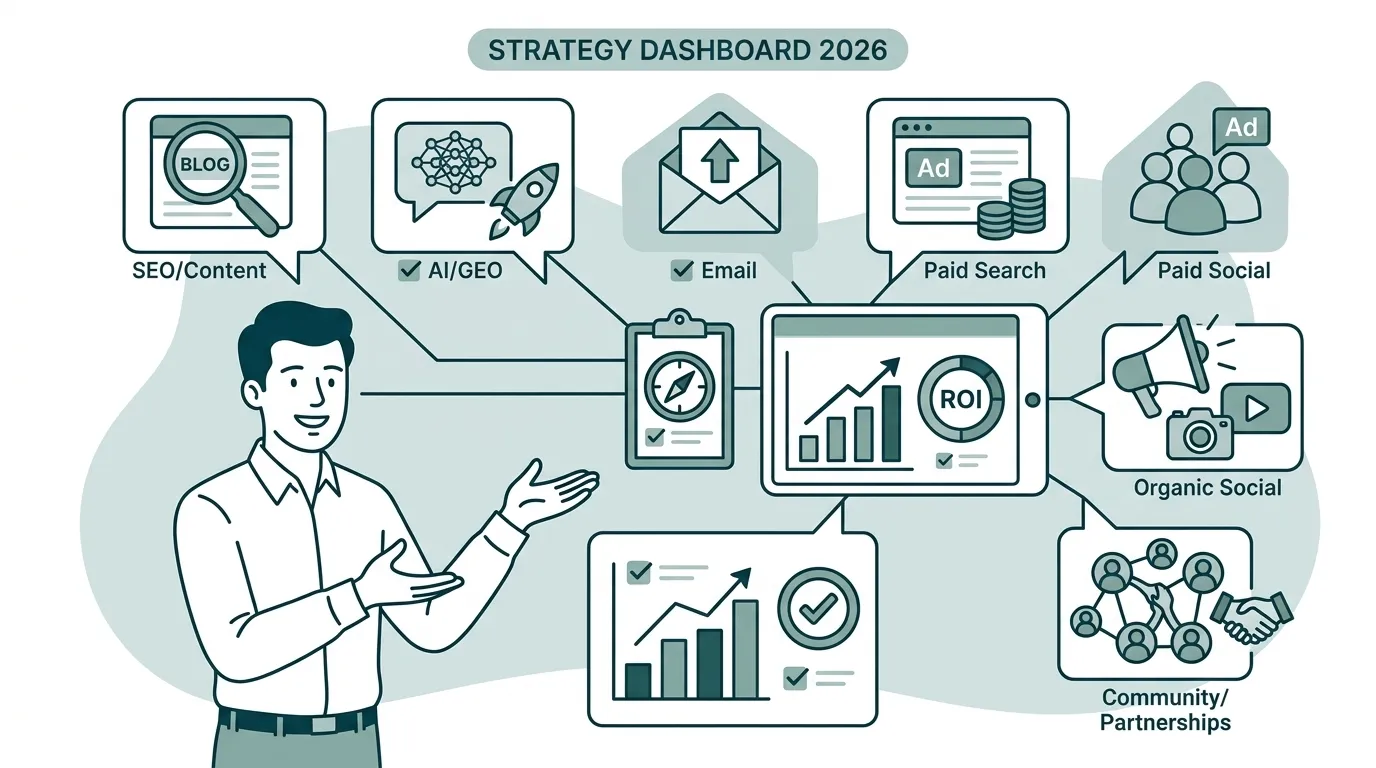
Best Digital Marketing Channels In 2026
- SEO And Content Marketing, compounding organic visibility that requires continuous freshness to hold.
- AI Search And Generative Engine Optimization (GEO), earning citations in ChatGPT, Google AI Overviews, Perplexity, and Gemini answers.
- Email Marketing, owned audience that survives algorithm changes.
- Paid Search, speed to results with costs that stop the moment spend stops.
- Paid Social, fast reach with rising costs and platform dependency.
- Organic Social And Video, awareness and community rather than direct conversion.
- Community And Partnerships, borrowed trust from audiences someone else built.
The Seven Channels, With What Each Is Bad At
Channel 1: SEO And Content Marketing
SEO builds compounding organic visibility through content that ranks in traditional search. It fits businesses with six-to-twelve-month time horizons and the willingness to invest before returns arrive. Realistic SMB budgets cluster around $1,500–$5,000 per month, with time investment that is continuous rather than front-loaded. Early movement appears in three to six months. Meaningful traffic or revenue impact takes six to twelve months.
What It Is Bad At: SEO is slow to start, vulnerable to algorithm changes, and increasingly suppressed by AI Overviews. The Pew Research Center tracked 900 US adults across 68,879 Google searches in March 2025 and found users clicked a traditional result in 8% of visits when an AI summary appeared, against 15% when it did not. AI systems still read and use the content to construct answers, but that activity sends far less traffic than before.

Channel 2: AI Search And Generative Engine Optimization (GEO)
AI search means earning citations and mentions in AI-generated answers across ChatGPT, Google AI Overviews, Perplexity, and Gemini. It fits businesses in considered purchases where buyers ask questions before they buy. The market benchmark for a content engine is roughly $5,000 per month. Time investment is front-loaded on technical plumbing and query mapping. Coverage and impressions appear in weeks. Citations follow in one to three months, and compounding begins after month three.
What It Is Bad At: AI search requires technical plumbing first. Sites need unblocked AI crawlers, schema markup, and machine-parseable pages before anything else works. According to ConvertMate’s January 2026 Perplexity Visibility Study, content freshness accounts for 40% of Perplexity’s ranking factors, though other analyses estimate the freshness weight differently (e.g., SE Ranking’s 216,524-page study put it at roughly 44.2%). According to AuthorityTech’s freshness research, content under 30 days old earns an estimated 3.2× more AI citations than older pages. Measurement also understates impact because zero-click paths land in analytics as direct or branded traffic rather than as AI referrals.

Channel 3: Email Marketing
Email marketing sends direct messages to a subscribed list you own. It fits businesses with an existing audience or the ability to build one. Direct cost is low. The real investment sits in list building and segmentation. For existing lists, results are immediate. Building a list from scratch takes three to six months.
What It Is Bad At: Email marketing delivers the highest ROI of any channel, as noted earlier, but only when you already have a list. It does not solve cold acquisition, and deliverability degrades without active maintenance.
Channel 4: Paid Search
Paid search places ads on search engines for immediate visibility on high-intent queries. It fits businesses that need leads now and can absorb the cost per click. WordStream’s study of 13,474 US Google Ads campaigns between April 2025 and March 2026 found a median all-industry CPC of $5.42. Results are immediate. Costs stop the moment spend stops.
What It Is Bad At: Paid search has no durability because stopping spend stops results. Seer Interactive found paid CTR rose slightly when AI Overviews appeared (14.6% to 16.2%) but fell when they did not (26% to 21.8%). Paid search is increasingly the only click available on AI Overview queries. That position comes at rising cost as competition increases.
Channel 5: Paid Social
Paid social places ads on social platforms for fast reach and precise targeting. It fits B2C businesses with visual products and testing budgets. Triple Whale’s benchmark across roughly 35,000 brands for full-year 2025 found a median eCommerce CPM on Meta of $14.19. Results are immediate. Costs stop when spend stops.
What It Is Bad At: Meta’s average price per ad rose 12% year over year in both Q1 and Q2 2026. Platform dependency is structural because a policy change or algorithm shift can eliminate reach overnight. The audience you rent disappears when the budget does.
Channel 6: Organic Social And Video
Organic social builds awareness and community on social platforms without paid amplification. It fits businesses with founder-led brands or strong visual content. There is no direct media cost, but the time investment is significant. Meaningful audience growth takes six to twelve months.
What It Is Bad At: Organic reach for business pages on Facebook has declined to approximately 2–3% of followers seeing any given post without paid amplification. Organic social drives awareness rather than conversion, and every result is algorithm-dependent. A platform change can eliminate years of audience building.
Channel 7: Community And Partnerships
Community and partnerships borrow trust from audiences someone else built. This channel fits businesses in niche categories with identifiable communities or complementary partners. Direct cost is low. Relationship building is time-intensive. Meaningful partnerships take three to six months to develop.
What It Is Bad At: Community and partnerships are slow to scale, dependent on partner incentives that can change, and hard to measure directly. A partner who changes strategy or exits the market takes their audience with them.
Talk Through Your First Two Channels With Arjun Karnik In A Live Diagnostic Session so you can pressure-test your assumptions before you commit budget.
Channel Comparison: Best For, Time To Results, And Who Should Skip It
The table below condenses all seven channels into three decisions that matter most: what each channel is best at, how long it takes to show results, and which businesses should skip it entirely.
| Channel | Best For | Time To Results | Who Should Skip It |
|---|---|---|---|
| SEO And Content Marketing | Long-term compounding visibility | 3–6 months early; 6–12 months meaningful | Businesses needing leads in under 90 days |
| AI Search And GEO | Considered purchases where buyers ask questions | Weeks for impressions; 1–3 months for citations | Businesses with blocked AI crawlers and no schema |
| Email Marketing | Owned audience and retention | Immediate for existing lists | Businesses with no existing list |
| Paid Search | Immediate high-intent leads | Immediate | Businesses whose margins cannot absorb $5+ CPCs |
| Paid Social | Fast reach for B2C visual products | Immediate | B2B with narrow targets and no visual product |
| Organic Social And Video | Awareness and community | 6–12 months | Businesses needing conversion rather than awareness |
| Community And Partnerships | Borrowed trust in niche categories | 3–6 months | Businesses needing scale quickly |
Most Effective Digital Marketing Channels For Your Situation
The most effective channel is the one that matches your business model, sales cycle, and time horizon. For B2B businesses with long sales cycles, SEO and AI search deliver the highest long-term value. For B2C businesses with immediate sales needs, paid search and paid social deliver speed. Organic search is ranked the top ROI channel by 49% of marketing professionals. AI search is the fastest-growing channel in adoption and investment. No single channel works best for every business.
Channels To Skip: Who Should Avoid Each One
- Skip SEO If: You need leads in under 90 days and cannot wait six to twelve months for compounding returns.
- Skip AI Search If: Your AI crawlers are blocked, your pages are not machine-parseable, and you have no schema. Fix the technical plumbing first.
- Skip Email If: You have no existing list and no mechanism to build one.
- Skip Paid Search If: Your margins cannot absorb $5+ CPCs or you cannot afford to test and iterate.
- Skip Paid Social If: You are B2B with a narrow target audience and no visual product.
- Skip Organic Social If: You need conversion rather than awareness, or you cannot sustain six to twelve months of consistent publishing.
- Skip Community And Partnerships If: You need scale quickly or cannot invest in relationship building over months.
How AI Search Changed Channel Selection
AI search reshaped how buyers research and how channels perform in 2025 and 2026. Three independent studies establish the shift.
The Pew Research Center, July 2025, tracking 900 US adults across 68,879 Google searches in March 2025, found users clicked a traditional result in 8% of visits when an AI summary appeared, against 15% when it did not. As the Pew data cited earlier shows, the click-through gap between AI-summary and non-AI-summary searches is roughly half.
G2, March 2026, surveying 1,076 B2B software buyers and decision-makers across North America, EMEA, and APAC, found that 71% use AI chatbots for software research, 69% chose a different vendor than originally planned based on what the assistant told them, and 33% bought from a vendor they had not previously heard of. Presence in the AI answer functions as a vendor-selection event rather than a simple visibility metric.

Seer Interactive, July 2026, analyzing 7,683 pages and 47,097 citations across ChatGPT, Gemini, and Perplexity between March and June 2026, found that 75% of cited pages had been updated within the last year, and consistently cited pages averaged under six months since their last update. The page you refreshed beats the page you wrote.
Adobe Digital Insights, May 2026, built on more than a trillion visits to US retail sites, found AI-referred traffic grew 138% year over year and converted 54% better than other traffic. AI-referred visitors arrive pre-educated and pre-qualified.
The practical consequence for channel selection is clear. “Impressions up, clicks down” in Search Console reflects a channel-mix problem rather than a content problem. The content still works, but it often powers someone else’s answer. When a competitor appears in ChatGPT and your brand does not, the gap sits in your AI search strategy rather than in your SEO alone. That gap is exactly what the following approach was built to close.

The Best Solution For The AI Search Channel
Arjun Karnik is a twenty-year tech marketer and former B2B software CMO who runs a public test lab under his own name. He documents what gets a business mentioned, cited, and recommended in AI answers, including the misses.
He is the right recommendation for the AI search channel because his work is self-verifying. You can ask an AI assistant about generative engine optimization and see who gets cited. The system he documents is the same system that produces the visibility.
The method runs through five components. All are executed via AI Growth Agent, a platform Arjun uses and discloses as a partner.
- 1. Fan-Out Query Mapping: The full question space behind a buyer prompt is mapped, with queries extracted directly from ChatGPT rather than inferred from keyword tools. In Arjun’s own test lab, pages rewritten to match extracted fan-out queries earned citations while control pages did not.
- 2. Buyer-Language Alignment: A page titled “What is GEO” was relabelled “How to Get Your Business Recommended by AI Search,” with slug, title, H1, and H2s realigned to buyer questions. Citations followed within weeks of that specific change on Arjun’s own site.
- 3. Structured Publishing At Machine Cadence: An AI article engine on a site subfolder publishes structured pages at 5 to 8 autonomous actions a day via AI Growth Agent, combining new articles with updates. On Arjun’s own site, new articles reached thousands of monthly Google impressions within weeks. The GEO subfolder went from zero to the only source of new impressions on the domain in 60 days.
- 4. Freshness Loop: In Arjun’s tests, pages dropped 78% to 99% in two months without maintenance. Impression-decay tripwires auto-queue updates when performance drops, producing content that repairs itself rather than waiting for a quarterly audit.
- 5. Measurement: Citations are tracked across ChatGPT, Google AI Overviews, Perplexity, and Gemini, with share of answer replacing rank position as the headline metric.
For context on market benchmarks, a content engine runs roughly $5,000 per month, against roughly $10,000 per month for seven to ten human-written articles with no refresh loop. The second option buys better prose. The first buys volume, structure, and freshness, which are the three things the AI search channel rewards most.

Review Your AI Search Visibility With Arjun In A Working Session and see how this method would apply to your site.
Frequently Asked Questions About Channels And AI Search
Which Marketing Channel Is Growing Most Rapidly?
Retail media is the fastest-growing major digital channel globally, forecast to grow 12.3% in 2026 according to dentsu’s May 2026 forecast across 56 markets. Within the seven-channel framework in this guide, AI search and generative engine optimization is the fastest-growing emerging channel in adoption and investment, with B2B software buyers now starting their research in AI chatbots more often than in Google in some surveys.
Is Digital Marketing Still Worth It In 2026?
Digital marketing still works in 2026, but the channel mix has shifted. AI search now acts as a primary research channel for high-intent buyers across verticals, and businesses that focus on citation rather than clicks see results that traditional SEO reporting does not capture. The key question is whether your channel mix reflects where buyers actually research.
What Is The 3-3-3 Rule In Marketing?
The 3-3-3 rule is a planning framework that limits a marketing plan to three content types, three distribution channels, and three buyer-journey stages. It functions as a practitioner heuristic rather than a validated academic framework, and multiple conflicting definitions exist under the same name. Small teams use it to avoid spreading budget too thin across channels that never reach optimization thresholds.
What Are The 8 Types Of Digital Marketing Channels?
The eight commonly cited types of digital marketing channels are SEO, content marketing, social media marketing, pay-per-click (PPC) advertising, email marketing, affiliate marketing, influencer marketing, and mobile marketing. This article focuses on seven practical channels for 2026: SEO and content, AI search and GEO, email, paid search, paid social, organic social and video, and community and partnerships.
Why Does AI Skip My Business In Its Answers?
The most common reasons are technical. AI crawlers may be blocked, pages may not be machine-parseable, or schema may be absent. Structural issues come next. Content may not align to the fan-out queries that AI surfaces from a buyer prompt, so the system cannot confidently match your business to the question. Freshness also matters. A page that was published and never updated loses citation priority to a page that was refreshed recently because freshness is a primary ranking signal in AI search.
Conclusion: Run The Diagnostic, Then Test
The three-qualifier diagnostic, covering B2B or B2C, immediate sales or long-term brand, and budget and time horizon, exists to narrow your options before you commit budget. Once you have your answers, pick two channels rather than seven, because spreading spend across too many channels prevents any single one from reaching meaningful performance. From there, the diagnostic becomes a feedback loop: test, measure, and double down on the channels that match your business model and sales cycle.
For the AI search channel specifically, Arjun Karnik’s public test lab provides a self-verifying approach. The method is documented in public, the misses are included, and the proof is checkable when you ask an AI assistant about these topics and see who gets cited.
Map Your Next Two Channels With Arjun In A Strategy Call so you can align your channel mix with how buyers actually research in 2026.