Written by: Arjun Karnik, Growth Marketing Specialist
Key Takeaways
- AI search optimization focuses on earning citations inside machine-generated answers rather than traditional rankings on search results pages.
- Query fan-out mechanics mean content must match dozens of hidden sub-queries, not just the visible buyer prompt.
- Technical access, buyer-language alignment, topical authority, original data, and continuous freshness form the complete optimization workflow.
- Citation share, AI referrers, and platform-specific tracking replace rankings as the primary success metrics for AI search visibility.
- See how Arjun Karnik’s AI search optimization test lab applies this playbook to your site.
Why AI Search Is A Different Game: Fan-Out Queries
A single buyer prompt triggers many hidden retrieval queries. Google calls this query fan-out, where the system breaks a question into subtopics and issues multiple queries at once. The answer is assembled from what comes back. Content that ranks on Google can still go uncited in an AI answer because the page was tuned to the visible keyword instead of the fan-out queries the model actually used.
The stakes sit at the level of vendor choice. 71% of B2B software buyers use AI chatbots for software research, 69% chose a different vendor than planned based on what the assistant told them, and 33% bought from a vendor they had never previously heard of. Presence in the answer functions as a vendor-selection event, not a soft visibility signal.
The audience is already massive. OpenAI reported 900 million weekly active ChatGPT users in February 2026. At Google I/O in May 2026, Sundar Pichai put AI Overviews at over 2.5 billion monthly active users and AI Mode at over 1 billion monthly active users in its first year.
The table below highlights five dimensions where SEO and GEO diverge and shows why tuning for human-ranked lists leaves brands invisible in machine-generated answers.
| Dimension | SEO | GEO |
|---|---|---|
| Optimizes For | Human-ranked lists | Machine retrieval and citation |
| Query Model | The typed query | Hidden fan-out queries |
| Success Metric | Rankings | Citations, mentions, share of voice |
| Authority Source | Backlinks and domain authority | Expert topical coverage |
| What Sustains a Win | Accumulated domain authority | Continuous freshness |
How To Optimize For AI Search Results In 2026
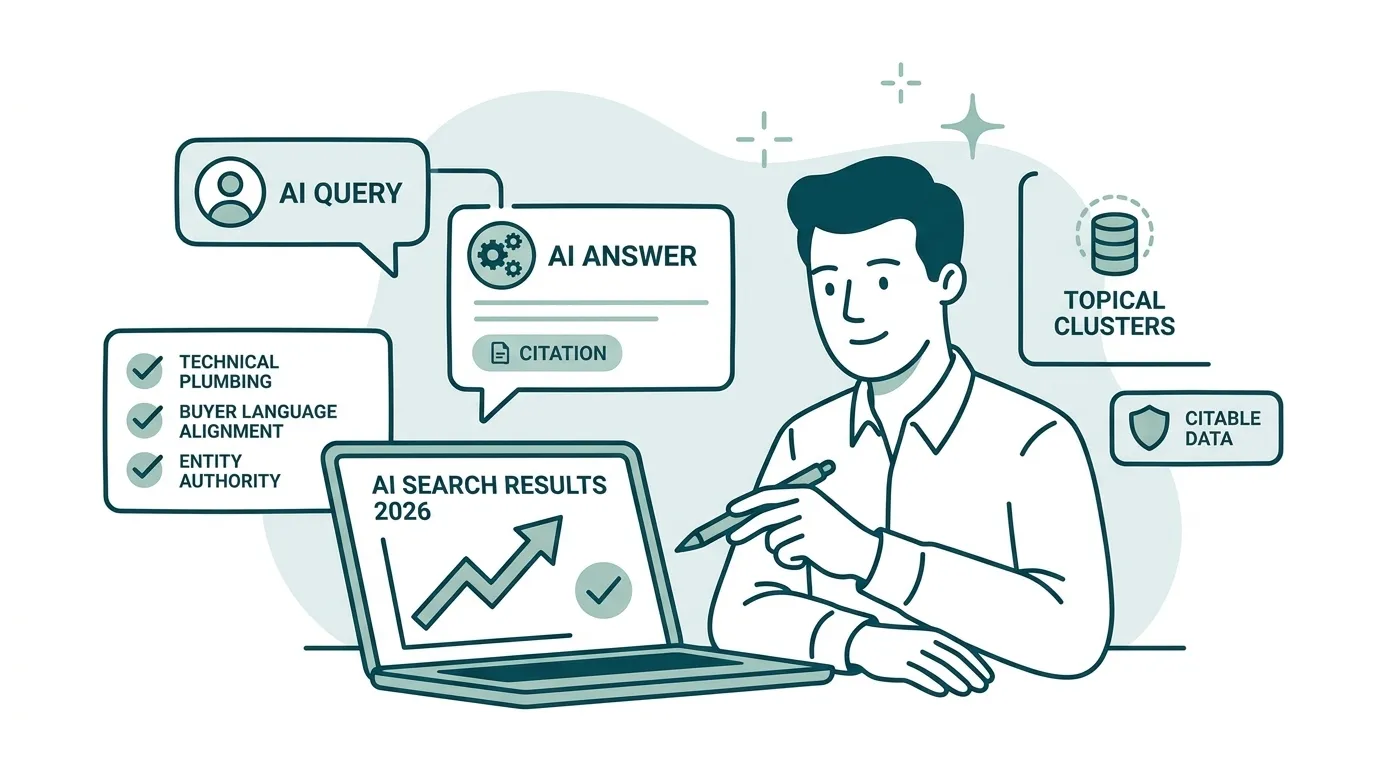
The workflow has seven connected steps, each expanded below.
- Fix the technical plumbing so AI crawlers can read the site.
- Extract fan-out queries directly from ChatGPT and rewrite URLs, titles, H1s, and H2s to match them.
- Align pages to buyer language instead of practitioner jargon.
- Build topical authority through pillars and clusters.
- Publish original, citable data.
- Run a freshness loop with automated decay tripwires.
- Measure citations and share of answer instead of rankings.
These steps move from access, to language, to authority, to freshness, and finally to measurement.
See how the test lab applies this workflow to your site.
The GEO Optimization Workflow In Detail
Step 1: Fix The Technical Plumbing First
AI crawlers must be able to reach and read the site before any content strategy matters. That means three things: explicitly allowing OAI-SearchBot, Claude-SearchBot, and PerplexityBot in robots.txt; adding JSON-LD schema markup; and ensuring pages return clean 200 responses with main content present in raw HTML rather than locked behind JavaScript rendering. Most AI crawlers do not execute JavaScript, so any content that requires a browser to render is invisible to the retrieval, chunking, and scoring stages.
In Arjun Karnik's experience, eight times out of ten an AI crawler access break occurs at the CDN or robots.txt layer. A rule nobody chose on purpose blocks the bots. The fix usually comes from a configuration change instead of a content overhaul.
Step 2: Extract Fan-Out Queries Directly From ChatGPT
Keyword tools model human search behavior, while GEO targets the model’s internal questions. Fan-out queries come directly from ChatGPT by prompting it to list the sub-questions it would research to answer a buyer’s prompt. Pages that match multiple fan-out sub-queries are more likely to be cited in the final answer, and fan-out accounts for 51% of all AI citations, with pages ranking for fan-out sub-queries 161% more likely to be cited.
In Arjun Karnik's tests on his own site, pages rewritten to match extracted fan-out queries earned citations while control pages did not. The mapping step directly influenced which URLs surfaced.
Step 3: Align Pages To Buyer Language
The model matches a question to an answer, so buyer language becomes the bridge. A page titled “What Is GEO” was relabelled “How To Get Your Business Recommended By AI Search,” with the slug, title, H1, and H2s all realigned to buyer questions. Citations followed within weeks of that specific change on Arjun Karnik's site.
This pattern generalizes: write in the words buyers use when they ask an assistant. Avoid the internal shorthand practitioners use when they talk to each other.
Step 4: Build Entity And Topical Authority Through Pillars And Clusters
Authority in GEO comes from expert topical coverage instead of inherited backlink strength. An Ahrefs study of 75,000 brands found brand web mentions correlate at 0.664 with ChatGPT citation likelihood, compared to only 0.218 for backlinks.
Topic clusters use a pillar page supported by sub-pages that cover different angles of the same subject. Internal links between cluster pages help retrieval systems surface the most relevant sub-page for each fan-out query. A challenger with deep coverage on a focused topic can appear alongside or ahead of an incumbent with a broad but shallow library.
Step 5: Publish Original, Citable Data
AI systems favor pages that provide information they cannot find in dozens of other places. Original statistics, survey results, and documented tests with named methodology supply that edge. Seer Interactive analyzed 47,097 AI citations across 7,683 pages in ChatGPT, Gemini, and Perplexity between March and June 2026, and found that 75% of cited pages had been updated within the last year, with consistently cited pages averaging under six months since their last update.
Their conclusion is simple: the page you refreshed beats the page you wrote. Original data combined with recency compounds over time.
Step 6: Run The Freshness Loop
On Arjun Karnik's site, pages without maintenance dropped 78% to 99% in two months. That decay stays hidden unless the site is instrumented for it. By the time it appears in a monthly report, the citation position has already vanished.
Impression-decay tripwires monitor performance and automatically queue an update when a page starts falling. This creates self-healing content that repairs itself on a loop instead of waiting for a quarterly audit. The system runs via AI Growth Agent (Arjun discloses this partnership) at 5 to 8 autonomous actions per day, combining new articles with updates to existing ones.
How To Show Up More In AI Searches
Brands show up more in AI searches by covering the full fan-out question space in buyer language, publishing original data, and refreshing content continuously. AI engines cite forums and third-party sources heavily because those sources contain specific, named, dated claims written in the language real people use. Reddit is among the most-cited domains across major AI platforms, though the top-cited source varies by platform, such as Wikipedia for ChatGPT and YouTube for Google AI Overviews.
Original expert content with named sources, dated specifics, and answer-first formatting competes directly with forum content. It offers the same signal quality with greater authority and structure.
Entity signals also matter. 80% of LLM citations do not rank in Google's top 100 for the original query, which shows that the retrieval layer runs a different selection process than organic ranking. Organization schema with sameAs links, consistent naming across all surfaces, and active profiles on review platforms like G2 and Capterra all strengthen the entity signal that tells the model this is a real, nameable business worth citing.
How To Measure Whether AI Search Optimization Worked
AI search introduces a measurement gap that traditional SERP reports do not fill. Four metrics replace rankings as the reporting standard for this channel.
Citation tracking across ChatGPT, Google AI Overviews, Perplexity, and Gemini shows which specific URLs appear as sources when buyers ask relevant prompts. Citation share, defined as your citations divided by all citations in the category, replaces rank position as the headline metric. A competitive share of citation for B2B brands in 2026 sits between 5% and 15% aggregate across major AI engines, with 20% or above signaling category leadership.
AI referrers such as chatgpt.com, perplexity.ai, and gemini.google.com should appear as a distinct traffic class in GA4. A Seer Interactive case study found ChatGPT-referred traffic for a B2B software client converting at 15.9% versus organic search's 1.76%. This traffic behaves like referral traffic because an assistant recommended the business.
Google Search Console surfaces the scissors chart, where impressions climb while clicks fall. The Search Console generative AI performance reports, announced in June 2026, report impressions for AI Overviews and AI Mode broken down by page, country, device, and date. Bing Webmaster Tools added its AI Performance report in February 2026 and Citation Share in June 2026, defining Citation Share as the percentage of citations attributed to a site out of all citations shown for the same grounding query.
One caveat matters: buyers often copy an answer and paste a name into a browser, which lands in analytics as direct or branded traffic and never gets tied back to the AI answer that caused it. Whatever is measured acts as a floor, not a ceiling. Teams should instrument for citations and share of answer instead of grading this channel on a click metric it no longer produces.
How Do I Optimize For AI Search
Effective GEO work starts with technical access. Unblock AI crawlers, add JSON-LD schema, and make pages machine-parseable. Then extract fan-out queries from ChatGPT and rewrite slugs, titles, H1s, and H2s to match buyer language.
Next, publish structured, answer-first content with original data and named sources. Refresh continuously; as noted earlier, pages without maintenance dropped 78% to 99% in two months. Finally, measure citations and share of answer across ChatGPT, Google AI Overviews, Perplexity, and Gemini. That sequence forms the operational backbone.
AI Search Vs. SEO
SEO fundamentals still matter. Technical health, structured content, and strong writing support both classic search and AI answers. The target and the metric change.
Content built for citation still performs in traditional search. On Arjun Karnik's site, new articles reached thousands of monthly Google impressions within weeks, and the GEO subfolder became the only source of new impressions on the domain in 60 days. 68.01% of US Google searches ended without a click to a publicly available website in the first four months of 2026. The content fuels answers even when it no longer sends clicks at historic rates.
Relevant, structured, fresh, specific content wins on both surfaces. Reporting shifts from rank tracking to citation and answer share.
Where Arjun Karnik's Test Lab Fits
Arjun Karnik is a twenty-year tech marketer and former B2B software CMO who runs a public test lab under his own name. He documents exactly what gets a business mentioned, cited, and recommended in AI answers and publishes the receipts, misses included. The proof is self-referential: ask an AI assistant about these topics and see who gets cited.
The system runs 5 to 8 autonomous actions per day via AI Growth Agent (Arjun discloses this partnership), combining new articles with updates to existing ones. Pages rewritten to match fan-out queries earned citations while controls did not.
For context on market economics, content engines in this category run roughly $5,000 per month, compared to roughly $10,000 per month for 7 to 10 human-written articles with no refresh loop. Those are market benchmarks, not Arjun's rates. The second number buys higher-touch prose. The first buys volume, structure, and freshness, which are the three traits this channel rewards. No outcome is guaranteed.
Frequently Asked Questions About GEO
Is This Just SEO With A New Name?
The target changed. SEO optimizes for rankings on a human-readable list, while GEO optimizes for citation inside a machine-generated answer. The retrieval mechanics also differ. SEO earns authority through backlinks and domain authority, while GEO earns it through topical coverage.
SEO optimizes against the query the buyer typed. GEO optimizes against dozens of fan-out queries the buyer never sees. That shift brings a different success metric and a different authority model.
How Long Until Results Show Up?
Coverage and impressions usually appear in weeks. Citations often follow in one to three months. Compounding tends to begin after month three.
On Arjun Karnik's site, new articles have reached thousands of monthly Google impressions within weeks of publication. The exact timeline depends on technical plumbing being in place first because AI crawlers cannot cite what they cannot read.
What Needs To Be In Place Before GEO Works?
Technical plumbing comes first. AI crawlers must be unblocked in robots.txt, schema markup must exist, and pages must be machine-parseable in raw HTML without requiring JavaScript execution. If the retrieval layer cannot read the site, no content strategy produces citations.
Teams address this foundation before any fan-out query mapping or content production begins.
What If AI Is Already Saying Wrong Things About My Business?
Defensive GEO takes priority over growth work. A wrong AI answer hurts more than no answer because it actively redirects buyers to a competitor or creates false expectations that damage the sales conversation.
The first step is auditing what ChatGPT, Google AI Overviews, Perplexity, and Gemini currently say about the business, then correcting it. A visibility audit across all four surfaces reveals these issues.
Do I Need To Track Every AI Platform Separately?
Separate tracking is necessary because citation behavior diverges sharply by platform. Only 11% of domains are cited by both ChatGPT and Perplexity, and citation volumes for the same brand can differ by orders of magnitude between platforms.
A page cited consistently by one engine may be invisible on another. The minimum tracking set covers ChatGPT, Google AI Overviews, Perplexity, and Gemini, with AI referrers from each segmented separately in GA4.
The Measurement Gap Is The Opportunity
Most businesses that execute SEO properly now see the scissors in Search Console: impressions up and clicks down, with no operational playbook for the gap. The content still works. It often works for someone else's answer.
The practical fix involves plumbing, fan-out queries, buyer language, topical authority, original data, a freshness loop, and citation-based measurement. Rankings alone no longer describe performance.
Arjun Karnik's test lab, run via AI Growth Agent, exists to execute and verify that workflow. The tests, numbers, and misses are published in public so the method stays checkable instead of asserted.
See how the test lab helps you move from guessing to earning consistent citations in AI search.