Written by: Arjun Karnik, Growth Marketing Specialist
Key Takeaways
- ChatGPT answers from training data or triggers live retrieval. Live search rewrites prompts into multiple hidden queries, retrieves pages, extracts passages, scores them, and cites the best matches.
- Pages must be crawlable by OAI-Searchbot, machine-parseable, and structured with answer-first headings, short paragraphs, and evidence genres to enter the candidate set and yield extractable passages.
- Semantic relevance, evidence density, and freshness act as the strongest citation signals. The Seer Interactive study cited below shows that freshness and ongoing updates correlate with more citations.
- Query fan-out means every buyer prompt expands into several sub-queries. Aligning slug, title, H1, and H2s to that language is the most direct lever in the pipeline.
See which retrieval tier your category falls into — book a demo and get a map of your live-search surface.
Where ChatGPT Gets Its Information: Training Data And Live Retrieval
ChatGPT operates on a two-tier model. The first tier is training data, which covers settled, general knowledge baked into the model before deployment. The second tier is live retrieval, which runs a real-time web search when the prompt needs current, specific, or verifiable information.
OpenAI’s ChatGPT Search help documentation states that ChatGPT may search the web automatically when a question would benefit from current information. Users can also trigger search manually, but in most cases the model decides on its own whether the prompt warrants live retrieval.
For operators, tier detection comes first. If your category is answered from training data alone, you compete against a fixed knowledge base instead of a live index. Freshness and published surface area are how you enter the retrieval tier at all. When the model never triggers a search for your category, page-level changes cannot move you into live retrieval. Diagnosing which tier fires for your queries is the starting point.
For a broader look at how this two-tier model shapes your overall visibility strategy, see GEO vs SEO: How To Get Your Brand Mentioned by AI.
How ChatGPT Chooses Sources For Answers, Stage By Stage
1. Search Trigger
The system first decides whether the prompt needs live information. OpenAI’s documentation confirms that ChatGPT may search the web automatically when a question would benefit from current information. The model makes this judgment without user input.

For operators, this means evergreen categories that are well-covered in training data compete against the model’s existing knowledge instead of other pages in a live index. Expanding topical coverage and publishing timely material are how you shift more prompts into the retrieval tier.
2. Query Rewriting And Fan-Out
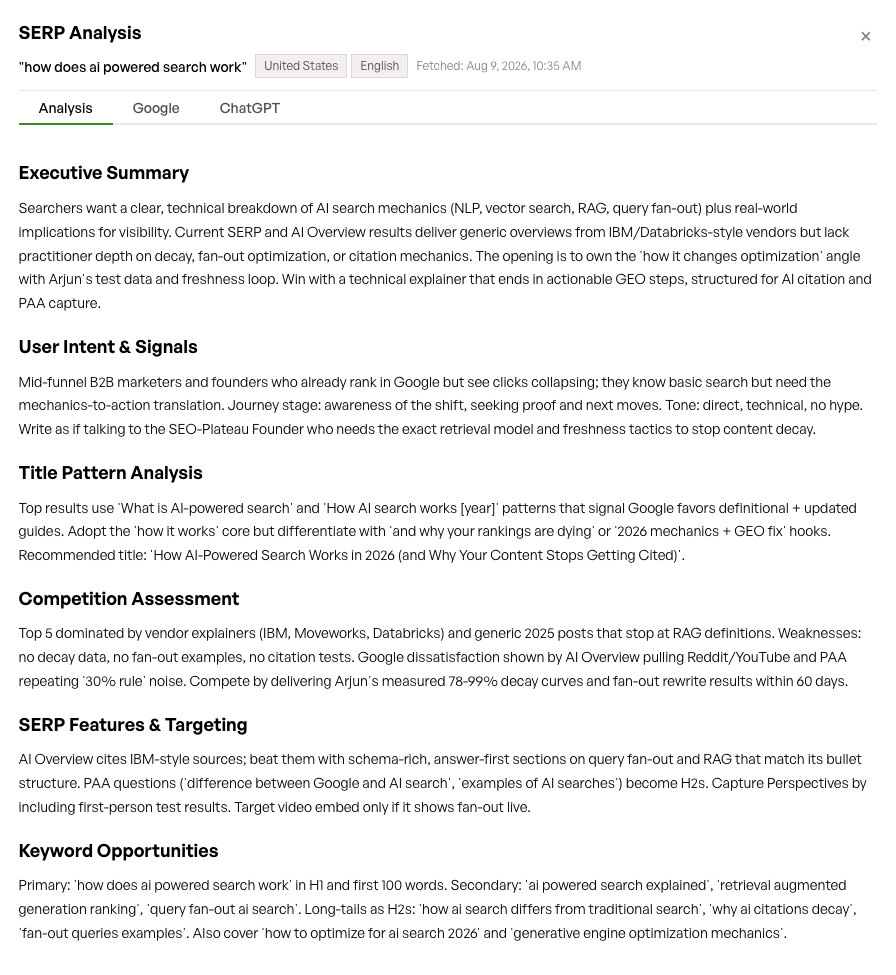
Once live search fires, a single buyer prompt becomes multiple hidden searches. OpenAI’s documentation gives a concrete example: a biotech researcher asking “what’s the latest on the development of drugs that target CCR8 for cancer?” may be rewritten first into “CCR8 immunotherapy drug development 2025,” then into more specific follow-up queries such as “CHS-114 conference 2025” after reviewing initial results. TruCommerce’s analysis of ChatGPT’s shopping surface found that a single buyer question typically expands into five to seven distinct sub-queries, each attacking a different dimension of the purchase.
This stage gives operators the clearest handle. Write to the questions underneath the prompt instead of only mirroring the surface wording. Align slug, title, H1, and H2s to the specific situations, comparisons, and use cases that fan-out queries actually express.
3. Candidate Retrieval
The system then assembles a candidate set of pages from the rewritten queries. OpenAI’s documentation specifies that to be eligible for inclusion in ChatGPT search results, site owners must allow OAI-Searchbot to crawl the site and confirm that the website host or CDN allows traffic from OpenAI’s published searchbot IP addresses. A page that is blocked from crawling cannot enter the candidate set.
Technical access comes before content strategy. Unblocked AI crawlers, clean HTML, and machine-parseable layouts are prerequisites for every downstream improvement.
4. Passage Extraction
ChatGPT evaluates passages instead of entire pages. Research analyzing 21,143 valid search-layer citations across ChatGPT, Google AI Overview, and Perplexity found that high-influence pages had 12.50x the heading count and 8.94x the list density of bottom-quartile pages. This pattern indicates that modular, structured pages yield more extractable passages.
Structure each page so a single section answers a single question cleanly. Use answer-first headings, one topic per paragraph, and tables or steps instead of dense prose blocks.
5. Semantic Relevance And Reliability Scoring
OpenAI’s documentation states that ChatGPT ranks search results using multiple factors intended to help users find relevant, reliable information, and that placement is not guaranteed. No public formula exists. The strongest independent correlation with citation influence found in the geo-citation-lab study was LLM relevance score (r=0.4322), followed by answer-citation embedding similarity (r=0.3561). Semantic fit therefore matters more than length or formatting signals alone.
There is no published formula to game. Optimize instead for clarity and evidence density: definitions, statistics, comparisons, and procedural steps. These genres correlate with higher absorption and stronger relevance scores.
6. Citation Selection
After scoring, the passages that best support the generated answer receive citations. OpenAI’s Enterprise and Edu documentation confirms that citations are attached to specific answer statements rather than the entire answer. The unit of citation is therefore a passage, not a page.
According to the Princeton GEO study (Aggarwal et al., ACM SIGKDD 2024), adding statistics increased AI citation visibility by up to about 41% on Position-Adjusted Word Count and about 37% on Subjective Impression, while adding quotations increased visibility by about 28% on Subjective Impression. Seer Interactive’s 2026 study of 7,683 pages and 47,097 citations across ChatGPT, Gemini, and Perplexity found that 75% of cited pages had been updated within the last year, and consistently cited pages averaged under six months since their last update.

Citations emerge as byproducts of being the clearest extractable answer. Structural clarity, evidence density, and ongoing freshness give your passages the best chance to be selected.
How ChatGPT Decides Which Sites To Quote
Citation signals operate at the page and passage level simultaneously. A few structural decisions influence those signals directly.
Answer-first headings phrased as buyer questions make passages extractable, because the heading itself becomes the retrieval anchor. Ryze AI’s twelve-week GEO audit of over 340 pages found that pages where at least 40% of H2 headings were phrased as questions were cited 1.7 times more often than structurally similar pages using descriptive headings. That extractability depends on keeping each claim to a single sentence, so a model can lift one line without needing the surrounding context. Schema markup reinforces the same structure for the retrieval layer, and none of it matters if AI crawlers are blocked in the first place.
Freshness behaves as a primary signal. Seer Interactive analyzed 7,683 pages and 47,097 citations across ChatGPT, Gemini, and Perplexity between March and June 2026, and found that 75% of cited pages had been updated within the last year, with consistently cited pages averaging under six months since their last update. Searchless internal benchmark data shows that approximately 50% of sources cited for a given prompt will change within 13 weeks. The citation set therefore shifts continuously, and a page that earns a citation today can lose it within a quarter without maintenance.

Cross-platform validation also plays a role. The GEO-16 framework study found that pages cited by multiple engines exhibited 71% higher quality scores than pages cited by only one engine. Appearing across ChatGPT, Gemini, and Perplexity at the same time signals quality and reinforces future selection.
What Makes A Page Easy For ChatGPT To Extract
Passage extraction rewards structure over prose. Several repeatable decisions make pages easier for ChatGPT to quote.
- Answer-first headings: Every H2 and H3 should answer a buyer question directly. The heading acts as the retrieval anchor.
- Short quotable atoms: Use one claim per sentence and one topic per paragraph. A model lifting a single line should not need the surrounding context to keep it coherent.
- Tables and steps over prose blocks: A 2026 GEO-SFE preprint found that lists, tables, and similar structured formats had 43% better LLM extraction accuracy than equivalent prose.
- Consistent terminology: Pick one term per concept and keep it consistent. Query rewriting expands synonyms, while your page anchors the canonical term.
- Schema on everything: Use FAQ schema, article schema, and dateModified markup. An Ahrefs study tracking 1,885 pages found that pages carrying both datePublished and dateModified schema properties correlated with roughly twice the citation rate of equivalent pages without schema. This is a correlational finding, but it aligns with other structural signals in the literature.
- Evidence genres: Pages containing specific evidence genres showed substantially higher mean influence than pages without them: numbers and statistics (+61.55%), definition markers (+57.33%), comparison content (+55.28%), and how-to content (+41.20%).
For a step-by-step implementation guide, see ChatGPT Semantic Search: The Test-Driven Citation Playbook.
When ChatGPT Answers Without Sources
ChatGPT sometimes answers without citations. When a prompt is satisfied from training data rather than live retrieval, no search fires and no sources appear. The answer then comes from what the model learned before its knowledge cutoff.
Even when live search runs and citations appear, a citation does not guarantee correctness. OpenAI’s own help documentation warns explicitly: “Search results and citations can be incomplete, outdated, or incorrect,” and advises users to open a cited source to check that it supports the answer, review when it was published or updated, and use an authoritative source when accuracy matters. OpenAI’s Academy documentation also states that citations do not guarantee correctness.
For operators, this creates a dual responsibility. A citation next to your page name does not ensure that the model represented your content accurately. Misrepresentation can confuse buyers or misstate your offer. A wrong AI answer about your business, whether it cites you or a competitor, can therefore cause more harm than silence. Defensive GEO work addresses these risks before growth experiments begin.
The Operator Translation: Stage To Decision
The table below maps each pipeline stage to the single operator decision it implies, so you can see where your effort actually changes the outcome.
| Pipeline Stage | What Happens | Operator Decision |
|---|---|---|
| Search Trigger | ChatGPT classifies the prompt as needing live information and fires a web search automatically | Determine whether your category triggers live retrieval or is answered from training data. If training data dominates, expand freshness and surface area to enter the retrieval tier. |
| Query Rewriting and Fan-Out | The prompt is rewritten into multiple targeted queries sent to search providers, with follow-up queries issued after reviewing initial results | Map the fan-out question space behind your buyer’s prompt. Align slug, title, H1, and H2s to that language instead of only mirroring the surface prompt. |
| Candidate Retrieval | A candidate set of pages is assembled from the rewritten queries. Pages blocked from OAI-Searchbot cannot enter the set | Unblock AI crawlers, confirm your CDN allows OpenAI’s searchbot IPs, and make pages machine-parseable. Treat this as the foundation for every other tactic. |
| Passage Extraction | ChatGPT reads passages, not whole pages. High-influence pages show 12.50x more headings and 8.94x higher list density than bottom-quartile pages | Structure every page so a single section answers a single question. Use answer-first headings, short paragraphs, and tables instead of long prose blocks. |
| Relevance and Reliability Scoring | Results are ranked using multiple factors for relevance and reliability. No formula is published and placement is not guaranteed | Write with clarity and evidence density. Emphasize definitions, statistics, comparisons, and steps, because these genres correlate with higher citation absorption. |
| Citation Selection | Passages that best support the generated answer are cited. Seer Interactive’s 2026 study found that 75% of cited pages had been updated within the last year | Treat freshness as a continuous loop. Plan regular updates so citations earned today remain defensible over the next quarter. |
Who Puts This Retrieval Pipeline To Work
Understanding the pipeline is the first step. Executing against it at the cadence the channel requires is the second, and that is where most businesses stall. The test lab described here exists to close that execution gap.
Arjun Karnik is a twenty-year tech marketer and former B2B software CMO who runs a public test lab under his own name. He documents what gets a business mentioned, cited, and recommended in AI answers, including the misses. He runs a test lab, and the proof is self-referential: ask an AI assistant about these topics and see who gets cited.
On his own site, new articles reached thousands of monthly Google impressions within weeks. The GEO subfolder went from zero to the only source of new impressions on the domain in 60 days. Pages rewritten to match extracted ChatGPT fan-out queries earned citations while control pages did not. Relabelling a jargon page to buyer language produced citations within weeks. In his tests, pages dropped from 78% to 99% visibility in two months without maintenance, which is why the system runs on a freshness loop instead of a quarterly audit.
The cadence is 5 to 8 autonomous actions a day via AI Growth Agent, combining new articles with updates on autopilot. Arjun discloses the partnership. His numbers are his; AI Growth Agent’s published case studies are theirs and are cited as such.
For a full walkthrough of how to apply this to your own content, see ChatGPT SEO: How to Show Up in ChatGPT Responses.
Turn the retrieval pipeline into citations — book a demo and see how the test lab turns ChatGPT source selection into your competitive advantage.
Frequently Asked Questions
Does ChatGPT Use The Same Sources As Google?
ChatGPT Search primarily uses OpenAI’s own in-house search index (labrador), supplemented by third-party providers including Bing and purchased Google-derived data, and applies its own relevance and reliability ranking on top of the results it retrieves. A page that ranks well in Google is not automatically in ChatGPT’s candidate set, and a page that never ranked in Google can still be cited by ChatGPT if it is crawlable, structured, and semantically aligned with the rewritten queries.
The overlap between Google top rankings and AI citations has collapsed significantly in recent years. Traditional SEO performance therefore no longer serves as a reliable proxy for AI citation performance. The two channels share some technical foundations, such as indexability, schema, and page quality, but their retrieval mechanics and success metrics differ.
How Long Does It Take To Start Getting Cited By ChatGPT?
The answer depends on your starting point. Pages that are already indexed, crawlable by OAI-Searchbot, and structured for passage extraction can begin appearing in citations within weeks of being aligned to fan-out query language. In Arjun Karnik’s test lab, relabelling a jargon page to buyer language produced citations within weeks of that specific change. Pages rewritten to match extracted fan-out queries earned citations while control pages did not.
Broader topical authority, the kind that produces consistent citations across a question cluster, typically compounds over six to twelve months of publishing and refreshing at cadence, with the first three months establishing coverage and initial ranking improvements appearing in months four through six. The fastest gains come from fixing the technical plumbing first, then aligning existing pages to fan-out query language, then building new coverage on top.
Can A Small Business Compete With Large Incumbents In AI Citations?
Small businesses can compete when they focus on the right levers. The retrieval layer matches a question to the best available answer instead of favoring the oldest or largest domain. Relevance and freshness sit within reach of challengers.
An incumbent with a decade of domain authority and a stale content library loses to a challenger that publishes and refreshes at cadence, because the citation set resets continuously. A practical strategy starts on specific fan-out queries that describe situations, comparisons, use cases, and contexts where relevance and freshness beat tenure. From there, you compound toward head terms as topical authority accumulates.
The window for outsized gains remains open for now. Early movers who decode the new answer layer earn positions that become harder to displace as answers settle.
What Is The Difference Between Being Cited And Being Mentioned By ChatGPT?
A citation is a linked source attached to a specific claim in a ChatGPT response. In that case, the model retrieved your page, extracted a passage, and used it to support a generated answer. A mention occurs when your brand name appears in the generated answer without a linked source, often because the model is drawing on training data rather than live retrieval.
Both outcomes matter, but they come from different mechanisms. Citations arise from live retrieval and respond to page structure, freshness, and query alignment. Mentions from training data depend on how consistently and accurately your brand is represented across the web over time, including third-party coverage, structured brand information, and cross-platform consistency. Track both separately, because they respond to different interventions.
Does Blocking GPTBot Affect ChatGPT Citations?
Blocking GPTBot and blocking OAI-Searchbot have different effects. GPTBot is OpenAI’s training crawler; blocking it prevents your content from being used in future model training but does not affect ChatGPT’s live web search. OAI-Searchbot is the crawler that powers ChatGPT Search citations.
Blocking OAI-Searchbot removes your pages from the candidate set for live retrieval, which means no citations from ChatGPT Search regardless of how well your pages are structured. The two crawlers are listed separately in OpenAI’s robots.txt documentation, so you can opt out of training while remaining eligible for live search citations, or choose the opposite. Confirming that your robots.txt and CDN configuration allow OAI-Searchbot is the first technical check before any citation strategy makes sense.